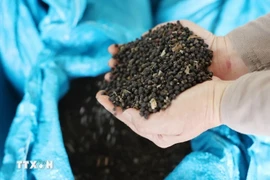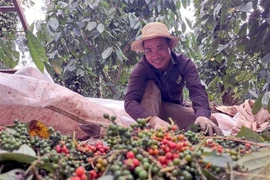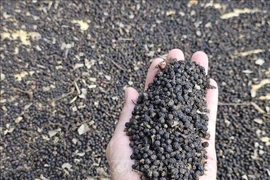
HCM City (VNA) – As of the end of November, Vietnam had exported around 225,000 tonnes of pepper, earning more than 1.5 billion USD in revenue.
Although the export volume fell by 4.4% year-on-year, the turnover rose by 24.4% thanks to improved demand and persistently high export prices, according to the Vietnam Pepper and Spice Association (VPSA).
From January to November, the average export price hit 6,618 USD per tonne for black pepper and 8,636 USD per tonne for white pepper, marking an increase of 767 USD and 2,175 USD, respectively, compared to the same period last year.
The US remained Vietnam’s largest export market, accounting for 21.7% with 48,849 tonnes, despite a 28% decline. It was followed by the United Arab Emirates (UAE) with 19,930 tonnes, China with 17,744 tonnes, India with 11,750 tonnes and Germany with 10,876 tonnes.
Vietnam exported 18,582 tonnes of pepper in November alone, including 16,322 tonnes of black pepper and 2,260 tonnes of white pepper, earning 121.5 million USD. Compared with October, the export volume fell by 4.4% and the value dropped by 6.2%. However, year-on-year exports still posted solid growth of 16.5% in volume and 14.2% in value.
The average export price in November stood at 6,519 USD per tonne for black pepper and 8,072 USD per tonne for white pepper, representing a 1.2% increase for black pepper but a 3.8% decline for white pepper month-on-month.
On the import side, Vietnam imported 2,459 tonnes of pepper in November, worth 15.2 million USD. This marked a significant 47.2% rise from October but a sharp 43.9% fall compared with November 2024. Notably, Cambodia was the largest supplier in the month with 1,506 tonnes (61.2%), followed by Brazil (475 tonnes) and Indonesia (210 tonnes).
By the end of November, Vietnam had spent 252 million USD on importing a total of 40,242 tonnes of pepper. Year-on-year, import volume rose 22% and value increased by 62.3%, reflecting stronger purchasing for re-export and processing. Brazil remained the biggest supplier with 18,956 tonnes (up 10.6%), followed by Cambodia with 11,211 tonnes (up 65.5%), while Indonesia supplied 7,156 tonnes, down sharply by 49.3%./.