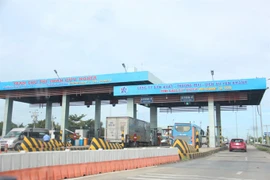
A toll station at Noi Bai-Lao Cai expressway (Photo: VietnamPlus)
Hanoi (VNA) - According to the Vietnam Expressway Corporation (VEC), toll collection and supervision is carried out according to regulations, and the toll revenue of expressways is reported to State management agencies.
After a robbery at the Ho Chi Minh City – Long Thanh – Dau Giay expressway’s toll station in February 2019, concerns over possible false declaration of fee collection and transparency in toll collection were raised.
Regarding this issue, leading officials from the VEC said toll collection, supervision and post-supervision is conducted in accordance with regulations and reported to the Ministry of Transport and the Directorate for Roads in terms of traffic flow and toll revenue.
The VEC was assigned by the State to be the investor and manage four expressways, namely Cau Gie – Ninh Binh, Noi Bai – Lao Cai, Da Nang – Quang Ngai and Ho Chi Minh City – Long Thanh – Dau Giay. The VEC’s projects are not build-operate-transfer (BOT).
The corporation has assigned its member units to run toll collection at these four expressways. They are the Vietnam Expressway Operation and Maintenance Joint Stock Company (VEC O&M), the Vietnam Expressway Services Joint Stock Company (VECS) and the Vietnam Expressway Services Engineering Joint Stock Company (VESE).
The VEC has built processes to collect fees and supervise toll collection to ensure transparency, and has tightened management to prevent toll losses, assigned the collection of tolls for each route, and set up an internal supervision department.
To strengthen the management of toll collection, the VEC has set up the Vietnam Expressway Operation Monitoring Centre (VEC M) as an independent unit. One of the main tasks of the centre is to supervise the collection, maintenance and operation of expressways managed by the VEC.
Additionally, expressways invested by the VEC are newly constructed with electronic toll collection systems.
Drivers have to pay a fee depending on the kinds of vehicle, the actual distance (km) and the unit price corresponding to each type of vehicle (VND/km), which are publicly announced on mass media and toll stations.
On the toll collection process, representative from the VEC said toll gate staff work three shifts: from 6:30 to 11:30; from 11:30 to 18:30; and from 18:30 to 6:30.
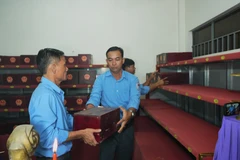
The toll collectors are responsible for fee collection during their shift, then hand it over to heads of the toll stations as regulated. The VEC emphasised the tight control of tolls between shifts.
Besides, the VEC has signed cooperation contracts with banks to collect tolls. On normal days, the banks collect fees at toll stations once a day; on holidays and Tet once every two days.
Units assigned by the VEC to collect fees on expressways must send daily and monthly reports about the traffic flow and toll revenue of each station to the VEC.
Every three months, the VEC reports to the Ministry of Transport and the Directorate for Roads of Vietnam about the traffic flow and toll revenue of expressways.
To ensure accurate, transparent and public toll collection, the VEC has conducted around-the-clock supervision through many stages and with the participation of multiple departments from direct inspection to supervision through the camera systems.
The VEC representative also said information on the computers at toll stations and the images are directly transmitted to the monitoring office of the VEC M.
Periodical toll collection data is backed for monitoring and post-inspection work, according to the VEC which added that video files that monitor toll stations are backed and kept for at least one year.
The organisation of toll collection and supervision accords with current regulations and ensures transparency, he said.
Additionally, the Directorate for Roads of Vietnam and law enforcement agencies regularly launch inspections and monitor the operation of toll collection stations in expressways invested by the VEC.
At about 7:00 am on February 7, two men namely Tran Tuan Anh (born in 1993, Tien Giang province) and Nguyen Vu Hoang Nam (born in 1990, Nam Dinh province) broke into the Ho Chi Minh City – Long Thanh – Dau Giay expressway’s toll station for robbery. They used a gun and a machete to threaten three employees and stole more than 2.2 billion VND (94,600 USD).
On February 10, police from the southern province of Dong Nai commenced criminal proceedings in the case and the two robbers, and temporarily detained them for four months for further investigation of their robbery.
The two men confessed their crime. The police recovered 1.7 billion VND (73,100 USD).-VNA