ASEAN+3 university leaders discuss solutions for higher education development

Experts and higher education leaders proposed a range of strategic solutions for strengthening the ASEAN higher education system.

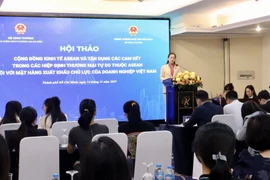
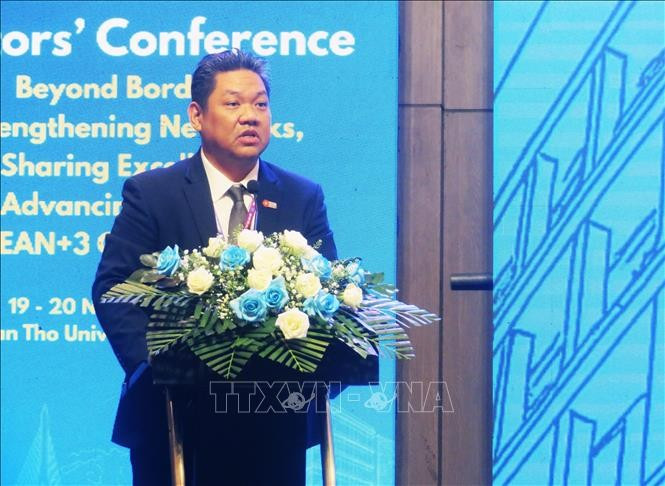
Associate Prof. Dr. Thanapan Laiprakobsup, Executive Director of the ASEAN University Network, speaks at the event (Photo: VNA)

Can Tho (VNA) - Leaders of higher education institutions from ASEAN member countries, Japan, the Republic of Korea (RoK) and China met in Can Tho on November 19–20 to exchange visions, share governance experience and outline directions for the development of higher education amid regional integration and global transformation.

This year’s ASEAN+3 Rectors’ Conference, themed “Strengthening Networks, Sharing Excellence, and Promoting Sustainable ASEAN+3 Cooperation,” reflects the common aspiration of universities to deepen linkages, enhance collaboration and pursue sustainable development.

Nguyen Van Khoi, Vice Chairman of the Can Tho municipal People’s Committee, said the city aims to become a knowledge and innovation hub of the Mekong Delta and stands ready to expand cooperation with ASEAN+3 universities through training, research and technology transfer. The city pledges to facilitating cross-border education programmes, particularly in artificial intelligence, big data, robotics, smart agriculture and ecological urban development.

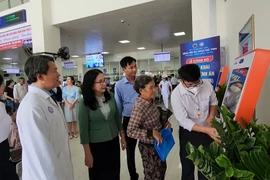
Within the framework of the conference, delegates discussed three key pillars: health equity, climate resilience and food security, and technological cooperation and sustainable growth. Sessions focused on sustainable agriculture and fisheries, climate adaptation, water resource management and the application of digital technologies in regional development. Delegates also visited Can Tho University’s laboratories and observed a UAV technology demonstration for agricultural production.

Experts and higher education leaders proposed a range of strategic solutions for strengthening the ASEAN higher education system. These include expanding joint training and dual-degree programmes, establishing joint research clusters to address local challenges, promoting student and lecturer exchange, enhancing cooperation with enterprises and international organisations, and accelerating digital transformation towards the “smart university” model.

Associate Prof. Dr. Thanapan Laiprakobsup, Executive Director of the ASEAN University Network, reaffirmed the network’s commitment to placing education quality at its core. He highlighted the importance of strengthening resilience and institutional immunity, as well as reinforcing internal quality assurance systems, processes and self-improvement mechanisms.

He commended Vietnam and Can Tho University for their efforts to enhance quality and international engagement. Joint ASEAN+3 initiatives in interdisciplinary research, scholar exchanges and scientific data sharing will help the region better address challenges such as climate change, food security and sustainable development, he said./.

VNA

See more

Delegates at the SEAN Future Forum NextGen Workshop 2026 held in Jakarta, Indonesia on March 9 (Photo: VNA)

Vietnam contributes youth perspectives to AFF NextGen initiative

The ambassador expressed confidence that fresh perspectives, innovative thinking and lessons drawn from the workshop will be proposed to AFF 2026, representing the voice of the younger generation in shaping ASEAN’s future in line with their aspirations.

A young volunteer donates blood during the 2026 Red Sunday programme. (Photo: VNA)

Nearly 5,000 people join blood donation campaign in Ho Chi Minh City

According to health authorities, Vietnam collected nearly 1.75 million units of blood in 2025, with 98% from volunteer donors, equivalent to around 1.75% of the population participating in blood donation. Large-scale campaigns such as Red Sunday have played a key role in achieving these results.

More than 30 kilogrammes of various drugs trafficked from Cambodia to HCM City were seized in a police operation in March 2025. (Photo: VNA)

Ho Chi Minh City aims to become drug free by 2030

Every commune, ward or residential area in Ho Chi Minh City is expected to meet official drug-free standards by the end of 2029, while schools, hospitals, government offices, businesses and social organisations across the city are to remain free of drug activity.

Military forces take a resident from a flooded area. Photo: VNA

Da Nang, Oxfam join hands to support flood victims

In the coming time, the Da Nang Red Cross Society will continue to coordinate with Oxfam to implement support activities in Nong Son commune, helping residents overcome difficulties and stabilise their livelihoods.

Training on response to reservoir incidents (Photo: VNA)

Central Civil Defence Fund established to bolster disaster response

The Central Civil Defence Fund is authorised to receive, manage and use voluntary contributions from domestic and foreign entities and individuals, plus transfers from provincial civil defence funds in line with the PM’s decisions and allocations from relevant state financial sources outside the state budget, all earmarked for incident and disaster response and recovery efforts.

Vietnamese women shine in the traditional Ao dai (Photo: VNA)

March shines with elegance of “Ao dai”

In early March, scenes of women in flowing Ao dai taking spring photos by lakes, parks, offices, temples and historical sites have become a familiar sight on the streets of Hanoi. Social media is also filled with images and stories surrounding the elegant attire, which has become a symbolic signal of the season dedicated to honouring women.

Hanoi voters learn about candidates’ biographies and action programmes. (Photo: VNA)

Hanoi thoroughly prepares for NA, People’s Council election

According to the municipal Election Committee, the capital city has established election committees in 126 communes and wards. In addition, 11 electoral boards for National Assembly deputies, 31 electoral boards for the city-level People’s Council, 831 commune-level electoral boards and more than 4,000 polling teams have been set up to serve the election process.

Artisan Vu Van Vinh from Chuyen My commune introduces to visitors a set of mother of pearl inlaid lacquer furniture including a platform bed, tea cabinet, and lacquered horizontal boards and parallel sentences made by his family, worth more than 3 billion VND. (Photo: VNA)

Four Hanoi craft villages join global creative crafts network

The recognition is not only a source of pride for the capital but also creates opportunities to promote these craft villages globally, strengthen international connections, and support their sustainable development in the process of global integration.

Vietnamese women affirm growing role in national economy

Vietnamese women affirm growing role in national economy

Vietnamese women have long been an indispensable force in the country’s socio-economic development. Today, they are present across a wide spectrum of economic activities, from production, trade and small-scale services to innovative start-ups, collective economic development, the digital economy, green growth, the circular economy and financial inclusion.