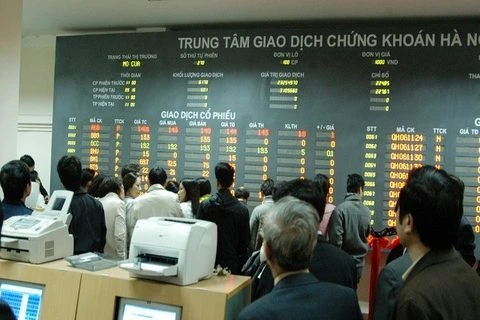
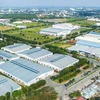
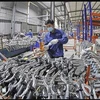
Illustrative image (Source: VNA)
This is the paradox of Vietnam’s steel production, causing a trade deficit and affecting the stability of the macro economy.
Vietnam’s steel industry has great potential but the industry’s development is not synchronised. For example, hot rolled coil (HRC) and alloy steel cannot be produced domestically, therefore, Vietnam still has to import a large quantity of these raw materials and semi-finished products, he said.
“The country’s ship-building industry is depending entirely on imported steel,” Hoai said, adding that Vietnam has spent billions of dollars to import steel annually, reflecting the huge domestic demand of a developing country requiring infrastructure and undergoing rapid urbanisation.
By 2020, Vietnam will face a shortage of about 15 million tonnes of crude steel and up to 20 million tonnes by 2025, Hoai said, adding that the country must develop steel complex projects to produce all kinds of steel to serve the country’s mechanical industry.
According to the Vietnam Steel Association (VSA), steel imports in 2016 surpassed the country’s total steel production, reaching 17.5 million tonnes, up 16.8 percent year-on-year, of which the amount of consumption reached 15.3 million tonnes, up 23.7 percent compared to 2015.
VSA vice chairman Nguyen Van Sua warned that Vietnam risks being flooded by imported steel products, adding that strong rises in imports are hindering the growth of domestic producers.
According to the General Department of Customs’ statistics, Vietnam spent 11 billion USD importing over 22 million tonnes of steel and iron products in 2016, an increase of 18.4 percent and 7.2 percent in volume and value, respectively, against the same period in 2015.
Imported steel from China amounted to more than 10 million tonnes, worth nearly 4.5 billion USD, and accounting for 50 percent of Vietnam’s imported steel. The figures represent year-on-year increases of 14 percent in volume, and 7 percent in value, he said.
Japan and the Republic of Korea are the other major steel exporters to Vietnam, making up 20 percent of the country’s total imported steel. Import numbers from Japan and the Republic of Korea were 2.6 million tonnes and 1.8 million tonnes, worth 1.2 billion USD and 1 billion USD, respectively
Meanwhile, Vietnam exported approximately 3.9 million tonnes of steel of different types to traditional ASEAN and US markets. Sua said that last year, steel export faced many difficulties due to trade defence lawsuits filed by the US, Canada, India, Thailand and Malaysia.
"China steel massively penetrating into Vietnam is mainly produced at industrial zones and factories located in the country’s coastal region. This type of steel is competing with local steel as sea transport costs are very cheap, not to mention the convenient transport conditions,” Hoai said.
Hoai said 18 Vietnamese steel companies had petitioned the Government and the Ministry of Industry and Trade to extend the scope of application of trade defense tax, tightly controlling steel imports to prevent trade fraud and tax evasion.
In March 2016, the Ministry of Industry and Trade issued a decision to apply additional tariffs on imported steel products as a temporary safeguard against inexpensive imports that were allegedly threatening the domestic industry.
Temporary safeguard duties of 23.3 percent were imposed on steel billets and 14.2 percent on long steel products for a maximum of 200 days. However, the foreign steel exporters avoided the tax by changing their product codes.-VNA
VNA