Vietnam in 42nd place in Competitive Industrial Performance rankings

Vietnam ranked 42nd in the world and fifth among South and Southeast Asian nations in the 2018 Competitive Industrial Performance rankings of the United Nations Industrial Development Organisation.
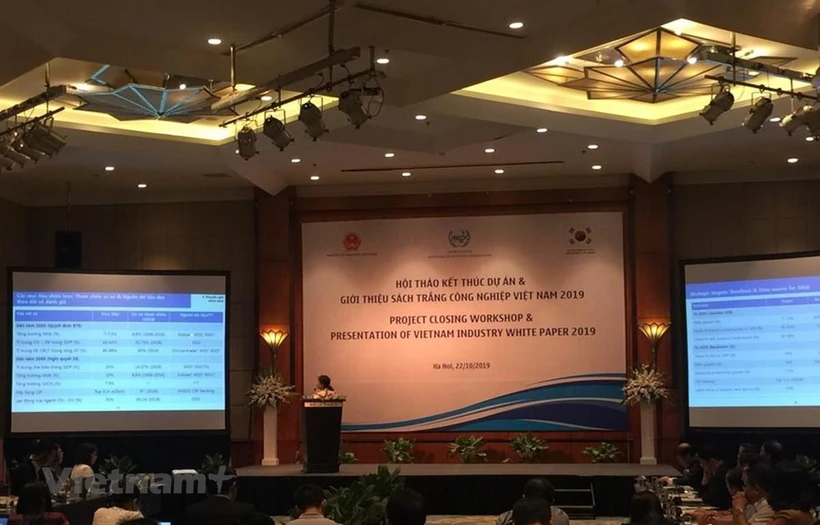
The Ministry of Industry and Trade releases the Vietnam Industry White Paper 2019 on October 22 (Photo: VietnamPlus)

Hanoi (VNA) – Vietnam ranked 42nd in the world and fifth among South and Southeast Asian nations in the 2018 Competitive Industrial Performance rankings of the United Nations Industrial Development Organisation (UNIDO).

The index shows the country’s substantial improvement from the 69th position in 2006.

However, the added value of the local processing – manufacturing industry in 2016 accounted for only 14.3 percent of the gross domestic product (GDP), down from 19.4 percent in 2006, while the percentage in Southeast Asia was 20.9 percent.

On that basis, the Ministry of Industry and Trade (MoIT) unveiled the Vietnam Industry White Paper 2019 on October 22. This was part of the ministry’s efforts to implement the Party Central Committee’s Resolution No. 23-NQ/TW on the orientation for making the national industrial development policy until 2030, with a vision to 2045.

The White Paper analysed and assessed the situation of the processing – manufacturing industry and pointed out the bottlenecks and problems that need to be addressed at the macro and sectoral levels.

MoIT Deputy Minister Do Thang Hai said the White Paper provides policy makers, researchers and businesses with useful information about industries in Vietnam. It is also a helpful tool for the analysis and making of industrial policies.

Recommendations in the paper will be taken into account during the Government’s building of industrial policies in order to enhance the role of the processing – manufacturing sector, said Nguyen Thi Xuan Thuy from the MoIT’s Industry Agency, who is also head of the compilation group.

The paper was built within the framework of the project “Support to the Government of Vietnam in the formulation of sub-sector industrial strategy and of related implementation policy through institutional capacity building”, which has been carried out by the MoIT and UNIDO since 2016, with the sponsorship of the Republic of Korea.

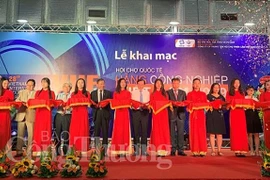
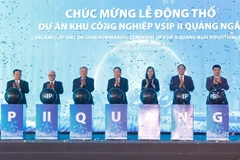
Vietnam in 42nd place in Competitive Industrial Performance rankings ảnh 1Participants in the event unveiling the Vietnam Industry White Paper 2019 on October 22 (Photo: VietnamPlus)

According to Deputy Minister Hai, the processing – manufacturing industry has been playing an increasingly important role in the national economy. It contributed 16 percent to the GDP in 2018, an increase from 12 percent in 2010, and created 9.7 million jobs. The sector has continually made up more than 80 percent of Vietnam’s total export revenue over the past decade.

As a result, Vietnam has swiftly improved its position in the annual Competitive Industrial Performance report and considerably narrowed the gap between the country and other nations in the region.

However, he noted, despite such impressive achievements, Vietnam’s industry is still facing enormous challenges, particularly those posed by the Fourth Industrial Revolution and global economic uncertainties, including the growing protectionism and the trade tension between the world’s two biggest economies.

Le Thi Thanh Thao, UNIDO Country Representative in Vietnam, said industrial competition is the main growth momentum in developing countries since a competitive industry will accelerate the structural shifting that is a decisive factor in national development and poverty reduction.

She pledged to further coordinate with the MoIT in industrial development in the country.

Over the past time, UNIDO has closely partnered with the ministry in promoting strategies and policies on industrial development through institutional capacity enhancement, completing industrial reports in both public and private sectors, and proposing strategies and specific policies for the processing – manufacturing sector, she noted.

Earlier, the project carried out by the MoIT and UNIDO had introduced and provided training in the use of the “Enhancing the Quality of Industry Policies” (EQuIP) toolbox, built by UNIDO and the German Agency for International Cooperation (GIZ). The EQuIP offers methodologies for industrial diagnosis and strategy design, as well as instruments for analysing industrial data with social and environmental aspects taken into account to formulate evidence-based dynamic industrial policies.

Thao said they hope that the EQuIP toolbox and the Industrial Analytics Platform (IAP) of UNIDO will continue to be used by Vietnamese policy makers to build sustainable and inclusive industrial development strategies./.
VNA

See more

SME products livestreamed on the digital platform of Ca Mau Radio and Television Station.( Photo: VNA)

Digital transformation key to unlocking SME growth in Vietnam

Science, technology, innovation and digital transformation have become strategic imperatives directly linked to labour productivity, competitiveness, growth quality and the economy's self-reliance, with sci-tech application and innovation by small and medium-sized enterprises (SMEs) playing an important role.

New Zealand apples on sale at a supermarket in Vietnam (Photo: VNA)

Vietnamese consumers develop taste for Australian, New Zealand fruit

According to statistics from the Department of Customs, in the first six months of 2026, Vietnam imported 102.8 million USD worth of fruit, vegetables and flowers from Australia, up 55.7% from the same period last year. Australia's share of total imports rose from 5.5% to 6.51%, highlighting the growing position of the market as a supplier. Imports from New Zealand reached 78.04 million USD, up 20.4% year-on-year.

Semiconductor products, chips and components displayed at a ceremony to launch a national centre for semiconductor chip pilot production support in Hanoi on June 26. (Photo: VNA)

US semiconductor push offers Vietnam opportunities, policy challenges

The Vietnam-US semiconductor partnership is therefore not simply a “golden opportunity” arising from geopolitical shifts, but also a long-term test of Vietnam’s institutional reform and implementation capacity. If domestic capacity cannot keep pace, adjusting targets toward quality and execution, rather than simply expanding the number of projects, will be essential.

Workers process fruit for export at the Chanh Thu factory in Cho Lach commune, Vinh Long province. (Photo: VNA)

Vietnam works to maintain edge in key agricultural market

According to Le Hang, Deputy Secretary-General of the Vietnam Association of Seafood Exporters and Producers (VASEP), China and Hong Kong (China) remained bright spots for Vietnam’s aquatic exports in July, with revenue exceeding 267 million USD, up 24.7% year-on-year.

An estimated 6,300 workers are needed by the semiconductor industry in Bac Giang province during the 2025-2030 period. (Photo: VNA)

India's semiconductor strategy complementary to Vietnam's chip sector: expert

Sudhanshu Mittal, Director of Engineering Solutions at the National Association of Software and Service Companies (Nasscom) of India, noted that during the state visit to India by General Secretary of the Communist Party of Vietnam Central Committee and President To Lam in May, the two countries signed a number of cooperation agreements, with semiconductors identified as a priority area alongside artificial intelligence (AI), cybersecurity, and advanced technologies.

At the working session between Vietnamese Minister of Finance Ngo Van Tuan (right) and RMIT University’s Vice-Chancellor and President Professor Alec Cameron in Sydney on August 10 (Photo: tapchikinhtetaichinh.vn)

Vietnam, Australia seek to expand investment in rice value chain

During General Secretary of the Communist Party of Vietnam Central Committee and President To Lam’s state visit to Australia from August 9-12, Vietnamese Minister of Finance Ngo Van Tuan, authorised by the General Secretary and President, held working sessions with SunRice Group CEO Paul Serra and RMIT University’s Vice-Chancellor and President Professor Alec Cameron in Sydney on August 10.

Students practice microcontroller programming at the Vietnam-Korea College of Technology in Bac Ninh province (Photo: VNA)

Vietnam – one of most attractive destinations for leading US semiconductor companies: expert

Vietnam has built a solid semiconductor and electronics industry before joining ITSI, attracting major US semiconductor companies. Intel Products Vietnam is one of Intel's largest assembly and testing facilities worldwide, while chip design companies such as Synopsys, Cadence, Marvell and Qualcomm have established engineering and research centres in the Southeast Asian country.

Lawmakers on August 9 discuss a draft law amending and supplementing a number of articles of the Law on the State Bank of Vietnam, the Law on Anti-Money Laundering and the Law on Credit Institutions. (Photo: VNA)

Lawmakers discuss measures to ensure banking system safety, support digital economy

The draft law sets out provisions to control conflicts of interest when commercial banks act as agents managing collateral for corporate bonds. In this regard, Deputy Le Van The of Ninh Binh province said he supported the move, noting that it could provide a more professional approach to collateral management and help strengthen investor confidence if properly regulated.