Vietnam, Laos review border cooperation

The Vietnamese and Lao chairpersons of the two countries’ joint committee for border marker planting held a meeting in Hanoi on March 1 and 2.
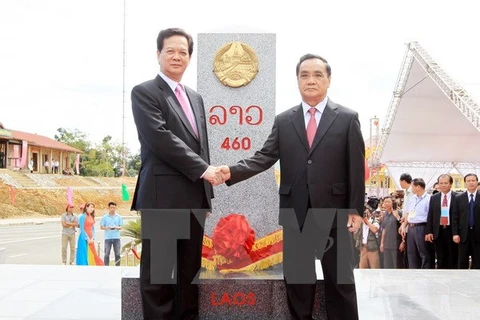
Vietnam, Laos review border cooperation ảnh 1The marker No. 597 on the Vietnam-Laos border (Photo:VNA)

Hanoi (VNA) – The Vietnamese and Lao chairpersons of the two countries’ joint committee for border marker planting held a meeting in Hanoi on March 1 and 2.

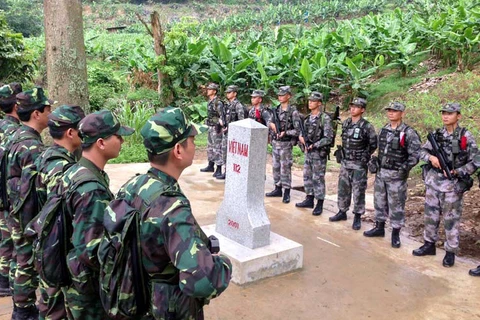
The two sides lauded the completion of the Vietnam-Laos project on increasing and upgrading national markers along their shared border line as scheduled. The project has established a system of 1,002 markers and stakes, defining a stable, clear and easy-to-recognise border line between the two countries.

They agreed to ask the two governments to early organise a ceremony to mark the completion of the project and sign a protocol on the borderline and national border markers of Vietnam and Laos and an agreement on regulations of managing the borderline and border gates on land.

The two sides noted the encouraging outcomes of both countries’ border management, as seen in the political-security situation and social order and safety in border areas, the friendly and cooperative ties between ministries, central agencies and local authorities of border areas.

They discussed and reached agreement on border-related tasks for 2016, including speeding up the implementation of a governmental agreement on handling unplanned migration and unregistered marriages in border areas.

On March 2, head of the Vietnamese sub-committee Deputy Foreign Minister Ho Xuan Son and his Lao counterpart Saleumxay Kommasith signed addenda to the protocol on Vietnam-Laos borderline and national border markers.-VNA
VNA

See more

Deputy Minister of Foreign Affairs Le Thi Thu Hang and non-resident foreign ambassadors at the meeting (Photo: VNA)

Deputy FM hosts non-resident ambassadors attending 14th National Party Congress

The 14th National Party Congress is a milestone in Vietnam’s development, as it not only reviews and assesses 40 years of Doi moi (Renewal), but also sets out orientations for national development in the 2026–2030 period, with a vision to 2045, through strong and right decisions to guide the country into a new era of development.

Professor Zhu Chenming, Honorary Director of the South Asia–Southeast Asia Research Institute under the Yunnan Academy of Social Sciences. (Photo: VNA)

14th National Party Congress: Bridging the past and the future

Zhu said the congress plays a crucial role in shaping Vietnam’s future development, as it discusses development pathways and policy directions to achieve targets set for 2030 and realise the long-term vision towards 2045. The convening of the congress is truly a major political event in the life of the Vietnamese people.

Dr. Kin Phea, Director of the International Relations Institute under the Royal Academy of Cambodia (RAC). (Photo: VNA)

Vietnam’s progress tied to Communist Party of Vietnam leadership: Cambodian expert

In his presentation at a recent seminar hosted by the Vietnamese Embassy in Cambodia, Dr. Kin Phea described the the 14th National Congress of the CPV as a historic and momentous event, saying that with three strategic breakthroughs and six key tasks set for the country’s new revolutionary period, the Congress is seen as a landmark ushering in a new era - the era of the nation’s rise.

General Secretary of the Communist Party of India (CPI) Doraisamy Raja (Photo: VNA)

Vietnam advances creative, adaptive socialism for new era: Indian Communist Party leader

The 14th National Congress of the CPV comes at a critical juncture, as the world faces profound upheavals marked by escalating geopolitical tensions, economic instability, and deep structural crises within global capitalism. Against this backdrop, Vietnam’s decision to pursue a new growth model driven by science, innovation, and digital transformation reflects strategic vision, confidence, and a clear grasp of the requirements of the times.

Deputy Minister of Foreign Affairs Le Thi Thu Hang welcomes journalists and updates them on a number of achievements Vietnam has attained in recent years. (Photo: Ministry of Foreign Affairs)

Deputy Foreign Minister meets int’l journalists covering 14th National Party Congress

Deputy Minister of Foreign Affairs Le Thi Thu Hang said the 14th Congress holds special historical significance, marking a major turning point in the country’s development, as it not only reviews and assesses the achievements of 40 years of Doi moi (Renewal), but also defines goals, vision, and major policy decisions to lead Vietnam into a new era of development.

Professor Carl Thayer from the Australian Defence Force Academy, University of New South Wales (Photo: VNA)

Australian expert shows expectations on Vietnamese Party’s groundbreaking decisions

The 14th congress takes place in a context in which Vietnam recognises the need to adjust its “Doi moi” economic development model. Accordingly, one of the key tasks of the coming period is the use of science and technology, innovation, and digital transformation as the main driving forces for the country’s rapid and sustainable development.

President of the Vietnamese Students’ Association in Australia Huynh Tan Dat (Photo: VNA)

Australian partners, OVs voice strong support for 14th National Party Congress

In a congratulatory message sent to the Communist Party of Vietnam, the Communist Party of Australia described the Congress as a momentous event for the Vietnamese Party, State and people to chart the country’s socialist development path in a new era. Among its key tasks, the Congress will review 40 years of Doi Moi (renewal), 35 years of following the Platform on National Construction, and five years of carrying out the 13th National Party Congress’s resolution.

Secretary of the municipal Party Committee Nguyen Duy Ngoc (Photo: VNA)

Hanoi sets pace in translating 14th National Party Congress’s vision into action

With the strong political determination of the entire system and the united support of the people, Hanoi is set to steadily realise its goal of becoming a “cultured, civilised, modern, happy” capital, achieving sustainable and comprehensive development, emerging as a livable and globally connected city, worthy of its role as the nation’s leading engine.