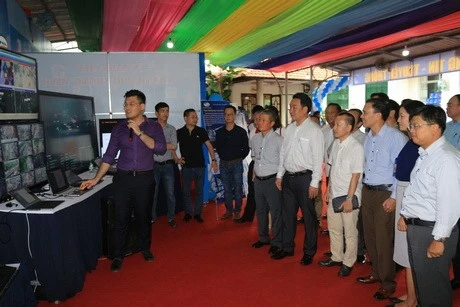
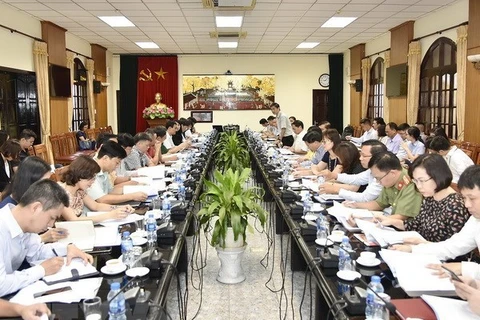
Prime Minister Nguyen Xuan Phuc (middle) speaks at the working session (Photo: VNA)
 Hanoi (VNA) – Vietnam must strive to become a powerhouse in the field of information technology, Prime Minister Nguyen Xuan Phuc said, adding that the Ministry of Information and Communications, as the State management agency in the field, should lead the efforts towards this goal.
Speaking at a working session in Hanoi on September 8 with the Ministry of Information and Communications, the PM urged the ministry to create an environment conducive to high technology, play a guiding role in digital transformation and industry 4.0.
He also instructed the ministry to enhance its management of the press and social media and develop human resources for national construction and development.
Pointing out the sector’s shortcomings, the PM said many shortcomings remain in press planning and management work, resulting in commercialization of press coverage which erodes public trust in the press. Meanwhile, policy consultation remains slow with poor quality.
Phuc also pointed to a serious problem that Vietnam is one of the countries highly vulnerable to malware infection via multimedia devices.
Outlining the direction and tasks for the ministry, the PM said the ministry must guide the efforts to build a digital economy, an e-government and develop e-commerce in the context of the fourth industrial revolution.
The ministry was required to work closely with the Party Central Committee’s Commission on Education and Information in orienting press coverage, and better managing social media.
PM Phuc also called attention to the development of telecommunications infrastructure, adding that the ministry should support the building of several leading firms so that they will train others during the Industry 4.0.
The ministry should concentrate on developing the IT and electronic telecom industries to transform Vietnam into a manufacturer of IT and telecommunications electronics and software developer from its current status of importer and outsourcing country.
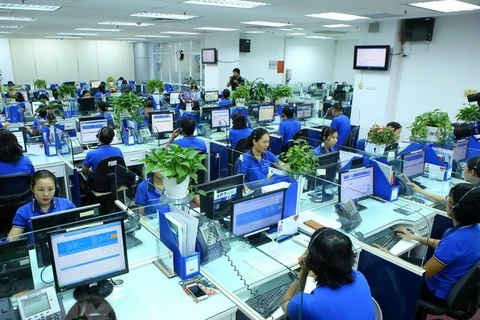
At the meeting, acting Minister of Information and Communications and deputy head of the Party Central Committee’s Commission on Education and Information Nguyen Manh Hung reported that with nearly 1 million km of optical cable lines reaching villages, communes and districts in 63 cities and provinces nationwide, Vietnam has become one of the countries with the world’s highest fiber optic cable coverage. The mobile coverage has reached 99.5 percent of the population while 3G/4G coverage has come to 98 percent.
In the next period, Vietnam will strive to become among top 10 countries globally with the most developed telecommunications network.
With more than 28,000 IT firms and 900,000 workers, the IT industry has expanded by over 20 percent annually over the past decade. Last year, the sector earned 91.6 billion USD in revenue, 81.6 billion USD of which was from hardware, 3.8 billion USD from software, 5.4 billion USD from IT services, and 800 million USD from digital contents. Its exports reached 83.4 billion USD, contributing over 39.2 trillion VND (1.7 billion USD) to the State budget.
In the next decade, the postal sector is expected to surpass telecommunications in terms of revenue thanks to an annual growth of 35-40 percent.
Head of the Commission on Education and Information Vo Van Thuong asked the ministry to continue refining laws and policies on information and mass media to fix existing shortcomings.
He suggested that domestic social media suppliers need to receive support to increase their competitiveness while legal responsibility for information supply should be enhanced so as to address the spread of fake information.-VNA
Speaking at a working session in Hanoi on September 8 with the Ministry of Information and Communications, the PM urged the ministry to create an environment conducive to high technology, play a guiding role in digital transformation and industry 4.0.
He also instructed the ministry to enhance its management of the press and social media and develop human resources for national construction and development.
Pointing out the sector’s shortcomings, the PM said many shortcomings remain in press planning and management work, resulting in commercialization of press coverage which erodes public trust in the press. Meanwhile, policy consultation remains slow with poor quality.
Phuc also pointed to a serious problem that Vietnam is one of the countries highly vulnerable to malware infection via multimedia devices.
Outlining the direction and tasks for the ministry, the PM said the ministry must guide the efforts to build a digital economy, an e-government and develop e-commerce in the context of the fourth industrial revolution.
The ministry was required to work closely with the Party Central Committee’s Commission on Education and Information in orienting press coverage, and better managing social media.
PM Phuc also called attention to the development of telecommunications infrastructure, adding that the ministry should support the building of several leading firms so that they will train others during the Industry 4.0.
The ministry should concentrate on developing the IT and electronic telecom industries to transform Vietnam into a manufacturer of IT and telecommunications electronics and software developer from its current status of importer and outsourcing country.
At the meeting, acting Minister of Information and Communications and deputy head of the Party Central Committee’s Commission on Education and Information Nguyen Manh Hung reported that with nearly 1 million km of optical cable lines reaching villages, communes and districts in 63 cities and provinces nationwide, Vietnam has become one of the countries with the world’s highest fiber optic cable coverage. The mobile coverage has reached 99.5 percent of the population while 3G/4G coverage has come to 98 percent.
In the next period, Vietnam will strive to become among top 10 countries globally with the most developed telecommunications network.
With more than 28,000 IT firms and 900,000 workers, the IT industry has expanded by over 20 percent annually over the past decade. Last year, the sector earned 91.6 billion USD in revenue, 81.6 billion USD of which was from hardware, 3.8 billion USD from software, 5.4 billion USD from IT services, and 800 million USD from digital contents. Its exports reached 83.4 billion USD, contributing over 39.2 trillion VND (1.7 billion USD) to the State budget.
In the next decade, the postal sector is expected to surpass telecommunications in terms of revenue thanks to an annual growth of 35-40 percent.
Head of the Commission on Education and Information Vo Van Thuong asked the ministry to continue refining laws and policies on information and mass media to fix existing shortcomings.
He suggested that domestic social media suppliers need to receive support to increase their competitiveness while legal responsibility for information supply should be enhanced so as to address the spread of fake information.-VNA
VNA