Vietnam needs to develop affordable homes
The real estate market is suffering a severe shortage of affordable homes despite the segment witnessing huge demand, attendees heard at a recent conference.
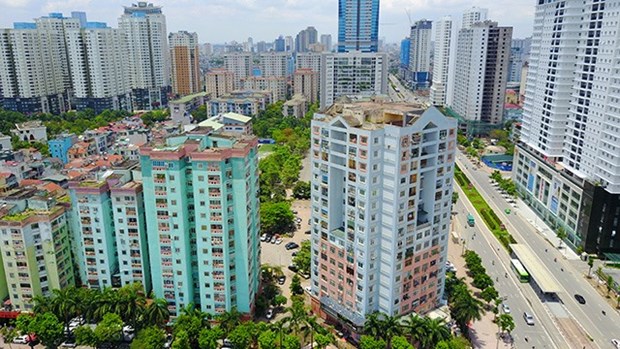 Experts say that Vietnam needs to come up with policies for developing affordable homes. (Photo: danviet.vn)
Hanoi (VNS/VNA) - The real estate market is suffering a severe shortage of affordable homes despite the segment witnessing huge demand, attendees heard at a recent conference.
Expert Dang Hung Vo said at the conference held by Dan Viet newspaper that the structure of property products in Vietnam did not match market demand, especially in Hanoi and HCM City.
Vo pointed out that the supply of high-end apartments was abundant while there was a shortage of affordable homes.
The Central Institute for Economic Management (CIEM) cited statistics showing that as Vietnam was undergoing rapid urbanisation, on average around 1 million people migrated from rural areas to big cities like Hanoi and HCM City each year and the figure is expected to rise further.
This increases demand for affordable homes in big cities. It was estimated that demand for affordable homes accounted for around 60-70 percent of total market demand, but the supply met less that 20 percent. Specifically, apartments of less than 60sq.m with prices of less than 700 million VND (30,500 USD) accounted for just around five per cent of market supply.
Vo said that the Government’s policies for developing social housing projects and affordable homes had failed to raise resources from the private sector.
Many projects had ground to a halt after the 30 trillion VND package of preferential loans for social housing development ended, proving that social housing development was still too reliant on Government support.
Vo said that it was important to develop policies to promote the development of affordable homes, rather than social housing development.
CIEM Deputy Director Tran Kim Chung agreed, saying that focus should be placed on developing affordable homes.
He pointed out current regulations had not allowed for the development of small apartments, which was hindering the development of affordable homes. This issue was made worse by difficulties in accessing credit, complicated procedures and a lack of land available for construction.
Chung said that Vietnam needs to have appropriate policies in land, tax, interest rates, credit and mortgages for affordable home development together with allowing the development of apartments of different sizes to meet demand.
He stressed that developing affordable homes is a pressing issue for Vietnam as rapid urbanisation are putting pressure on city infrastructure, such as power grids, water networks and schools.
According to Nguyen Van Dinh, General Secretary of the Vietnam Association of Real Estate Brokers, due to a lack of infrastructure, such as transport, schools and retail outlets, many affordable housing projects were not attractive to buyers.
Dinh said that the development of affordable housing projects must be synchronised with the development of urban infrastructure to encourage people to buy and live in areas which were far from the city centre. “Affordable does not mean poor quality.”
Policies for developers and low-income earners to buy affordable homes should also be devised, together with the development of land available for building affordable housing projects.
In addition, it was necessary to develop affordable homes for lease, Dinh said.
Vu Van Phan, Deputy Director of the Ministry of Construction’s Department of Housing and Real Estate Management, said that developers were still not interested in developing affordable homes and they expected to be provided with more incentives. However, the Government could not provide too much financial support for developers of affordable housing projects, given the limited budget, he said.
The ministry’s statistics showed that by 2020, around 1.7 million people were in need of homes in urban areas together with 1.7 million workers demanding stable accommodation, requiring the development of nearly 1 million apartments.-VNS/VNA





You should also see
Energy industry needs nearly 5 trillion VND of investment in 2021-2030
The total investment capital demand for the whole energy sector in the 2021-2030 period is between 4.13-4.8 trillion VND (163.01-189.46 million USD), according to a plan to implement the National Power Planning in the 2021-2030 period with a vision to 2050.


See more
 Business
Vietnam needs drastic reforms to create firm ground for economic growth: experts
Drastic institutional reforms are needed to create firm ground for economic growth in the context that persistent challenges, both external and internal, still cloud the growth prospect, experts have said.
 Business
Dak Lak firm pioneers in following EUDR in coffee production
The Dak Lak September 2 Import-Export Company Limited (Simexco) has pioneered in building coffee growing areas following the EU Deforestation Regulation (EUDR), it announced on April 25.
 Business
Dong Nai calls for Korean investment into green growth
The southern province Dong Nai introduced its investment projects and incentives to the Republic of Korea (RoK)’s firms at a workshop in Seoul on April 25.
 Business
Vietnam ranks fifth among aquatic product suppliers for Singapore
Vietnam jumped one place to become the fifth largest exporter of aquatic products to Singapore for the first time in the first quarter of this year, according to its Trade Office in the city state.
 Business
Forum seeks ways to boost exports amid external challenges
Experts gathered at a forum in Ho Chi Minh City on April 25 to seek ways to untangle knots in terms of capital and market for exporters in the context that the ongoing conflicts in many regions are disrupting international trade.
