Vietnam not taking advantage of free labour mobility

Two years after joining the ASEAN Economic Community (AEC), Vietnam’s labourers have not tapped the opportunities brought about by greater labour mobility, according to the Ministry of Labour, Invalids and Social Affairs.
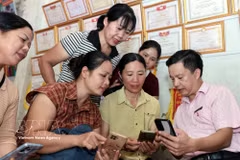
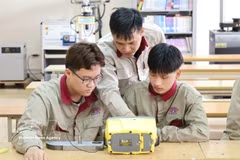
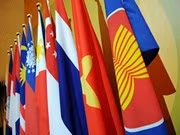
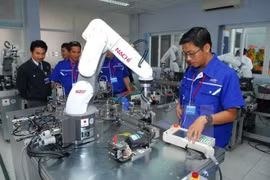
Vietnam not taking advantage of free labour mobility ảnh 1Illustrative image (Source: VNA)
Hanoi (VNA) – Two years after joining the ASEANEconomic Community (AEC), Vietnam’s labourers have not tapped the opportunitiesbrought about by greater labour mobility, according to the Ministry of Labour,Invalids and Social Affairs.

As ASEAN countries seek further integration, they have agreedto allow engineers, nurses, architects, doctors, dentists, surveyors,accountants and tourism professionals from one ASEAN country to work in anotherif they meet certain requirements.

However, Ha Thi Minh Duc, deputy head of the InternationalRelations Department under the labour ministry said that so far only 109engineers and architects in Vietnam qualified for mobility requirements.

“While the AEC allows free labour mobility, member countrieshave requirements for each occupation and they need to discuss among each otherhow to grant mutual recognition and set up skills standards for theseoccupations,” Duc said.

“Meanwhile, there’s still a considerable gap among thenational occupation skill framework among ASEAN member countries, especiallyamong Cambodia, Laos, Myanmar and Vietnam,” she said.

The slow mobility was also due to policies of each country, Ducadded, saying that after workers meet the general occupation standards, they willalso have to meet standards set by each country.

Workers’ ability to work outside their country also dependson local demand.

For instance, a Vietnamese doctor who wants to work inThailand has to know how to speak Thai. On the other hand, some local employerswho want to recruit foreign workers have to prove that they can’t findqualified locals of equal pay to hire a foreigner, she said.

Mac Van Tien from the South East Asia Finance, Investment andTrade Institute, said apart from technical barriers set by ASEAN membercountries, slow mobility was also caused by moderate Vietnamese labour skills.

“Vietnamese labourer’s skills in teamwork and working inmulti-cultural environments are limited,” Tien said.

He added that while skills and knowledge can be improved andcultivated, Vietnam’s preparation for integration has been poor.
“We rank 11 out of 12 Asian countries in terms of labourerquality and our productivity is one third of Malaysia’s and two fifth ofThailand’s,” he said.

Currently, the number of labourers moving among ASEANcountries is 6.5 million, of which 2.28 million are from ASEAN countries andthe rest are from outside the bloc. The main destinations are Malaysia,Singapore and Thailand. Most migrant workers to these countries come fromIndonesia, Myanmar and Malaysia.

“Vietnam is not yet a destination or the starting point forqualified labourers moving in the region,” Tien said.

In order to take advantage of free labour flow, the abilityto speak foreign languages, professionalism and work ethics are the mostimportant factors, said Nguyen Thu Trang, Director of Human ResourcesRecruitment and Consultancy of Manpower Group.

“For the labourers, they need to be able to speak foreignlanguages, work in a team effectively, learn new skills and adapt new workingenvironments,” Trang said.

“What the Government can do is to be flexible in labourtraining so that workers can catch up with changes and regional standards.

Foreign language skills and soft skills must be improved, and the Governmentneed to work with enterprises to make training programmes more relevant tomarket demands,” she said.-VNA
VNA
See more

An official of the Bank for Social Policies in Lao Cai province guides local women in using the mobile application. (Photo: VNA)

Efforts made to create value from digital environment

As digital services become more accessible and public feedback is increasingly heard, Vietnamese citizens are expected to move from simply benefiting from digital transformation to actively contributing to the development of a prosperous digital nation, where people's happiness and satisfaction remain the ultimate measures of success.

The Viet Youth Readiness Hub of the Canada Vietnam Council for Culture & Education (CVCEC) during a Vietnamese language lesson for Vietnamese-Canadian children in Toronto, Canada. (Photo: VNA)

Vietnamese culture connects generations in Canada

Beyond language skills, children learn about Vietnamese history, stories of filial devotion and national heroes, and the importance of respecting parents and teachers. Weekend classes begin with the national anthem, while festivals and traditional holidays offer opportunities to make greeting cards, prepare traditional cakes and learn to wrap 'banh chung' (square sticky rice cakes).

Delegates and local residents explore the themed exhibition “Coastal and Island Archaeology in Ho Chi Minh City: New Discoveries in 2020–2025”. (Photo: VNA)

Archaeological exhibition showcases 300 artefacts in Ho Chi Minh City

The exhibition presents 150 artefacts and 150 documentary photographs collected through archaeological surveys, field investigations and excavations over the past five years. The items were unearthed at notable sites including Cu Bi, Quang Thanh, Go Nan, Kim Long, Go Dat Nai, Giong Lon, Con Dao and Vong Thanh Da Trang. The findings have helped researchers shed light on traces of ancient settlements, craft workshops, distinctive burial practices, as well as ancient citadels and trading ports.

A TTU–VWAI representative hands the National Steering Committee 515 delegation several sets of dossiers on martyrs’ burial sites and artefacts that TTU–VWAI experts collected and studied during joint work to search for, recover and identify Vietnamese martyrs’ remains. (Photo: VNA)

Vietnam, US step up cooperation in search for fallen soldiers’ remains

Ambassador Nguyen Quoc Dung pressed partners to adopt four strategic tracks: a two-way verification process, standardised and professionalised outputs, breakthrough use of digital technology and AI, and maximum diplomatic patronage and resources, all aimed at converting documentary research into field investigation capacity.

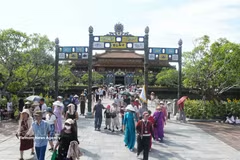
Visitors tour the Hue Imperial Citadel. (Photo: VNA)

Hue cuts heritage site entrance fees to attract more tourists

Under the first scheme, visitors using new tourist transport services to Hue will receive a 50% discount on entrance fees. Eligible services include the Hue – Phong Nha heritage railway, the Hue – Da Nang heritage steam train, and new domestic and international air routes, including charter and scheduled flights. The incentive does not cover existing air routes with increased flight frequencies.

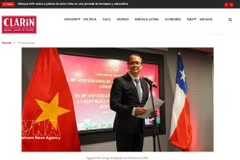
Screenshot of the article. (PhotoVNA)

Chilean media spotlight Vietnam’s growing global role

Chilean newspaper El Clarín recently published an interview with Vietnamese Ambassador to Chile Nguyen Viet Cuong, highlighting Vietnam’s foreign policy of independence and self-reliance and international integration, its contributions to regional cooperation, and prospects for bilateral ties as the two countries mark the 55th anniversary of diplomatic relations.

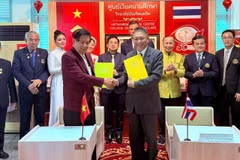
The exchange of a Memorandum of Understanding (MoU) on academic cooperation between the Vietnamese Consulate General in Khon Kaen and College of Asian Scholars. (Photo: VNA published)

Vietnam Studies Centre opens in northeastern Thailand

The centre would serve as a valuable academic hub for teaching and promoting Vietnamese language, culture and history, while fostering people-to-people exchanges and connecting younger generations of the two countries.

Fishing boats enter and leave Quy Nhon port (Photo: VNA)

Gia Lai tightens controls over vessels to combat IUU fishing

Inspections by an inter-sectoral working group identified weaknesses in managing ineligible fishing vessels, controlling vessels entering and leaving ports, seafood traceability, handling violations and implementing support policies for decommissioned vessels, according to the committee.

Construction site for the Ben Thanh - Tham Luong metro project on Cach Mang Thang Tam street (Photo: VNA)

Ho Chi Minh City plans five TOD areas along Metro Line No. 2

According to the Ho Chi Minh City Department of Planning and Architecture, the boundaries of the five TOD areas along Metro Line No. 2 (Ben Thanh – Tham Luong) have been approved, covering a total area of approximately 939 ha. The city is now drawing up plans for these areas.

Russian and CIS tourist groups visit the central city of Da Nang in 2026. (Photo: VNA)

Vietnam gains popularity among Russian tourists

Vietnam recorded the fastest growth in Russian tourist arrivals among mass-tourism destinations in the first nine months of 2026, according to data from the Association of Tour Operators of Russia (ATOR) and Russia’s Federal Security Service (FSB).

The 24th Asian Maritime and Fisheries Universities Forum takes place in Hai Phong city. (Photo: VNA)

Leading Asian maritime universities gather for Hai Phong forum

Vietnam needs engineers, seafarers, experts and managers who can adopt and develop advanced technologies for the maritime industry and future marine economy. That is why Vietnam attaches special importance to international cooperation in education, training and research.