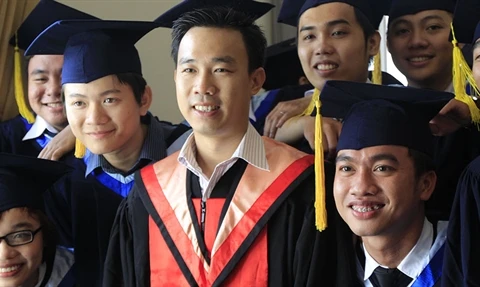
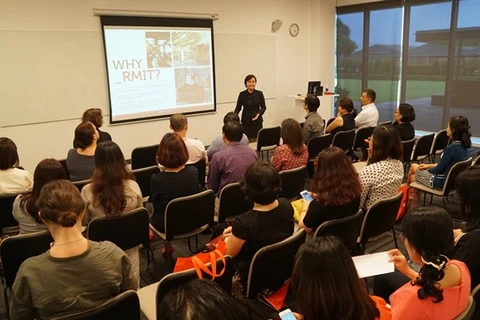
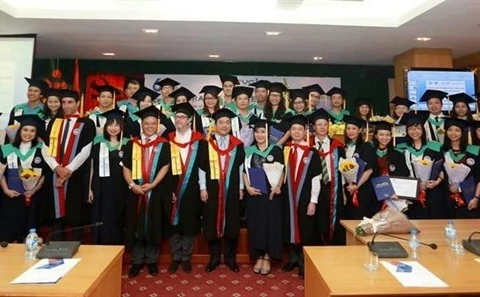
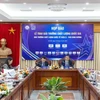
Reports from the Ministry of Education and Training showed that scientific research works from universities and institutes between 2011-2016 were modest. (Photo: tuoitre.vn)
 Hanoi (VNA) – Vietnam has had a remarkably high number of post-graduates in the recent years. However, scientific research projects, which are considered the soul of universities in their quest to produce new knowledge for the world, have remained modest in both quality and quantity.
According to education experts, this is due to shortcomings in post-graduate education, which fails to boost scientific research at universities.
Professor Ta Thanh Van, lecturer at Hanoi Medical University told Lao Dong (Labour) newspaper that post-graduate education in the country does not really boost scientific research and that universities did not play the key role of enhancing science and technology capacity in the country.
As a result, the quality of PhD-holders was low compared to other regional countries. The number of Vietnamese scientists honoured in the world’s educational system or in international research projects was still very modest, he said.
PhD Nguyen Xuan Han from the Hanoi National University said that in the 1970s, the number of PhD holders was only roughly 1,000, and this generation had made contributions to the construction and development of the country.
The number of PhD holders is now 23 times higher, but concrete achievements, proven by valuable and practical scientific research works, are limited. He said that the low quality of post-graduates was among the key reasons.
PhD Le Van Ut, head of the Ton Duc Thang University’s Science and Technology Management and Development Office, agreed, saying that candidates for professorships or associate professorships were not required to have scientific articles published on ISI/Scopus journals – the standard that the world has applied to evaluate the quality of research produced by individual scientists, scientific organisations and nations.
The low requirements produce poorly qualified scientists, he said.
Reports from the Ministry of Education and Training showed that scientific research works from universities and institutes between 2011-2016 were modest.
The group of agro-forestry-fishery universities had nearly 3,350 scientific articles published at international and national conferences during the period, according to an article published on the Vietnam Government portal chinhphu.vn last November. The figure is equivalent to an average of 0.74 article per scientist during the five-year period.
The group of pedagogical universities had 2,000 PhD holders, but only had 804 articles published on ISI/Scopus journals.
Currently, there were about 9,000 professors and associate professors, 24,000 PhDs and 100,000 MAs in the country. However, during the 2011-16 period, they had only 5,738 international scientific articles published.
PhD Nguyen Ngoc Minh, Vice Chairman of the Vietnam Academy of Science and Technology, said that it was necessary to have a testing system to evaluate the education and training quality of universities.
To improve the education quality and scientific research of post-graduates, experts said that it was necessary to set up a centre of forecasting human resources, which would take surveys and forecast changes on human resources in different fields and different regions.
Based on the survey, the State would set up a policy to train human resources properly.
The role of the professor councils, who would vote for candidates registered for Doctorate or Professor, should be improved. Council members should be voted on instead of assigned, as they are now, to ensure the transparency and fairness of the process. -VNA
VNA