Vietnam ready to accompany with GEF in boosting development

Vietnam ready to accompany with GEF in boosting sustainable development

Vietnam is willing to accompany with the Global Environment Facility (GEF) in boosting sustainable development for the current and future generations, said Prime Minister Nguyen Xuan Phuc.
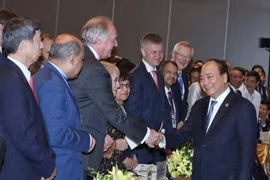
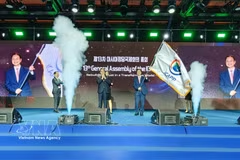
Vietnam ready to accompany with GEF in boosting sustainable development ảnh 1Prime Minister Nguyen Xuan Phuc addresses the opening of the 6th GEF Assembly (Photo: VNA)

Da Nang (VNA) – Vietnam is willing to accompany with the GlobalEnvironment Facility (GEF) in boosting sustainable development for the currentand future generations, said Prime Minister Nguyen Xuan Phuc.

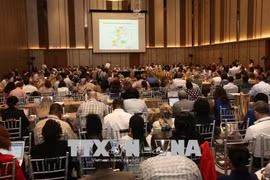
The PM made the statement in his speech delivered at the opening session of the6th GEF Assembly held in the central city of Da Nang on June 27.

The earth – the home of the mankind – is facing severe impacts fromenvironmental degradation and pollution and climate change. If no overallsolutions are given, countries, nations and people will have to suffer tremendousconsequences, he said.

This big challenge isalso a chance for the humankind to review development models and ways, therebymaking a change in their mindset and behaviours for an everlasting natural environment,he stated.

The Government leader notedthat the GEF has made important contributions to the settlement of challengesin environment and climate change in the world, especially in developingcountries, including Vietnam.

During its development, Vietnam has countered many problems in environmental degradationand climate change, he said.

Despite manydifficulties in resources, the Vietnamese Government has added environmentalprotection and climate change response into the country’s socio-economicdevelopment plans, while mobilising all resources and creativeness as well as efforts of the whole society forthe work.

“Vietnam will notexchange environment for economic development which affects the sustainabledevelopment,” he said before about 1,500 delegates from 183 GEF countries,along with leaders of UN agencies, regional development banks, socio-economicorganisations and businesses.

The country isfocusing on implementing the UN Sustainable Development Goals (SDGs 2030) andits commitments at COP-21 on climate change.

At the G7 OutreachSummit in Canada earlier this month, the PM hailed the important role andeffective cooperation of the GEF, while pledging to work with the GEF inimplementing the regional project for a plastic waste-free ocean.

On the occasion, thePM thanked the GEF and its members and development partners, expressing hishope to continue receiving consultations, cooperation and assistance from theGEF.

He held that Vietnamis a favourable placefor the GEF to launch its new projects in environmental protection, adding thatVietnam is ready to engage in global, inter-regional and inter-sectoralprojects in order to learn experience in dealing with global environmentalproblems such as ocean plastic waste and preserving biodiversity.

PM Phuc raised anumber of issues for discussion at the event, including the definition of majorenvironmental challenges to the mankind, thus seeking prioritised policies forthe comprehensive and effective settlement of these challenges.

The PM suggested thatit is necessary to evaluate the efficiency of current supporting andcoordinating mechanisms, so as to make breakthrough improvements, especially inmobilising and distributing resources to assist member countries, particularlythose facing huge problems due to environmental degradation, pollution andclimate change.

Participants shouldpropose projects to cope with the root of environmental degradation, pollutionand climate change as well as urgent matters related to ocean plastic waste.

The sixth Assembly ofthe GEF is one of the most important events in environment hosted by Vietnam in2018.

Along with a plenarysession, the event also includes a number of discussions on issues related tofood, land use and restoration, sustainable cities, cooperation in implementingthe 2030 agenda, plastic waste released to the ocean, and reform in greenpower.

Vietnam became a memberof the GEF in 1994. The GEF was established on the eve of 1992 in Rio EarthSummit to help tackle the planet’s most pressing environmental problems.

So far, it hasprovided over 17.9 billion USD in grants and mobilised an additional 93.2billion in co-financing for more than 4,500 projects in 170 countries.

Today, GEF is aninternational partnership of 183 countries, international institutions, civilsociety organisations and the private sector that addresses globalenvironmental issues.-VNA 
VNA
See more

☀️ Morning digest on November 9

☀️ Morning digest on November 9

Activities of Party General Secretary and President To Lam's official visit to Japan, the 10th National Buddhist Congress, and the sixth political consultation at the deputy foreign minister level between Vietnam and Spain are among news highlights over last weekend.

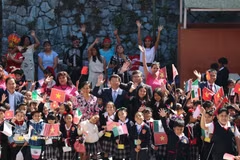
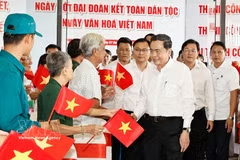
The Vietnamese delegation takes photo with students at the primary school named after the Socialist Republic of Vietnam (Photo: VNA)

CPV values traditional friendship with Mexican Labour Party

Deputy head of the CPV Central Committee’s Commission for Publicity Tran Thanh Lam proposed deeper theoretical exchanges and sharing of experience in Party building and national development; stronger cooperation in education, science, culture, external information, press, publishing and traditional medicine.

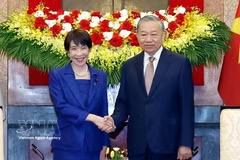
General Secretary of the Communist Party of Vietnam (CPV) Central Committee and President To Lam and Japanese Prime Minister Sanae Takaichi during her official visit to Vietnam in May, 2026. (Photo: VNA)

Top Vietnamese leader’s Japan visit to open up new space for bilateral cooperation

The visit is expected to further deepen ties through Party, State, parliamentary and people-to-people channels, while creating breakthroughs in economic, financial, scientific and technological cooperation, innovation, education and training, digital and green transformation, and supply chain diversification, thereby contributing to a peaceful and stable environment for development in both countries.

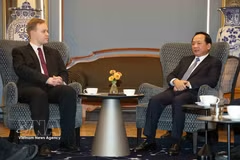
Politburo Member and Head of the Party Central Committee’s Commission for Publicity Trinh Van Quyet (R) meets with Jiri Mäntysalo, Vice Chairman of the Communist Party of Finland. (Photo: VNA)

Vietnam, Finland move to strengthen political trust, expand cooperation

Politburo Member and Head of the Party Central Committee’s Commission for Publicity Trinh Van suggested that Finland further promote its role as a bridge between Vietnam and the European Union (EU), while Vietnam could serve as a bridge between Finland and the Association of Southeast Asian Nations (ASEAN). He called for effective utilisation of the EU-Vietnam Free Trade Agreement (EVFTA) and urged Finland to encourage the remaining EU member states to ratify the EU-Vietnam Investment Protection Agreement (EVIPA) at an early date.

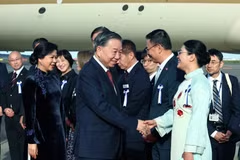
Representatives of the Japanese State and the Embassy of Vietnam in Japan welcome General Secretary of the Communist Party of Vietnam Central Committee and President To Lam and his spouse at Haneda International Airport in Tokyo. (Photo: VNA)

Top Vietnamese leader begins official visit to Japan

The visit is expected to further translate the potential and achievements of bilateral cooperation into concrete outcomes, strengthen the longstanding bonds between the two countries and ensure that the friendship nurtured across generations continues to deliver lasting benefits to both peoples.

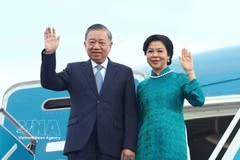
General Secretary of the Communist Party of Vietnam Central Committee and President To Lam, his spouse Ngo Phuong Ly and a high-ranking Vietnamese delegation leave Hanoi on November 8 for a four-day official visit to Japan at the invitation of the Japanese State. (Photo: VNA)

Top leader and spouse depart for official visit to Japan

General Secretary of the Communist Party of Vietnam Central Committee and President To Lam, his spouse Ngo Phuong Ly and a high-ranking Vietnamese delegation left Hanoi on November 8 for a four-day official visit to Japan at the invitation of the Japanese State.

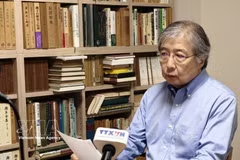
Toshiro Nishizawa, a Senior Fellow at Graduate School of Public Policy under the University of Tokyo in an interview with the Vietnam News Agency (VNA)'s correspondent in Japan (Photo: VNA)

Top leader’s visit to deepen Vietnam-Japan strategic cooperation: expert

The upcoming visit to Japan by General Secretary of the Communist Party of Vietnam Central Committee and President To Lam is expected to give fresh impetus to the Vietnam-Japan Comprehensive Strategic Partnership, reflecting the strategic priorities of both countries, according to a Japanese expert.

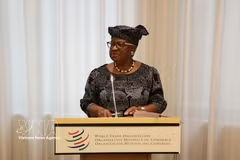
WTO Director-General Ngozi Okonjo-Iweala speaks at the event (Photo: VNA)

WTO hails Vietnam’s 20-year journey since accession

Joining the WTO was a strategic choice for Vietnam, closely associated with its Doi Moi (Renewal) process, opening-up policy and international economic integration. Over the past two decades, international economic integration has become a driving force for institutional reforms, trade expansion, foreign investment attraction and enhancement of the country's international standing.

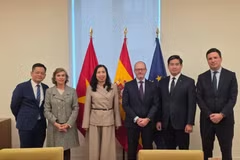
Vietnamese Deputy Minister of Foreign Affairs Le Thi Thu Hang (third, left) and other delegates at the political consultation (Photo: The Ministry of Foreign Affairs)

Vietnam, Spain seek to deepen Strategic Partnership

Vietnam asked Spain to continue voicing its support for and urging the European Commission (EC) to swiftly lift the IUU “yellow card” imposed on Vietnamese seafood, while actively encouraging EU member states to ratify the EU-Vietnam Investment Protection Agreement (EVIPA) at an early date.

Standing Deputy Minister of Foreign Affairs Nguyen Minh Vu (Photo: Ministry of Foreign Affairs)

Top leader's official visit to Japan carries three major strategic implications: Deputy FM

The visit, the first to Japan by the leader in his new capacity and the first visit to Japan by a General Secretary of the Communist Party of Vietnam in 11 years, will first set the overall strategic direction for bilateral relations in the new period, enabling leaders of the two countries to identify long-term cooperation orientations and priority areas that meet the development needs of both sides.