Vietnam records trade deficit of 1.3 billion USD in May

Vietnam recorded a trade deficit of 1.3 billion USD in May, resulting in a total deficit of 548 million USD for the first five months of the year, according to General Statistics Office (GSO)s monthly report.
Vietnam records trade deficit of 1.3 billion USD in May ảnh 1Harvesting coffee for exports (Photo: VNA)

Hanoi (VNA) -
Vietnam recorded a trade deficit of 1.3 billion USD inMay, resulting in a total deficit of 548 million USD for the first five monthsof the year, according to General Statistics Office (GSO)'s monthly report.

The domestic sector reported a trade deficit of 13.3 billion USD in the period,while foreign-invested firms posted a trade balance of 12.7 billion USD.

GSO statisticians blamed the return to a trade deficit on slowing growth ofexports in May. In the first four months of the year, the country posted asurplus of 771 million USD.

They said the country’s import-export turnover reached more than 202 billion USDin the five-month period, a year-on-year rise of 7 percent. However, thisgrowth rate was much lower than 19 percent and 17.5 percent seen in the sameperiods of 2018 and 2019, respectively, with key export items such as rice,coffee and cashew nuts posting turnover reductions of between 14 and 23 percent.

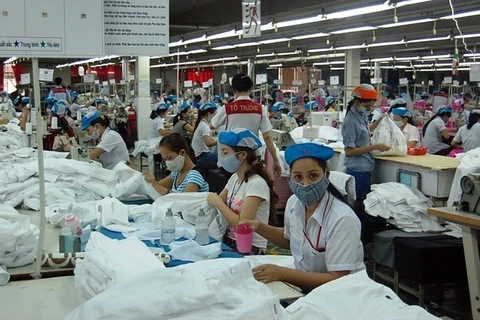
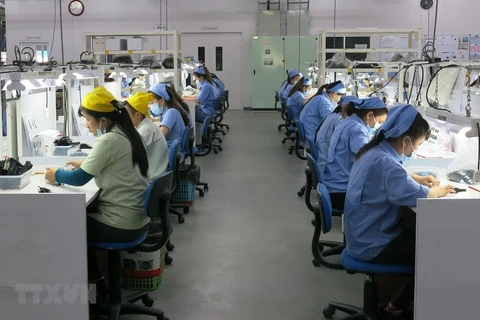
Phones and parts recorded the highest export turnover of approximately 20billion USD, accounting for 20 percent of total exports, up 3 percent year onyear, followed by electronics, computers and components (12 billion USD, up 11 percent),garments (12.1 billion USD, up 10 percent) and footwear (7.1 billion USD, up 14percent).

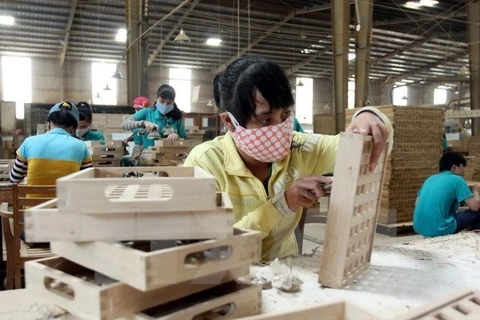
Other areas were equipment and parts with 7 billion USD, up 6 percent year onyear, wood and furniture (4 billion USD, up 18 percent) and vehicles and parts(3.6 billion USD, up 5 percent).

The US remained Vietnam's biggest export market in the period, spending nearly 23billion USD on Vietnamese goods, a yearly hike of 28 percent. The EU rankedsecond at 17 billion USD, up 2 percent and China came third with 14 billion USD,down 3 percent.

GSOs figures also showed that import turnover between January and May toppedmore than 100 billion USD, surging 10 percent over the same period last year.The domestic sector hit 44 billion USD, up 15 percent, while theforeign-invested sector hit nearly 58 billion USD, up 7 percent.

China retained its position as Vietnam's largest source of imports withturnover of 29.6 billion USD, with products recording significant growthincluding electronics, computers and components at 83 percent; machinery,equipment and spare parts at 28 percent and fabric at 13 percent.

The Republic of Korea came next with 19.2 billion USD, up 1 percent, and ASEANcountries ranked third with 14 billion USD, up 9 percent. Japan, the US and theEU followed.

GSO statisticians noted that Vietnam saw an increase of 46 percent in its tradedeficit with China to total of 16 billion USD in the period. The RoK hit 11billion USD, down 4 percent; and ASEAN was 3.3 billion USD, up 26 percent. -VNA
VNA

See more

Professor Tao Yitao, Director of the China Centre for Special Economic Zone Research (Photo: VNA)

Stable beginnings, powerful breakthroughs for Vietnam’s private economic sector

Vietnam is now at a critical juncture in pursuing what its leadership has described as a new era of national rise. In the long term, the development of the private economic sector will depend not only on supportive policies but also on a stable, transparent institutional environment that guarantees fair competition, said Professor Tao Yitao, Director of the China Centre for Special Economic Zone Research.

The trade policy review of Uruguay at the WTO headquarters. (Photo: VNA)

Vietnam participates in WTO review of Uruguay's trade policy

Vietnam also welcomed Uruguay's active engagement in the multilateral trading system as a founding member of the WTO. Uruguay has ratified the Agreement on Fisheries Subsidies, joined the Multi-Party Interim Appeal Arbitration Arrangement (MPIA), and contributed to Joint Statement Initiatives (JSIs) on e-commerce and micro, small and medium-sized enterprises (MSMEs).

Experts discuss cooperation opportunities in Vietnam-Germany manufacturing value chains at the forum. (Photo: VNA)

Vietnam-Germany cooperation creates new opportunities for sustainable manufacturing

Germany is an important partner of Vietnam and a global leader in green technology, smart manufacturing, automation and circular economy solutions. The combination of German technological expertise and Vietnam's manufacturing capabilities and strong commitment to transformation would create significant opportunities in green production, supporting industries, digital transformation, supply chain management and eco-industrial park development.

Businesses introduce Halal market products at the workshop. (Photo: VNA)

Da Nang businesses eye growth in booming global Halal market

Huynh Xuan Son, Deputy Director of the Da Nang Department of Industry and Trade, said the Halal market has emerged as a strategic destination for Vietnamese exporters amid persistent global economic uncertainties. Serving more than two billion consumers across over 110 countries and territories, the market offers significant opportunities for business expansion.

Vietnamese bananas are sold at an AEON supermarket in Japan. (Photo: VNA)

Vietnamese products promoted at AEON stores across Japan

Speaking at the opening ceremony, Deputy Minister of Industry and Trade Phan Thi Thang highlighted the significance of 2026, which marks a decade of cooperation between the ministry and AEON in organising Vietnam Week in Japan.

Growing demand for financing for infrastructure and green transition projects is driving Vietnam’s search for new sources of capital. In the photo: A section of Noi Bai – Lao Cai Expressway. (Photo: VNA)

Vietnam seeks to unlock capital for infrastructure, green transition

As Vietnam advances its sustainable growth agenda and commitment to achieving net-zero emissions by 2050, the need for long-term capital is rising rapidly. Experts say meeting these financing requirements will depend not only on expanding available resources but also on broadening funding sources and improving project financing models.

Private technology enterprises are increasingly viewed as a driving force at the heart of the innovation ecosystem. (Photo: VNA)

Vietnam pushes to develop world-class technology startups

Vietnam’s startup ecosystem now comprises roughly 4,000 startups, 208 investment funds, 84 incubators and more than 20 startup support centres. With an estimated valuation of 75 billion USD, the ecosystem has established most of the key foundations needed for long-term growth.