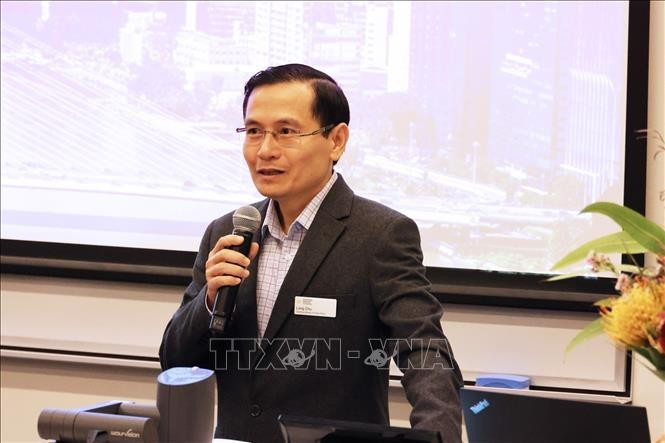
Sydney (VNA) - Vietnam serves as a key driver of ASEAN’s cooperation policy, which is based on self-reliance, respect for shared interests, and adherence to international law, said Prof. Chu Hoang Long from the Australian National University (ANU).
In an interview granted to the Vietnam News Agency's correspondents in Australia on the occasion of the 30th anniversary of Vietnam’s accession to ASEAN (July 28, 1995 – 2025), Long shared insightful assessments of the country's role and contributions to the bloc over the past three decades.
He noted that Vietnam has played a pivotal role in ASEAN’s expansion, particularly in the admission of Cambodia, Laos, and Myanmar. This effort helped transform ASEAN into a more cohesive Southeast Asian community, rather than a fragmented bloc, thereby strengthening intra-bloc unity amid intensifying strategic competition among major powers.
ASEAN’s cooperative policy, rooted in self-reliance, respect for common interests, and adherence to international law, is also reflected in Vietnam’s diplomatic philosophy and has been embedded in the ASEAN Charter.
Vietnam is also one of ASEAN’s most important economic drivers, Long said, noting that with its high and stable growth rate, the country has contributed to elevating ASEAN’s economic standing on the global stage.
The country has successfully assumed the role of the coordinator and chair within ASEAN during difficult times. Notable milestones include during the Asian financial crisis in 1998, and during the global COVID-19 pandemic in 2020, when Vietnam served as ASEAN Chair and effectively managed the bloc’s relations with major partners such as the European Union (EU), the US, China, Japan, the Republic of Korea (RoK), and India.
He emphasised that Vietnam’s accession to ASEAN marked a strategic turning point in the country’s international economic integration, opening up significant opportunities for both economic growth and institutional development.
The country has significantly expanded its export markets and attracted substantial investment. Its participation in the ASEAN Free Trade Area (AFTA) and ASEAN’s trade agreements with major partners have enabled Vietnam to access a rapidly growing market, rising from about 500 million people in 1995 to nearly 700 million today.
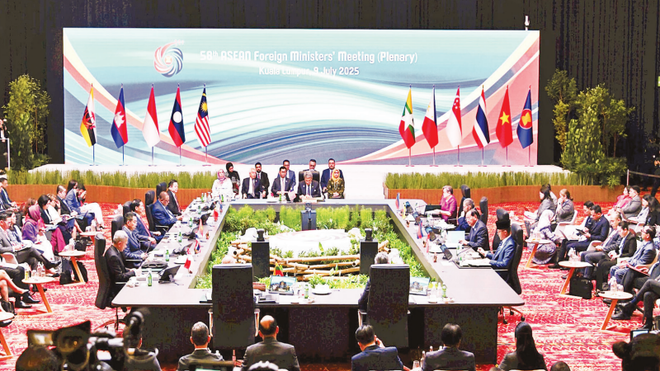
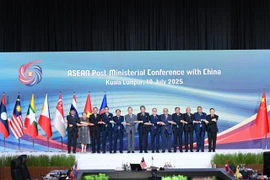
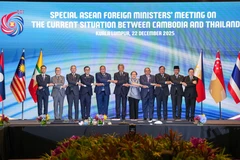
A view of the 58th ASEAN Foreign Ministers' Meeting in Malaysia in July 2025. (Photo: VNA)
ASEAN has served as a catalyst for institutional reform and enhanced competitiveness. Integration commitments have required Vietnam to continuously improve its legal, business, and governance environment, thereby boosting economic efficiency and labour productivity.
Additionally, the bloc has supported Vietnam in developing human resources, technology, and infrastructure. Vietnam has effectively leveraged ASEAN’s training cooperation programmes, technical transfer initiatives, and development assistance to between the quality of its internal development.
Amid growing global complexities, Vietnam is increasingly asserting its central role within ASEAN – both at strategical level and in terms of long-term development orientation, the expert said.
According to him, Vietnam is actively joining the drafting of the “ASEAN Community Vision 2045,” a strategy focused on sustainable development, security cohesion, and regional connectivity. Notably, this vision aligns with Vietnam’s own goal of becoming a high-income developed country by 2045, creating strategic synergy between national and regional development orientation.
With its strategic location near major economic hubs, Vietnam has also emerged as a vital connector between ASEAN and key partners such as the US, China, Japan, and the RoK. Ongoing trade negotiations, particularly with the US, highlight Vietnam’s growing status as a priority partner in global economic and geopolitical strategies.
Vietnam’s independent, balanced, and friendly foreign policy allows it to serve as a mediator between parties and help manage differences both within and beyond ASEAN. Its image as a “bridge-builder” was clearly demonstrated when it hosted the US – DPRK Summit in 2019, a role it is well-positioned to continue playing in the future, he said.
The expert stressed that amid increasingly strategic competition among major powers, ASEAN’s top priority is to maintain intra-bloc unity and a shared development vision.
Regarding issues such as the East Sea, maritime security, and technological or economic rivalry among major powers, ASEAN must maintain a common voice, Long said, stressing that as a key member, Vietnam can contribute to building trust and promoting dialogue both within the bloc and between ASEAN with partners.
Vietnam can actively contribute to strengthening ASEAN’s institutional capacity by initiating and implementing concrete projects in areas where it excels, such as digital transformation, innovation, and green development, he noted.
On the other hand, deepening strategic partnerships with the US, China, Japan, the EU, the RoK, and India, will be a vital motivation for ASEAN to enhance its role in regional and global architecture. With its pragmatic foreign policy and broad network of strategic ties, Vietnam is well-positioned to continue serving as an effective “connector,” thus promoting the harmonisation of interests between ASEAN and its partners, he went on.
Looking ahead to 2045, the centennial of the country’s founding, he said he believes that Vietnam has the foundation and capacity to become a pillar nation in ASEAN, taking a leading role in strategic areas./.