Vietnam renewable energy week opens

The Vietnam Renewable Energy Week took place for the first time in the Mekong Delta city of Can Tho on November 15-16.
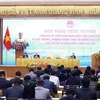
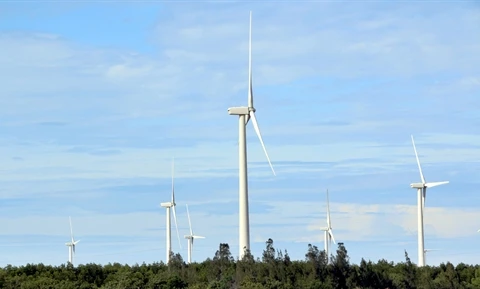
Vietnam renewable energy week opens ảnh 1Illustrative image (Source: VNA)

Can Tho (VNA) – The Vietnam Renewable Energy Week took place for the first time in the Mekong Delta city of Can Tho on November 15-16.

The event, co-hosted by the Steering Committee for the Southwestern Region, the Vietnam Sustainable Energy Alliance, and the Green Innovation and Development Centre (GIDC), featured an energy model exhibition, film screenings, two seminars on renewable energy development strategy for the Mekong Delta and practical initiatives for renewable energy.

Participating experts and scientists at home and abroad were updated on the development of the renewable energy industry and interacted with policymakers, businesspeople and activists from social organisations in the field.

Speaking at the event, member of the Steering Committee for the Southwestern Region Tran Huu Hiep said under the development goal until 2030 with orientations to 2050, the Mekong Delta is expected to become a centre for agro-fishery processing, electricity, support industry for agriculture, eco-tourism and services.

To that end, the region should not rely on only fossil fuel but have to seek new and green energy sources.

According to Hiep, the Mekong Delta holds the greatest potential of biomass energy thanks to its abundant amount of agricultural by-products, including straw, bran, risk husk and cattle droppings.

More than 20 million tonnes of straw are being wasted each year since over 70 percent of them are burnt.

In 2013, the Ministry of Industry and Trade issued a decision approving a master plan for biomass power development for the Mekong Delta until 2030 when 300MW of electricity will be generated from straw, sugar cane bagasse and husk.

GIDC Director Nguy Thi Khanh suggested more incentives be provided for investment in renewable energy while the construction on new thermoelectric coal and nuclear power plants be stopped.-VNA
VNA

See more

Engineers and workers carry out construction activities at sea. (Photo: VNA)

Hon Khoai transport project gathers pace despite rainy season challenges

Together with the Ca Mau – Cai Nuoc and Cai Nuoc – Dat Mui expressway projects, the Hon Khoai route forms part of a trio of key infrastructure developments expected to strengthen regional connectivity, boost economic growth and reinforce the safeguarding of Vietnam’s southwestern maritime frontier once completed.

Prime Minister Le Minh Hung (right) and S. Kudryashov, General Director of Zarubezhneft (Photo: VNA)

Prime Minister meets leaders of major Russian enterprises

During his meeting with Rosatom Director General Alexey Likhachev, PM Hung expressed his sincere thanks for the cooperation, support, and significant contributions of Rosatom and the Russian side to the development of Vietnam's atomic energy sector over the past four decades.

Delegates at the seminar in Bangkok on June 17. (Photo: VNA)

Thanh Hoa seeks stronger cooperation with Thai businesses

Mai Xuan Liem, Permanent Vice Chairman of the Thanh Hoa People’s Committee, said Thailand is one of the province’s important export markets, with export turnover reaching more than 12 million USD in the first five months of 2026.

Delegates press the button to officially launch the Doan Hung Industrial Park – AMATA City Phu Tho project at the conference. (Photo: VNA)

Vietnam, Thailand strengthen investment ties, smart city cooperation

Thailand is currently Vietnam's largest trading partner within ASEAN, while Vietnam ranks as Thailand's sixth-largest trading partner globally. Bilateral trade reached 22.07 billion USD in 2025, with both sides aiming to increase the figure to 25 billion USD in the coming years. Thailand also has 805 valid investment projects in Vietnam with a combined registered capital of 15.4 billion USD.

Deputy Prime Minister Nguyen Van Thang speaks at the meeting with ministries and sectors in Hanoi on June 17 to review public investment disbursement and address bottlenecks affecting ODA projects. (Photo: VNA)

Deputy PM requests faster disbursement of ODA-funded projects

As of June 15, the disbursement rate for public investment funded by external sources had reached only 9.99% of the assigned plan. Although the figure was higher than in the same period last year, it remained well below the national average. Notably, one out of eight ministries and central agencies and 13 localities had yet to disburse any allocated capital.

Sorting green-skinned pomelos for export at the processing facility of Vina T&T Group in Vinh Long province. (Photo: VNA)

Vietnamese fruits strengthen foothold in China

The expansion of fruit trade has been supported by the implementation of the Regional Comprehensive Economic Partnership (RCEP) and ongoing efforts to upgrade the China – ASEAN Free Trade Area.

Production line for camera modules and electronic components at the factory of the Korean-invested MCNEX VINA Co., Ltd, located in Phuc Son Industrial Park, Ninh Binh province. (Photo: VNA)

High-tech FDI attraction set as strategic priority: official

The resolution sets out a number of specific targets for foreign investment attraction during the 2026–2030 period. Annual registered FDI is targeted at between 40 billion USD and 50 billion USD, while realised capital is expected to reach approximately 30–40 billion USD per year.

Production of electronic components at DBG Technology Vietnam Co., Ltd. in Yen Binh Industrial Park, Thai Nguyen province. (Photo: VNA)

Vietnam’s trade surplus with EU expands amid economic headwinds

Trade between Vietnam and the EU maintained momentum during the January–May period, supported by the EU – Vietnam Free Trade Agreement (EVFTA) and sustained demand for key Vietnamese exports, even as the EU grappled with inflationary pressures and sluggish consumer spending.

Containers are unloaded at Nghi Son International Port in Nghi Son ward, Thanh Hoa province. (Photo: VNA)

Vietnam eyes to shape national maritime industrial ecosystem

These advantages provide a strong foundation for the development of the marine economy and logistics services. As a result, the marine economy has been identified as a national strategic priority, with the coordinated development of maritime transport, seaports and shipbuilding serving as a key pillar in shaping a sustainable national maritime industrial ecosystem.