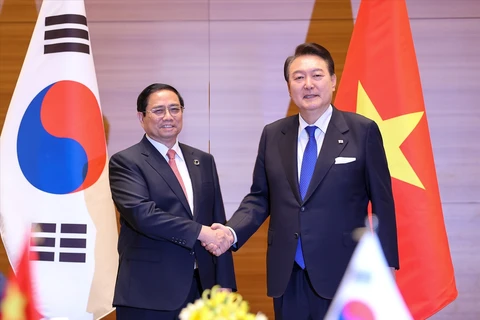
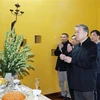
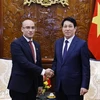
President of the Republic of Korea (RoK) Yoon Suk Yeol. (Photo: VNA)
 Seoul (VNA) - President of the Republic of Korea (RoK) Yoon Suk Yeol and his wife Kim Keon Hee will pay a state visit to Vietnam from June 22-24 at the invitation of President Vo Van Thuong. On this occasion, President Yoon Suk Yeol granted an interview to the Vietnam News Agency.
Following is the full text of the interview.
Reporter: After three decades of establishing diplomatic relations, Vietnam and the RoK officially elevated their relations to the level of “Comprehensive Strategic Partnership” in December 2022. As the President of the RoK, how do you evaluate the new dimensions and content of this partnership in terms of bilateral cooperation?
President Yoon Suk Yeol: Over the three decades since the establishment of diplomatic relations in 1992, our two countries have built an exemplary, mutually beneficial partnership on all fronts. It is important for us to develop more qualitative, future-oriented bilateral relations that adjust to volatile internal and external environments, rather than settle for what has already been achieved.
In this context, our two countries upgraded bilateral relations to a “Comprehensive Strategic Partnership” on the occasion of the 30th anniversary of diplomatic ties last year. This demonstrates how committed our two countries’ governments and peoples are to solidarity, broadening the scope of cooperation and deepening bilateral exchanges.
First of all, I intend to strengthen security cooperation with Vietnam, so a rules-based order will be able to take firm root in the Indo-Pacific region. The RoK will continue to cooperate with Vietnam in maritime security. Moreover, I hope that cooperation in the defence industry will be further expanded based on the RoK’s technological prowess which has a proven track record in the global market.
Forward-looking cooperation between the RoK and Vietnam will also be stepped up to ensure that our two countries can prosper together. We will continue to support VKIST, or the Vietnam-Korea Institute of Science and Technology, in order for it to establish itself as Vietnam’s center for scientific and technological development. The creation of this institute marks the RoK government’s single largest grant project. In particular, a new grant aid project will be announced on the occasion of my upcoming state visit to help Vietnam bolster its ability to conduct research in the fields of science and technology.
The world is confronting a polycrisis on a level unlike any before. The RoK and Vietnam should navigate through these challenges together. The Korean and Vietnamese governments are placing a special focus on critical minerals supply chains, energy, digital transformation, smart cities and climate change responses when it comes to future cooperation.
This year marks the spirited beginning of the “Comprehensive Strategic Partnership” between our two countries. I hope that my state visit to Vietnam in this meaningful year will serve as a catalyst for opening a new chapter of bilateral cooperation.
Reporter:Since the establishment of diplomatic relations in 1992, the RoK and Vietnam have made remarkable progress in various fields, particularly in the economic domain. Could you kindly provide insights on the RoK government’s future plans to expand economic cooperation and investment with Vietnam?
President Yoon Suk Yeol: In December last year, the Vietnamese President and I presented our goal of achieving 150 billion USD in trade by 2030, but bilateral trade could not avoid negative growth this year due to the global economic downturn. As part of our efforts to restore the dynamism of bilateral trade, I will travel to Vietnam with a large business delegation.
Vietnam is a key partner in the RoK’s Indo-Pacific strategy, and we need to further deepen and expand the extent of our primarily manufacturing-focused bilateral cooperation into finance, the retail industry, IT, cultural content and other service sectors. The means of cooperation should also aim for a horizontal division of labor, playing off each other’s strengths. Cooperation to help Vietnam develop its industrial technology will be significantly enhanced.
No less important is to work together for such future agendas as carbon neutrality by 2050 and the digital transformation. I hope that our two countries’ future generations will become key actors for such future agendas.
Reporter: The RoK has been implementing key foreign policies, namely the Global Pivotal State (GPS) vision and Korea-ASEAN Solidarity Initiative (KASI)… Could you please elaborate on potential cooperation between Vietnam and the RoK in policy coordination on both bilateral and multilateral aspects?
President Yoon Suk Yeol: Until his last moments, President Ho Chi Minh, the beloved father of the Vietnamese nation, remained occupied with the desire for the country to become independent, people to enjoy freedom, and everyone to have food to eat, dress to wear, and school to attend. And now – as it pursues world peace and active international cooperation – Vietnam is moving toward its goal of being ranked among the developed countries by 2045.
Vietnam’s goals are in line with the Korea-ASEAN Solidarity Initiative (KASI) that I announced last November at the ASEAN-Republic of Korea Summit in Phnom Penh, Cambodia, as part of the RoK’s efforts to realise its Global Pivotal State vision.
The RoK government’s GPS vision echoes our determination to contribute more actively in the region and international community by playing a role that’s commensurate with our elevated national power and status. Accordingly, we intend to explore creative ways for cooperation and work closely together with Vietnam – our comprehensive strategic partner – in order to contribute to peace and prosperity in the international community through multilateral organizations and consultative bodies, including the United Nations, APEC and P4G.
My upcoming visit to Vietnam will be the first bilateral visit to a Southeast Asian country since my inauguration as President. First and foremost, my visit this time is significant as it marks the full-fledged implementation of the KASI with Vietnam, the RoK’s key partner.
In particular, the RoK aims to enhance substantive and forward-looking cooperation with ASEAN and the Mekong region. Based on respect for ASEAN Centrality and the needs of ASEAN, the RoK will expand substantive cooperation in such future-oriented fields as digital transformation, climate change responses and healthcare and medical services. Furthermore, we will expand strategic cooperation in areas of mutual interest between the RoK and ASEAN, including maritime security and the defense industry. In addition, we will continue to provide support for Vietnam’s priorities like developing the Mekong region while narrowing the development gaps within it.
As a way of expressing our strong commitment to strengthening ASEAN-RoK relations, I hope to upgrade those relations to a comprehensive strategic partnership on the occasion of the 35th anniversary of the establishment of our dialogue partnership next year. To this end, after the ASEAN-Republic of Korea Summit scheduled for September this year, the RoK will submit a proposal containing the RoK government’s specific plans to ASEAN.
I am deeply grateful to Vietnam – the country coordinator for ASEAN-RoK dialogue – for carrying out its role as a bridge between the two sides in an exemplary manner. Both with the KASI’s implementation going forward and with the establishment of a comprehensive strategic partnership between the RoK and ASEAN next year, I look forward to communicating and cooperating more closely with Vietnam. Through this, I believe that our two countries can contribute even more to peace and prosperity in the Indo-Pacific region including ASEAN.
Reporter: Vietnam and the RoK share many historical and cultural similarities, which have greatly contributed to the robust development of people-to-people exchanges between the two countries over the past three decades. Could you please shed light on the RoK government’s upcoming policies aimed at promoting people-to-people exchanges and the exchange of human resources between our two nations?
President Yoon Suk Yeol: Since my father contributed to people-to-people exchanges between our two countries, this state visit to Vietnam is very personally meaningful to me. He was convinced that exchanges between future generations are important for the development of bilateral relations and sought to contribute to our academic exchanges in 1993 – right after the establishment of diplomatic relations – by enrolling students from National Economics University in Hanoi and University of Economics Ho Chi Minh City in Yonsei University’s Graduate School of International Studies.
 The Vietnamese Culture Festival is held annually in Seoul, the RoK. (Photo: VNA)
 Over the past 30 years, people-to-people exchanges between the two countries have exploded thanks to all levels of society in both countries making invaluable efforts. Before the outbreak of COVID-19, nearly 5 million people from both countries visited the other annually via more than 500 direct flights every week. Needless to say, it was the biggest people-to-people exchange that the RoK has ever experienced with a Southeast Asian nation.
Even last year after we regained our normal daily lives, Koreans made up the largest number of international visitors to Vietnam. Vietnam is said to be Koreans’ most popular overseas tourist destination this summer. Korean people have grown so familiar with rice noodles, bun cha and Vietnamese coffee as to consider them parts of everyday life.
Around 170,000 Koreans currently reside in Vietnam – the largest Korean presence in Southeast Asia. The number of households with both Koreans and Vietnamese in Vietnam also reached 6,500. More than 80,000 Korean-Vietnamese multicultural families live in the RoK. Since Ly Long Tuong, a descendant of the Ly Dynasty in Vietnam, came to the Goryeo Kingdom, Korea and Vietnam have maintained an in-law relationship over the past 800 years of history. Now, it is no exaggeration to say that we are one family.
The RoK government will provide institutional support, so our people-to-people exchanges can become more vibrant. During my upcoming visit to Vietnam, Vietnam’s top leaders and I will put our heads together to find ways that will ensure that our two peoples can conveniently travel back and forth and lead safe and happy lives.
In particular, we will provide more support to expand exchanges between the next generations who will lead the future of our bilateral relations. More assistance will be offered to the youth of Vietnam, so they can receive high-quality Korean language education locally. Opportunities will be expanded to help more Vietnamese study in the RoK as well. I believe that when our future generations come to better understand and like each other, the future of bilateral relations will shine brighter./.