Vietnam seeks to improve livelihoods to end child labour

To reduce child labour, Vietnam has perfected the legal framework to protect children's rights and prevent this problem, and carried out various measures to improve people’s livelihoods.

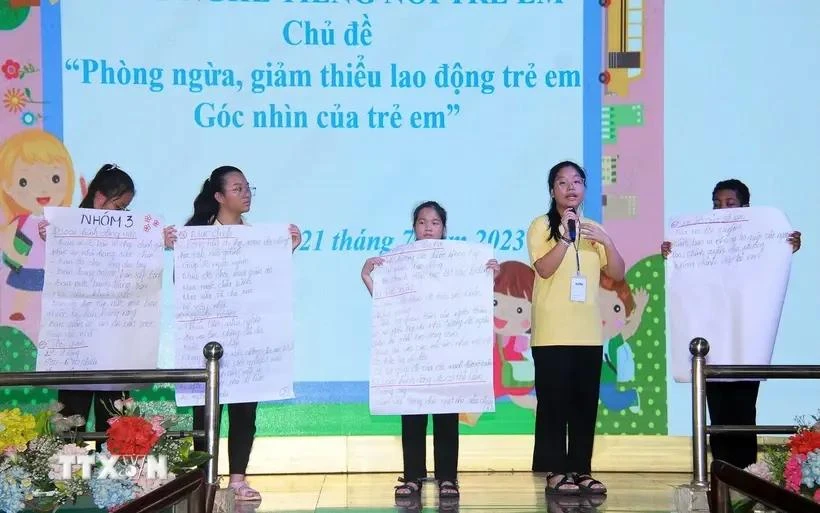
Children in difficult circumstances participate in a forum to listen to children's voices with the theme "Preventing and minimising child labour" (Photo: VNA)

Hanoi (VNA) - To reduce child labour, Vietnam has perfected the legal framework to protect children's rights and prevent this problem, and carried out various measures to improve people’s livelihoods.

A national report on child labour conducted by the Ministry of Labour, Invalids and Social Affairs (MOLISA) in 2020 showed that there were more than 1 million children involved in labour activities, mainly in agriculture, construction and services.

Children forced to work early are concentrated in rural and mountainous areas in the northern, Central Highlands and Mekong Delta regions, where economic conditions are less developed and access to education is limited. According to a report by the United Nations Children's Fund (UNICEF) in Vietnam, the rate of child labour in rural areas is nearly 4 times higher than in urban areas.

Experts said that there are many reasons why children have to work early, with the main reason being poverty. A report by the MOLISA shows that 70% of working children come from poor or near-poor families. The second reason is that some children cannot continue to go to school because they have to help their families make a living. According to UNICEF data, more than 20% of working children do not go to school or have to drop out of school early.

Dang Hoa Nam, Director of the MOLISA Department of Children’s Affairs, assessed that over the past decade, Vietnam has gained remarkable achievements in addressing child labour, establishing a solid legal framework to better suit international standards and implementing a number of programmes to reduce child labour at the central and local levels.

The Government has signed and ratified international conventions on children's rights and child labour combat. These include the International Labour Organisation (ILO)’s Convention on Minimum Age (C138) and Worst Forms of Child Labour Convention (C182). In addition, several national programmes to prevent and reduce child labour for the 2021 – 2025 period, with a vision to 2030 are being implemented to minimise this situation, including support of education and vocational training to improve living conditions for poor families.

child labour 2.webp
Children living in difficult circumstances study at Thien An charity school (Photo: VNA)

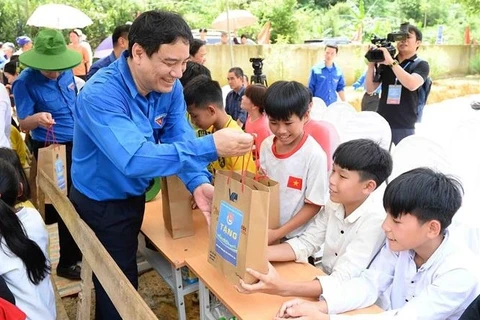
Every year, thousands of poor students, students in difficult circumstances, and orphans are given scholarships and tuition support to help them have the opportunity to continue studying. In 2023, the National Fund for Vietnamese Children granted 13,877 scholarships worth 9.4 billion VND (nearly 370,000 USD), and assisted 17,800 children living in difficult circumstances with a total cost of more than 20 billion VND.

According to experts, international cooperation is one of the most effective measures to help solve the main cause of the increase in child labour: poverty. International projects have focused on supporting the livelihoods of vulnerable families, helping children participate in labour appropriately and safely in accordance with laws.

For example, the Technical Support for Enhancing the National Capacity to Prevent and Reduce Child Labour in Viet Nam (ENHANCE) project, implemented in Hanoi, Ho Chi Minh City and the Mekong Delta province of An Giang since 2015, has brought about positive results.

After more than eight years, nearly 6,000 children have been supported with education and vocational training and nearly 550 children have received non-educational support such as health insurance. Some 1,600 households have received assistance to improve their livelihoods.

Experts assessed that over the past three decades, Vietnam has seen a lot of achievements in poverty reduction. The rate of child labour is 2% lower than the Asia Pacific region’s average. The country's efforts in reducing child labour have been recognised by the international community, including a positive assessment from the ILO.

The country is working to complete the Sustainable Development Goal (SDG) Target 8.7 towards eliminating child labour in all its forms by 2025./.
VNA

See more

NA Chairman Tran Thanh Man (left) and PM Le Minh Hung at the meeting with leaders of press agencies in Hanoi on June 14. (Photo: VNA)

NA, Government leaders meet with heads of press agencies

The press has taken a leading role in defending the Party’s ideological foundation, countering wrongful and hostile stances, and raising the volume and quality of mainstream information, contributing to a healthy, humane and responsible media environment, said NA Chairman Tran Thanh Man.

The UN Group of Friends for Combating Technology-facilitated Trafficking in Persons, makes its debut at a ceremony in New York on June 12 (Photo: VNA)

Vietnam joins UN group on combating technology-facilitated human trafficking

The ambassador affirmed that Vietnam attaches great importance to cooperation with countries, the UN, UNODC, and relevant partners in combating human trafficking. He also noted that the participation of several ASEAN countries as founding members reflects the region’s shared commitment to implementing the ASEAN Convention Against Trafficking in Persons, Especially Women and Children (ACTIP).

Prime Minister Le Minh Hung launches nationwide campaign for sustainable double-digit growth in Ho Chi Minh City on June 13. (Photo: VNA)

PM launches nationwide campaign for sustainable double-digit growth

Prime Minister Le Minh Hung called on ministries, sectors and localities to promptly translate the emulation movement into practical action plans and programmes, ensuring that emulation becomes not merely a campaign but a driving force for action, an ecosystem for discovering good models, replicating successful models and best practices.

NA Vice Chairwoman Nguyen Thi Thanh guides a student on how to use an English reading pen at the gift presentation event in Dien Bien province on June 12. (Photo: VNA)

NA Vice Chairwoman presents gifts to Dien Bien policy beneficiary families

Vice Chairwoman Nguyen Thi Thanh urged policy beneficiary families to carry forward revolutionary traditions, serve as role models for younger generations, and steer their children to follow Party’s guidelines and the State’s laws and policies, contributing to a more prosperous and civilised province.

The Vietnam Red Cross Society's members deliver gifts to needy people during the 2026 Humanitarian Month. (Photo courtesy of the VNRC)

Humanitarian Month raises nearly 762 billion VND

With the theme '80 Years - A Journey of Compassion for the Community', the campaign continues to affirm its role as a nationwide humanitarian initiative, mobilising participation across all levels, sectors, businesses, organisations, philanthropists and the general public to help those in difficult circumstances.

Participants of the 2026 Vietnam – China children’s exchange programme pose for a group photo (Photo published by VNA)

Vietnamese, Chinese children enhance mutual understanding, friendship

Participants gained deeper insights into the friendship between the revolutionary pioneers of Vietnam and China in their shared quest for national liberation, as well as a greater understanding that the achievements of national reunification in both countries were hard won and that the friendly neighbourly relationship and cooperation between them is of great value.

Border guards from Quang Tri and Khammouane provinces in the joint patrol (Photo: baochinhphu.vn)

Vietnam, Laos conduct joint patrol along shared border

Quang Tri and Laos’ Khammouane province agreed to strictly adhere to legal documents on border management, maintain delegation exchanges at all levels, increase cooperation in crime prevention and control, search and rescue, and run public awareness campaigns to encourage border residents to comply with border and border gate management regulations.

Students take Literature test (Photo: VNA)

Over 1.2 million students begin national high school graduation exam

Under the current examination format, candidates are required to complete the mandatory Literature and Mathematics tests, along with a combined test comprising two subjects selected from a range of options, including Physics, Chemistry, Biology, Informatics, Foreign Languages, History, Geography, Technology-Industry, Technology-Agriculture, and Economics-Law. Students may also choose to take a foreign language different from the one studied at school.