Vietnam to boost forest coverage in Central Highlands

The Government of Vietnam has been implementing drastic measures to increase forest coverage in the Central Highlands region, while improving output of coffee and high value crops in easing deforestation.
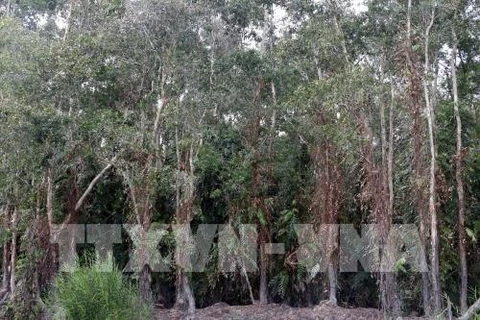
Vietnam to boost forest coverage in Central Highlands ảnh 1A corner of forest in the Central Highlands region of Vietnam (Photo: VNA)

Da Nang (VNS/VNA) - The Governmentof Vietnam has been implementing drastic measures to increase forest coveragein the Central Highlands region, while improving output of coffee and highvalue crops in easing deforestation.

Tran Dai Nghia, an official from the environmentaleconomics studies and policy institute, under the ministry of agriculture andrural development, made the comments at the Good Growth Partnership-side eventat the 6th Global Environment Facility (GEF) Assembly held in Da Nang.

Nghia said the government has asked localadministrations, ministries and relevant agencies to rearrange current coffeeplantations to stop encroachment on forest areas.

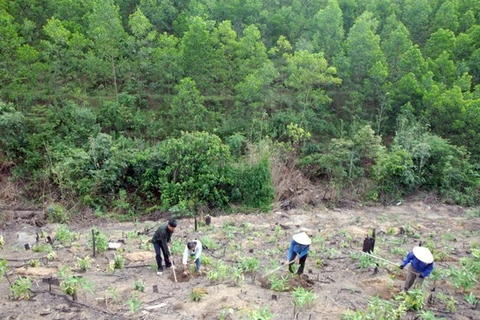
“The government firmly reallocated forestarea that had been cleared for coffee plantations, and restored the forestarea. It has planned to replant 120,000ha of coffee between 2014-20,” Nghiasaid.

“Vietnam wants to improve the quality andproductivity of coffee by limiting land clearance in forest areas, whileincreasing the application of technology to maximise harvests,” he said.

Nghia also said profitable crops have beenchosen to alternate in poor quality coffee areas, while focusing on brandbuilding as well as joining global value chains for worldwide export.

Coffee farms were encouraged to make use ofthe landscape with large green coverage (the shadow of coffee plants could actas forestation in areas that lack trees) for sustainable development.

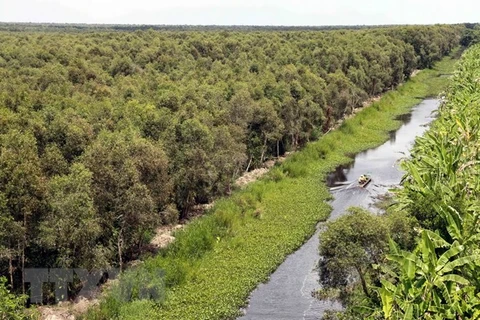
According to the latest report from theministry, the current coffee farm area (583,000ha) exceeds the 2020 plan(530,000ha), while forested areas account for just 2.5 million hectares (45.8 percentof coverage) in the Central Highlands region.

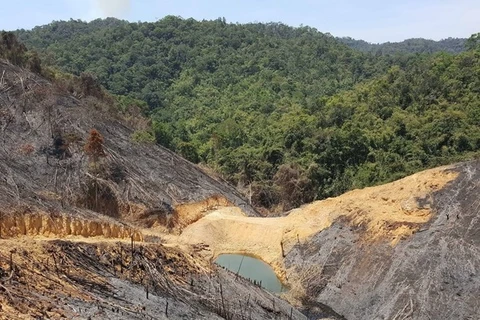
The region loses 34,000ha of forest eachyear due to illegal logging and land clearance for short-term profitable crops(coffee, rubber or acacia).

The ministry also said the forested areahad dropped by 180,000ha, of which 112,000ha had been destroyed or occupied byexpansion of other crops, and 37,000ha for hydro-power plants and roads,between 2010-15.

[Infographics: Vietnam strives to raise forest coverage to 42 percent]

Vietnam, which is the world’s secondlargest coffee exporter, has offered favourable conditions for ‘green’ growthcoffee enterprises, as well as involvement private and public partners, globalcoffee growers and producers in discussions for more effective policy making.

A series of side events related to greengrowth, mangrove forests, nature based resilience solutions to climate change,wildlife and environmental protection, recycling and waste treatment willcontinue through June 28.

Also represented at the GEF, a community ofthe ethnic Co Tu group living in suburban Hoa Bac commune of Da Nang, hasbenefited from a community-based eco-tourism and culture preservation projectin 2017-18 with 88,000 USD of funding from GEF’s Small Grant Programme.

The project aimed to improve thelivelihoods of the community, while protecting biodiversity in the buffer zoneof the Ba Na-Nui Chua nature reserve.

Vietnam, which joined the GEF in 1994, hasreceived sponsorships for 107 projects, worth 457 million USD in dealing withenvironment problems at the local level.

The country has been allocated a fund of 26million USD in fields of climate change, biodiversity and soil degradation fromGEF.

Since 1991, the GEF has provided over 17.9billion USD in grants and mobilised an additional 93.2 billion USD inco-financing for more than 4500 projects in 170 countries.

Through its Small Grants Programme (SGP),the GEF has invested 450 million USD and leveraged similar levels of cofinancing to support over 14,500 community based projects in over 125countries.

Da Nang has been chosen to implement anAsia Pacific Economic Cooperation (APEC) low-carbon model town project to boostthe use of battery-powered bikes; technology to curb greenhouse gas emissionsand use renewable energy sources.

The city, which had already cut 12,000tonnes of carbon emissions through a pilot project between 2008-11, plans tocut greenhouse gas emissions by 25 percent in 2030 in comparison to 2016.-VNA
VNA
See more

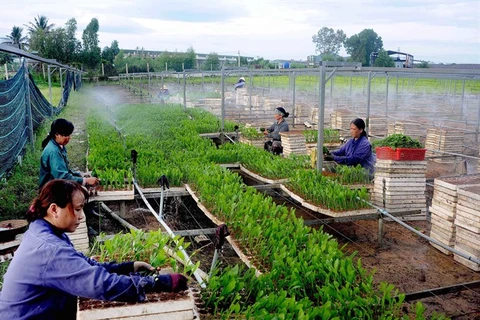
Vietnam is exerting efforts to cope with climate change. (Illustrative photo: VNA)

Vietnam approves carbon credit pact with Singapore under Paris Agreement

Signed on September 16, 2025, the Implementation Agreement on carbon credits collaboration under Article 6 of the Paris Agreement on climate change affirms Vietnam and Singapore’s pioneering role and commitment to close cooperation in the international carbon market, making a substantive contribution to global climate response.

A view of Vo Cuong ward, Bac Ninh province (Photo: VNA)

Bac Ninh earmarks over 1.7 billion USD for environmental protection

By 2030, Bac Ninh aims to ensure that all operating industrial clusters and industrial parks have centralised wastewater treatment systems meeting standards, while at least 95% of wastewater in Grade-I urban areas and 70% in Grade-II urban areas is collected and treated to required standards.

Many inland canals in Can Tho city dries up following a prolonged period of extreme heat. (Photo: VNA)

Government adopts action programme on environmental protection, climate resilience

The programme aims to translate the Party's orientations into concrete actions while strengthening environmental governance, enhancing climate resilience, and promoting a green, circular and low-carbon economy. It will serve as the basis for ministries, sectors and localities to formulate implementation plans for the 2026–2030 period, with a vision to 2045.

Dray Sap Waterfall lies within the UNESCO Dak Nong Global Geopark in Nam Da commune, Lam Dong province. (Photo: VNA)

Lam Dong steps up efforts to retain UNESCO global geopark status

Covering nearly 4,760 square kilometres across 22 communes and wards in western Lam Dong (equivalent to 73.1% of the former Dak Nong province's natural area), the geopark was shaped by millions of years of geological activity and successive volcanic eruptions.

A stump-tailed macaque (Macaca arctoides) is handed over to the Cam Lo–Dong Ha forest ranger station in Quang Tri province on January 27, 2026 (Photo: VNA)

Rare primate handed over to Phong Nha - Ke Bang National Park

A stump-tailed macaque (Macaca arctoides) was handed over to the Centre for Rescue, Conservation, and Development of Creatures under the Management Board of Phong Nha - Ke Bang National Park in Quang Tri province on July 21, for rehabilitation and eventual release into the wild.

Two Red Lories (Eos rubra) found among the 104 wild animals being kept without documentation proving their lawful origin in Phuoc Thanh commune, Tay Ninh province. (Photo published by VNA)

Criminal proceedings launched against case of illegal keeping, trading of 104 wild animals

They recorded a total of 104 wild animals, comprising 92 African spurred tortoises (Geochelone sulcata) of various sizes, six Red Lories (Eos rubra) and six Green-cheeked Parakeets (Pyrrhura molinae). Authorities said the animals are subject to management under Vietnam's forestry legal regulations and are listed in Appendix II of the Convention on International Trade in Endangered Species of Wild Fauna and Flora (CITES).

BUYO Bioplastics' biodegradable plastic products are made from brewer's grains and sugarcane bagasse. (Photo: nhandan.vn)

Vietnam urged to shift from plastic waste treatment to full life-cycle management

For years, efforts to tackle plastic pollution in Vietnam have focused mainly on waste collection, recycling and disposal. However, as sustainable development and green trade standards become increasingly important, specialists argued that a broader approach is needed, covering everything from product design and material selection to production, consumption and recycling.

Bang Mo volcano in Lam Dong province (Photo published by VNA)

Lam Dong optimises value of UNESCO Dak Nong Global Geopark

Alongside conservation, Lam Dong aims to tap the geopark's tourism potential through geological, ecological and community-based tourism. Infrastructure and tourism development projects must ensure that heritage values, landscapes and the natural environment are preserved.

Dr. Dang Trung Phuoc (left) is introducing the history and origin of the Pinhey sand dunes (Photo: VNA)

Vietnamese Canadian scientist revives forgotten ecosystems

From restoring an ancient sand dune ecosystem in Canada to promoting the conservation of Vietnam's coastal dunes, native forests and ecological corridors, Vietnamese-born scientist Dang Trung Phuoc has remained committed to using science to revive ecosystems long misunderstood or neglected. His quiet but sustained efforts reflect both a scientist's responsibility to the communities he serves and the enduring commitment of a Vietnamese expatriate to his homeland.

Police and military forces work together to rescue people and assist local residents in affected areas. (Photo: VNA)

PM orders proactive response to heavy rainfall in northern mountainous region

To minimise casualties and damage to public and private property, the PM instructed ministries, sectors and local authorities to strictly implement directions issued by Party General Secretary and State President To Lam, as well as the Government's directives on strengthening disaster prevention and response in 2026.