Vietnam wants to learn from China’s railway construction experience: Deputy PM

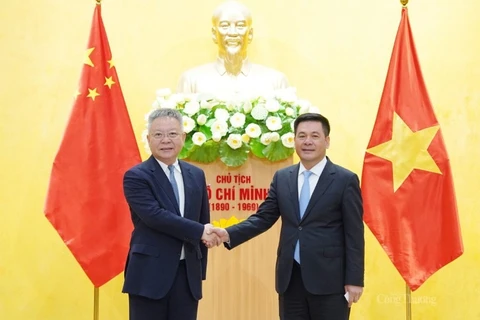
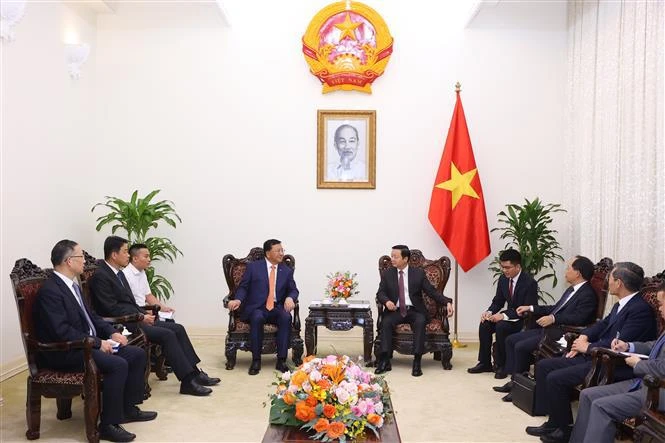
Deputy Prime Minister Tran Hong Ha received leaders of the China Railway Construction Corporation (CRCC) and the China Railway 16th Bureau Group Co., Ltd. (CRCC16) in Hanoi on October 11.

Deputy Prime Minister Tran Hong Ha (R) receives CRCC Chairman Dai He Gen (Photo: VNA)

Hanoi (VNA) – Deputy Prime Minister Tran Hong Ha received leaders of the China Railway Construction Corporation (CRCC) and the China Railway 16th Bureau Group Co., Ltd. (CRCC16) in Hanoi on October 11.

Ha expressed his hope that CRCC, one of China’s and the world’s leading construction conglomerates, can share its experience and transfer its knowledge on state-owned enterprise development and operational models, and advancements in science and technology.

In addition, the corporation can collaborate with Vietnamese partners and companies to implement smart transportation infrastructure projects between the two countries, thus serving as a model for cooperation and technology transfer.

Cooperation projects between CRCC and Vietnamese partners, once completed, will serve as a foundation for future investment cooperation of the corporation in Vietnam, using China’s top standards, regulations, design thinking, and operational models, he added.

CRCC Chairman Dai He Gen showed his desire for close collaboration with the Vietnam Railways Corporation and the Truong Son Construction Corporation to implement infrastructure projects in Vietnam.

He emphasised CRCC’s willingness to expand cooperation beyond railways, roads, and subways, expressing interest in seaport and airport construction, green energy development, and the use of new, environmentally friendly technologies and materials.

CRCC is currently ranked 42nd on the Fortune Global 500 list, operating in over 140 countries and territories. The company has designed and built more than 50% of China’s high-speed rail and normal rail networks, over 40% of its urban railway systems, and 30% of its expressways.

In Vietnam, it has been involved in projects such as the modernisation and renovation of Vietnam’s railway signaling system, the supply of railway materials, and the planning of the Lao Cai-Hanoi-Hai Phong railway route, through its Design Institute 5./.
VNA

See more

Workers process clams for export at the factory of Thanh Hoa Fishery Import-Export JSC in Thanh Hoa province. (Illustrative photo: VNA)

Vietnam notifies WTO committee of goods origin management reforms

The information presented by Vietnam attracted attention from others WTO members amid global efforts to accelerate the digital transformation of import – export procedures and improve the implementation of rules of origin to enhance supply chain adaptability.

A Petrolimex worker refuels a motorbike. (Photo: VNA)

Energy imports surge in first quarter of 2026

Data from Vietnam Customs shows that the country spent approximately 2.93 billion USD importing nearly 3.37 million tonnes of petroleum products in the first quarter of 2026, an increase of 77.8% in value and over 44% in volume compared to the same period last year.

A perspective of the Quang Ninh 1 Wind Power Plant project (Photo: Quang Ninh provincial Department of Construction)

Quang Ninh gives nod to first offshore wind power plant

The project is expected to have a designed capacity of 50 MW and will be implemented in nearshore waters of the Co To special zone. It will be the first offshore wind power project in the province, playing a pioneering role in tapping Quang Ninh’s abundant renewable energy potential.

Viettel launches the Unitel Logistics brand in Laos. (Photo: VNA)

Vietnamese firms expand global footprint

The Government recently approved the “Go Global” programme for 2026-2030, which identifies the private sector as a key driving force in Vietnam’s international expansion process. It aims to help Vietnamese private enterprises strengthen their overseas presence in a comprehensive, effective and sustainable manner through international investment, business activities and deeper integration into regional and global supply and value chains.

Vietnam and Cambodia are seeking to strengthen supply chain connectivity and promote sustainable border trade at a trade promotion conference in Vietnam's Mekong Delta province of Dong Thap on May 15. (Photo: https://thoibaonganhang.vn/)

Vietnam, Cambodia eye stronger border trade, supply chain connectivity

Vietnam–Cambodia trade ties have grown rapidly in recent years, becoming one of the major pillars of economic cooperation in the Mekong sub-region. The two countries share a 1,137-km border and an increasingly developed network of international and secondary border gates, facilitating cross-border trade, logistics and investment.

Illustrative image. (Photo: VNA)

Three proposals to connect overseas Vietnamese resources with private economy at home

There are currently many Vietnamese IT specialists working in technology corporations, banks, start-ups and innovation ecosystems across Canada. With appropriate mechanisms in place, this workforce could become a technology bridge, helping Vietnamese enterprises access management expertise, technical solutions, international standards and partnership networks in North America.

The Nguyen Van Linh–Nguyen Huu Tho intersection fully opens both underpasses to traffic, helping ease congestion in the area. (Photo: VNA)

Ho Chi Minh City pushes for full public investment disbursement

Ho Chi Minh City was allocated a record 147.599 trillion VND (5.6 billion USD) in public investment capital for 2026, up 22.6% from last year and accounting for nearly 14.6% of the nation’s total public investment budget. However, disbursement by the end of April remained below the national average.

Visitors explore Quang Tri province’s OCOP products (Photo: VNA)

Quang Tri links OCOP products with tourism to expand farm produce markets

The central province currently has 160 OCOP products developed by cooperatives, cooperative groups and businesses, including two five-star and 31 four-star products. These locally distinctive products are gradually becoming "ambassadors" showcasing Quang Tri’s culture and identity to domestic and international visitors.