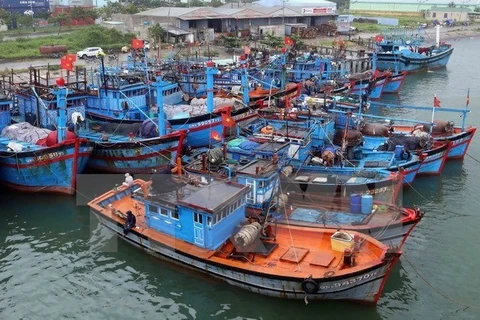
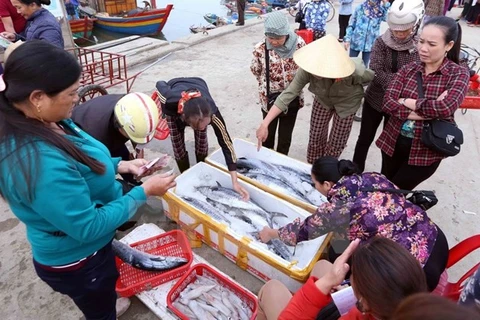
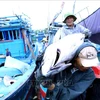
A fisherman and his catch off the coast of Nam Dinh province (Photo: VNA)
 Hanoi (VNA) - Vietnam has been actively working to implement the European Commission (EC)’s recommendations since it announced a yellow card on Vietnamese fisheries on October 23 last year.
According to Vu Van Tam, Deputy Minister of Agriculture and Rural Development, the issuance of the EC’s illegal, unreported and unregulated fishing (IUU) yellow card has gained positive results as the number of illegal fishing vessels has decreased.
The central coastal province of Khanh Hoa is one of several key provinces for tuna fishing with a large offshore fishing fleet. Being aware of the issue of illegal fishing, the province has tried drastic solutions as well as disseminated information among its fishermen to understand and practise responsible fishing.
Vo Khac En, Deputy Director of the Khanh Hoa Fisheries Sub-Department, said IUU fishing in the province was rare. However, after several cases of illegal fishing were reported recently in the adjacent areas, the sub-department immediately informed the fishermen about the range and geographic coordinates within which fishing was permitted.
“When the fishing vessel returns to the port, the sub-department sends its staff to the port to get information. If the fishing vessel is found to have violated any norm, it will not be granted fishing permit and will not get State preferences. In fact, the fishing vessel will be recovered permanently if it violates fishing norms a second time,” said En.
Quang Trong Thao, Deputy Director of the Department of Agriculture and Rural Development of Kien Giang province, said after the Prime Minister signed the official letter 732/CĐ-TTg on preventing, minimising and stopping Vietnamese fishing vessels and fishermen from illegally fishing in foreign seas, the provincial People’s Committee had drastically implemented the directive.
The department has actively cooperated with Border Guards, provincial police and local authorities to patrol and examine and handle violations to prevent illegal fishing vessels and fishermen in foreign waters.
The department has also set up teams to disseminate information and raise awareness among fishermen, in compliance with Vietnamese and foreign laws, of exploiting marine products and not infringing upon foreign waters.
Tam said along with official letter 732, the Prime Minister also issued Instruction 45 on urgent solutions to have the yellow card withdrawn within six months (before April 23, 2018). The ministry has also proposed suggestions to revoke the yellow card.
Institutional improvement based on the newly revised Fisheries Law has incorporated most of EC’s recommendations on IUU. These include regulations on IUU fishing activities and strict sanctions placed on ship owners and captains, with seven times higher penalty than the value of illegally exploited fisheries (individuals may be fined up to 1billion VND), regulations on the withdrawal of fishing licences for individuals and organisations that illegally exploit foreign seas, regulations for non-reissuance of fishing licences to organisations and individuals that have fishing vessels on the IUU list and those without control equipment for fishing activities.
In addition to these, legal normative documents have also been developed to integrate regulations in line with international rules, such as Food and Agriculture Organisation (FAO)’s Code of Conduct for Responsible Fisheries, FAO’s international plan of action against IUU, FAO Agreement on Port State Measures to Prevent, Deter and Eliminate IUU fishing and measures taken by the coastal countries to ensure that legal documents are effective at the same time as the 2017 revised Fisheries Law, which will come into effect on January 1, 2019.
Meanwhile, Vietnam has promoted training for fishermen, ship owners and enterprises as well as the State management system of aquatic resource exploitation, making them aware about the impact of yellow cards on the reputation of Vietnamese seafood.
Tam said the country continued to focus on practical implementation, including actions of fishermen and ship owners, who must follow criteria such as noting diary, installing equipment for controlling fishing itinerary, sending reports to the fishing port management agency, identifying the origin of seafood to fight against IUU fishing and certificating export batches of seafood following the demand of the European Union and other markets.
“It is imperative that ships that are 15-24m high will have to install equipment for controlling fishing itinerary as regulated and remain open 24 hours a day for inspection,” said Tam.
Nguyen Thi Phuong Dung, Director of Directorate of Fisheries’ Scientific, Technological and International Cooperation Department, said another important solution was to expand international cooperation, including top-level negotiation with EC to review its nine recommendations, to learn from other countries on fighting against IUU fishing.
“We need to negotiate and cooperate with other countries, such as Papua New Guinea, Brunei and New Caledonia, on this issue and take part in international forums to affirm Vietnam’s efforts in combating IUU fishing,” Dung said.
Tam said the agriculture ministry’s leaders had recently visited almost all the island countries of the Pacific region to share information and build cooperation. “We have increased our participation in international forums to express the government’s view that it will never tolerate illegal fishing activities.”-VNA
According to Vu Van Tam, Deputy Minister of Agriculture and Rural Development, the issuance of the EC’s illegal, unreported and unregulated fishing (IUU) yellow card has gained positive results as the number of illegal fishing vessels has decreased.
The central coastal province of Khanh Hoa is one of several key provinces for tuna fishing with a large offshore fishing fleet. Being aware of the issue of illegal fishing, the province has tried drastic solutions as well as disseminated information among its fishermen to understand and practise responsible fishing.
Vo Khac En, Deputy Director of the Khanh Hoa Fisheries Sub-Department, said IUU fishing in the province was rare. However, after several cases of illegal fishing were reported recently in the adjacent areas, the sub-department immediately informed the fishermen about the range and geographic coordinates within which fishing was permitted.
“When the fishing vessel returns to the port, the sub-department sends its staff to the port to get information. If the fishing vessel is found to have violated any norm, it will not be granted fishing permit and will not get State preferences. In fact, the fishing vessel will be recovered permanently if it violates fishing norms a second time,” said En.
Quang Trong Thao, Deputy Director of the Department of Agriculture and Rural Development of Kien Giang province, said after the Prime Minister signed the official letter 732/CĐ-TTg on preventing, minimising and stopping Vietnamese fishing vessels and fishermen from illegally fishing in foreign seas, the provincial People’s Committee had drastically implemented the directive.
The department has actively cooperated with Border Guards, provincial police and local authorities to patrol and examine and handle violations to prevent illegal fishing vessels and fishermen in foreign waters.
The department has also set up teams to disseminate information and raise awareness among fishermen, in compliance with Vietnamese and foreign laws, of exploiting marine products and not infringing upon foreign waters.
Tam said along with official letter 732, the Prime Minister also issued Instruction 45 on urgent solutions to have the yellow card withdrawn within six months (before April 23, 2018). The ministry has also proposed suggestions to revoke the yellow card.
Institutional improvement based on the newly revised Fisheries Law has incorporated most of EC’s recommendations on IUU. These include regulations on IUU fishing activities and strict sanctions placed on ship owners and captains, with seven times higher penalty than the value of illegally exploited fisheries (individuals may be fined up to 1billion VND), regulations on the withdrawal of fishing licences for individuals and organisations that illegally exploit foreign seas, regulations for non-reissuance of fishing licences to organisations and individuals that have fishing vessels on the IUU list and those without control equipment for fishing activities.
In addition to these, legal normative documents have also been developed to integrate regulations in line with international rules, such as Food and Agriculture Organisation (FAO)’s Code of Conduct for Responsible Fisheries, FAO’s international plan of action against IUU, FAO Agreement on Port State Measures to Prevent, Deter and Eliminate IUU fishing and measures taken by the coastal countries to ensure that legal documents are effective at the same time as the 2017 revised Fisheries Law, which will come into effect on January 1, 2019.
Meanwhile, Vietnam has promoted training for fishermen, ship owners and enterprises as well as the State management system of aquatic resource exploitation, making them aware about the impact of yellow cards on the reputation of Vietnamese seafood.
Tam said the country continued to focus on practical implementation, including actions of fishermen and ship owners, who must follow criteria such as noting diary, installing equipment for controlling fishing itinerary, sending reports to the fishing port management agency, identifying the origin of seafood to fight against IUU fishing and certificating export batches of seafood following the demand of the European Union and other markets.
“It is imperative that ships that are 15-24m high will have to install equipment for controlling fishing itinerary as regulated and remain open 24 hours a day for inspection,” said Tam.
Nguyen Thi Phuong Dung, Director of Directorate of Fisheries’ Scientific, Technological and International Cooperation Department, said another important solution was to expand international cooperation, including top-level negotiation with EC to review its nine recommendations, to learn from other countries on fighting against IUU fishing.
“We need to negotiate and cooperate with other countries, such as Papua New Guinea, Brunei and New Caledonia, on this issue and take part in international forums to affirm Vietnam’s efforts in combating IUU fishing,” Dung said.
Tam said the agriculture ministry’s leaders had recently visited almost all the island countries of the Pacific region to share information and build cooperation. “We have increased our participation in international forums to express the government’s view that it will never tolerate illegal fishing activities.”-VNA
VNA