Hanoi (VNA) – The Vietnamese and Chinese youth from across generations are actively playing the role of cultural ambassadors, building up the bridge of friendship between the two nations.
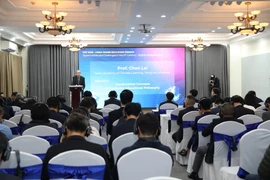
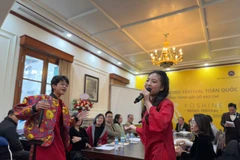
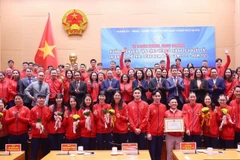
At a gathering of generations of Vietnamese and Chinese students held in Hanoi on March 20, alumni member MA Tran Thien Tu captivated the audience with a moving performance of the Vietnamese folk song "Beo Dat May Troi", elegantly sung in Chinese.
Once a famous child actress, Tran Thien Tu, a Vietnamese woman passionate about the Chinese language and culture, has gained widespread popularity on social media, particularly on TikTok, where she performs Vietnamese songs with Chinese lyrics.
Gifted in both languages and the arts, Tu received a scholarship to Shandong Art Institute in China after graduating from high school in 2009. In 2010, after returning to Vietnam to study at the University of Languages and International Studies under the Vietnam National University, Hanoi (VNU Hanoi), she won first prize in the 9th Chinese Bridge competition. In 2011, she secured a full-funded scholarship to gain a Bachelor’s degree on language and culture at the Chinese Language and Culture College of the Beijing Normal University. She later chose to study at the Central Academy of Drama in China to deepen her understanding of the Chinese culture and performing arts.
During the COVID-19 pandemic in 2021, she launched her TikTok channel, sharing videos of her performing famous Vietnamese songs in Chinese, aiming to connect with audiences passionate about music and translation. With her stage name “Tu Man Thau” (Tu the steamed bun), she quickly became beloved for her charming voice, endearing style, and meticulous lyric translations. Her videos always feature lyrics in Chinese characters, pinyin, with Vietnamese subtitles.
Speaking at the gathering, Thien Tu expressed hope of being a small brick in the foundation of a great bridge connecting the two nations.
Also at the event, Dr. Huang Xiao Long, a linguist, shared her aspiration to contribute to fostering the Vietnam - China friendship. Originally from Guangxi, which borders Vietnam, she has long admired the elegance and grace of Vietnamese women in their Ao Dai (Vietnam’s traditional long dress).
In 2009, she came to Vietnam under an academic exchange programme between the Guangxi University for Nationalities and the University of Social Sciences and Humanities, VNU Hanoi. She pursued a Master’s degree in 2011 and later earned a doctorate in 2018 from the same institution.
Having spent years living in Hanoi, Long has witnessed the city’s transformation firsthand. Upon returning to China, she intends to continue her career in education, teaching Vietnamese to Chinese students. She hopes to inspire young generations to uphold the Vietnam - China friendship, thus contributing to solidarity in Asia-Pacific.
Another inspiring story is that of Bao Shen (born in 2003), a student at the University of Social Sciences and Humanities, VNU Hanoi, who developed a deep love for the Vietnamese culture during his high school years. A trip to Nha Trang allowed him to experience Vietnam’s breathtaking landscapes and the warmth of its people, sparking his determination to explore the Vietnamese culture further.
Hailing from Zhejiang province, Bao Shen made the bold decision to study Vietnamese at the Yunnan Minzu University, located 2,000 km away from his hometown.
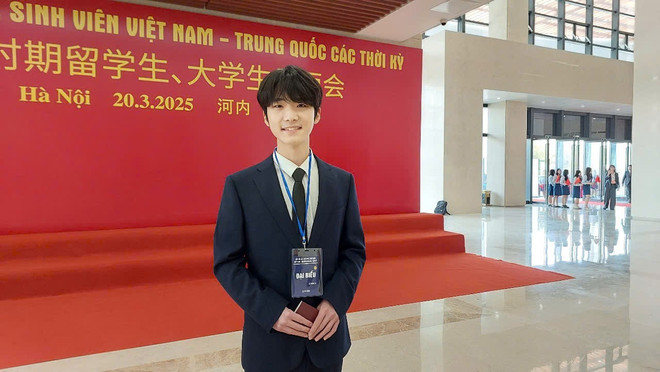
Since arriving in Vietnam, he has passionately immersed himself in the Vietnamese culture, starting with the first song he ever heard, “Chiec Khan Pieu”. Today, he has developed a broad knowledge of Vietnam’s traditional performing arts, including cheo (a type of traditional opera), tuong (classical drama), cai luong (reformed opera), and quan ho (love duet) folk singing.
"I find that Vietnamese literary and artistic works strongly reflect the tolerance and kindness of Vietnamese people. What makes the Vietnamese culture unique is its ability to blend Chinese, Indian, and Southeast Asian influences while maintaining its distinct identity," Bao Shen noted.
Although he has only been in Vietnam for four months, Bao Shen already feels a deep connection with the country. He particularly appreciates Vietnamese cuisine for its light and healthy flavours, which he finds similar to the culinary traditions of his hometown in Zhejiang./.