Vietnamese brides teach mother tongue in Taiwan

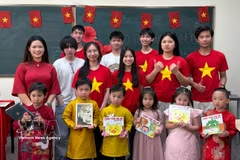
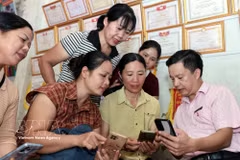
Many Vietnamese mothers in Taiwan have become teachers of their native language to their children after engaging in a programme entitled “Ngọn đuốc tân di dân” (New Immigrant Torch). A report by radio The Voice of Vietnam (VOV).
Many Vietnamese mothers in Taiwan have become teachers of their nativelanguage to their children after engaging in a programme entitled “Ngọnđuốc tân di dân” (New Immigrant Torch). A report by radio The Voice ofVietnam (VOV).

According to statistics, Taiwan is home toaround 100,000 Vietnamese mothers whose children number 200,000.Vietnamese women are very keen on teaching their mother language tochildren. Local authorities are also placing importance on theVietnamese language training for younger generations.

NguyenThi Lien Huong, a Vietnamese language and culture lecturer of TaiwanUniversity, has taken part in the “New Immigrant Torch” programme forseven years.

Huong married a Taiwanese man, and has three children who are taught Vietnamese language by their mother.

She said her children are learning to speak Vietnamese and herhusband has spent years studying the language and traditional culture.“We often talk in Vietnamese so that our children can learn Vietnamesedaily,” Huong said.

Her children stay proactive in joiningexchange programmes organised by the Vietnamese community in Taipei toimprove their Vietnamese language skills.

Huong considersmusic and literature effective channels for younger Vietnamesegenerations in Taiwan to learn the language. “When I was pregnant, Isang Vietnamese folksongs to my would-be babies. I also told Vietnameselegends and fairy tales to my little children.”

Tran LamPhung, who is teaching her native language in Taiwan, said she moved toTaiwan in 2000 to marry a Taiwanese man. She has two children. Phung isworking at a primary school and teaching Vietnamese for kids andstudents in Kaohsiung and Tainan cities.

Phung said many Vietnamese women voluntarily teach Vietnamese for “F2” generations of Vietnamese-Taiwanese families.

“Parents are encouraged to take their children to free-of-chargeVietnamese teaching centres. Younger generations will play an importantrole in strengthening Vietnam-Taiwan relations and contribute to theirhomeland,” she added.

Since 2012, Vietnam's Ministry ofEducation and Training has cooperated with the Taiwan ImmigrationDepartment to implement the “New Immigrant Torch” programme, targetingyounger generations of overseas Vietnamese, which provided an excellentopportunity for them to study their mother tongue language.

As a member of a group compiling Vietnamese teaching programme, NguyenThi Lien Huong said expatriates have many textbooks to study Vietnamese.These include chapters introducing Vietnam and Taiwan, as well asbilateral ties. Most of the Vietnamese language teachers are Vietnamesewomen who are working or residing in Taiwan, she added.

Huongsaid all Vietnamese students are provided with free-of-charge courses.“It’s my honour to teach my mother tongue to younger generations inTaiwan. The 'New Immigrant Torch' programme offers Vietnamese mothersin Taiwan a chance to teach their native language and introduceVietnam’s traditional culture,” she said.

Bui Trong Van,chief of the Vietnam Culture and Economics Office in Taipei, said Taiwanhas offered many incentives for Vietnamese girls and their children toimprove their lives and integrate into their current society.

Vietnamese now becomes one of the key foreign languages taught inTaiwan-based universities, which attaches importance to developing the“New Immigrant Torch” programme to popularise the Vietnamese language.All Vietnamese brides wish their children can speak their mother tongue,he added.

“There are many advantages for students in Taiwanto study Vietnamese, it is another foreign language besides English attertiary level and will help them seek jobs more easily aftergraduation. The mother language will help Vietnamese younger generationsin Taiwan get closer to their home country,” Van noted.

Atpresent, approximately 20 universities in Taiwan teach Vietnamese as thesecond foreign language, while around 10 high schools teach it as thefirst.-VNA
See more

An official of the Bank for Social Policies in Lao Cai province guides local women in using the mobile application. (Photo: VNA)

Efforts made to create value from digital environment

As digital services become more accessible and public feedback is increasingly heard, Vietnamese citizens are expected to move from simply benefiting from digital transformation to actively contributing to the development of a prosperous digital nation, where people's happiness and satisfaction remain the ultimate measures of success.

The Viet Youth Readiness Hub of the Canada Vietnam Council for Culture & Education (CVCEC) during a Vietnamese language lesson for Vietnamese-Canadian children in Toronto, Canada. (Photo: VNA)

Vietnamese culture connects generations in Canada

Beyond language skills, children learn about Vietnamese history, stories of filial devotion and national heroes, and the importance of respecting parents and teachers. Weekend classes begin with the national anthem, while festivals and traditional holidays offer opportunities to make greeting cards, prepare traditional cakes and learn to wrap 'banh chung' (square sticky rice cakes).

Delegates and local residents explore the themed exhibition “Coastal and Island Archaeology in Ho Chi Minh City: New Discoveries in 2020–2025”. (Photo: VNA)

Archaeological exhibition showcases 300 artefacts in Ho Chi Minh City

The exhibition presents 150 artefacts and 150 documentary photographs collected through archaeological surveys, field investigations and excavations over the past five years. The items were unearthed at notable sites including Cu Bi, Quang Thanh, Go Nan, Kim Long, Go Dat Nai, Giong Lon, Con Dao and Vong Thanh Da Trang. The findings have helped researchers shed light on traces of ancient settlements, craft workshops, distinctive burial practices, as well as ancient citadels and trading ports.

A TTU–VWAI representative hands the National Steering Committee 515 delegation several sets of dossiers on martyrs’ burial sites and artefacts that TTU–VWAI experts collected and studied during joint work to search for, recover and identify Vietnamese martyrs’ remains. (Photo: VNA)

Vietnam, US step up cooperation in search for fallen soldiers’ remains

Ambassador Nguyen Quoc Dung pressed partners to adopt four strategic tracks: a two-way verification process, standardised and professionalised outputs, breakthrough use of digital technology and AI, and maximum diplomatic patronage and resources, all aimed at converting documentary research into field investigation capacity.

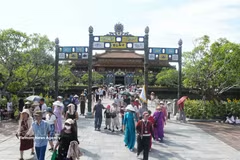
Visitors tour the Hue Imperial Citadel. (Photo: VNA)

Hue cuts heritage site entrance fees to attract more tourists

Under the first scheme, visitors using new tourist transport services to Hue will receive a 50% discount on entrance fees. Eligible services include the Hue – Phong Nha heritage railway, the Hue – Da Nang heritage steam train, and new domestic and international air routes, including charter and scheduled flights. The incentive does not cover existing air routes with increased flight frequencies.

Screenshot of the article. (PhotoVNA)

Chilean media spotlight Vietnam’s growing global role

Chilean newspaper El Clarín recently published an interview with Vietnamese Ambassador to Chile Nguyen Viet Cuong, highlighting Vietnam’s foreign policy of independence and self-reliance and international integration, its contributions to regional cooperation, and prospects for bilateral ties as the two countries mark the 55th anniversary of diplomatic relations.

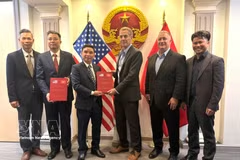
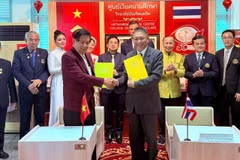
The exchange of a Memorandum of Understanding (MoU) on academic cooperation between the Vietnamese Consulate General in Khon Kaen and College of Asian Scholars. (Photo: VNA published)

Vietnam Studies Centre opens in northeastern Thailand

The centre would serve as a valuable academic hub for teaching and promoting Vietnamese language, culture and history, while fostering people-to-people exchanges and connecting younger generations of the two countries.

Fishing boats enter and leave Quy Nhon port (Photo: VNA)

Gia Lai tightens controls over vessels to combat IUU fishing

Inspections by an inter-sectoral working group identified weaknesses in managing ineligible fishing vessels, controlling vessels entering and leaving ports, seafood traceability, handling violations and implementing support policies for decommissioned vessels, according to the committee.

Construction site for the Ben Thanh - Tham Luong metro project on Cach Mang Thang Tam street (Photo: VNA)

Ho Chi Minh City plans five TOD areas along Metro Line No. 2

According to the Ho Chi Minh City Department of Planning and Architecture, the boundaries of the five TOD areas along Metro Line No. 2 (Ben Thanh – Tham Luong) have been approved, covering a total area of approximately 939 ha. The city is now drawing up plans for these areas.

Russian and CIS tourist groups visit the central city of Da Nang in 2026. (Photo: VNA)

Vietnam gains popularity among Russian tourists

Vietnam recorded the fastest growth in Russian tourist arrivals among mass-tourism destinations in the first nine months of 2026, according to data from the Association of Tour Operators of Russia (ATOR) and Russia’s Federal Security Service (FSB).

The 24th Asian Maritime and Fisheries Universities Forum takes place in Hai Phong city. (Photo: VNA)

Leading Asian maritime universities gather for Hai Phong forum

Vietnam needs engineers, seafarers, experts and managers who can adopt and develop advanced technologies for the maritime industry and future marine economy. That is why Vietnam attaches special importance to international cooperation in education, training and research.