Vietnamese firms told to focus on social, environmental performance to enter German market
Vietnamese enterprises need to improve their social and environmental performance to secure their position in global supply chains, a seminar heard in Ho Chi Minh City last week.
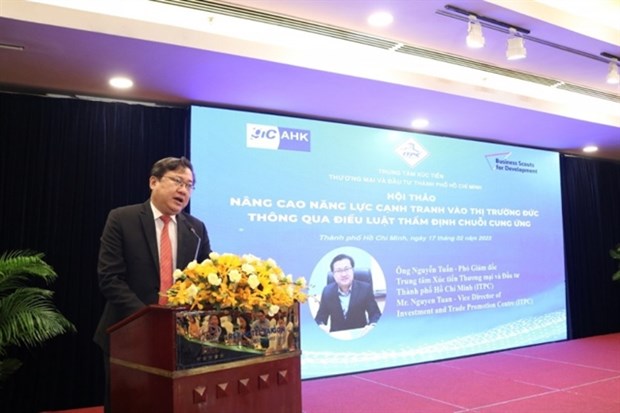 IPTC Deputy Director Nguyen Tuan speaks at the event (Photo: VNA)
 Nguyen Ngoc Sang, project manager of the German Business Incubator at the Delegation of German Industry and Commerce in Vietnam (AHK Vietnam), said in recent years Vietnam had been a popular investment destination for many countries, especially Germany.
AHK Vietnam was receiving increasing requests from German companies to find suppliers in Vietnam, he said while speaking at the seminar on enhancing Vietnamese companies’ competitiveness in global supply chains through compliance with the German Supply Chain Due Diligence Act.
With its geographical location, Vietnam is considered the gateway to Southeast Asia, a rapidly growing and dynamic region, according to Sang.
It is attractive to investors thanks to its low labour costs, high labour compliance, strong growth for many years, and open mechanism for attracting investment.
It has signed many trade deals, including the EU-Vietnam Free Trade Agreement, which gets much attention from European investors, including German, and enterprises seeking to diversify their supply chains also prefer the country.
According to Nguyen Tuan, deputy director of the Investment and Trade Promotion Centre of HCM City (ITPC), said trade and investment ties between Vietnam and the EU, especially Germany, have seen robust growth in recent years.
Germany is Vietnam's largest trading partner in Europe, accounting for more than 19 per cent of its exports and acting as the gateway for Vietnamese goods to enter other European markets.
While productivity and quality standards remain key factors, international business partners are increasingly looking at social and environmental conditions when choosing suppliers.
To ensure exports to demanding markets, Vietnamese enterprises must comply with stringent regulations like the German Supply Chain Due Diligence Act (LkSG).
Lanh Huyen Nhu, project coordinator for Sustainable and Climate Resilient Supply Chains at AHK Vietnam, said the act, which came into effect in January this year, sought among other things to prevent child and forced labour and ban substances that are hazardous to people and the environment.
"The law requires German companies to establish appropriate and effective risk management for their supply chains and integrate it into all relevant business processes," she said.
Companies in Vietnam could be indirectly affected by these regulations if they are part of a supply chain of a German company.
According to experts, while due diligence in supply chains and the resulting obligations are not new, these standards are becoming even more relevant, requiring more initiatives from businesses.
Understanding and putting these requirements into practice would lower risks and strengthen their competitiveness in the global supply chain, they said.
The seminar was held by ITPC and AHK Vietnam./.


You should also see
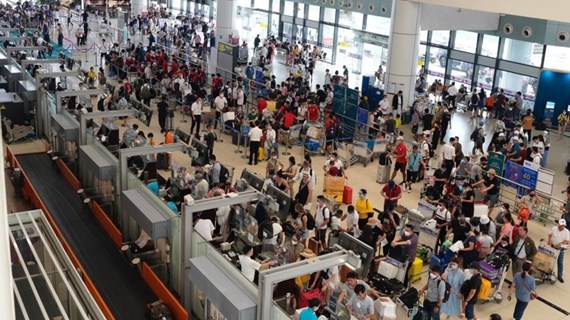
Airports to offer 9,000 domestic flights during upcoming holidays
Vietnamese airlines are expected to operate 9,000 flights on domestic routes to meet the travel demand during the upcoming National Reunification Day (April 30) and May Day (May 1) holidays, according to the Airports Corporation of Vietnam (ACV).

See more
 Business
Vietnam’s rice exports may exceed 2024 target
With positive results recorded so far, Vietnam can exceed its target of 7.6 million tonnes in rice export volume set for 2024, Nguyen Ngoc Nam, Chairman of the Vietnam Food Association, said at a conference in the Mekong Delta city of Can Tho on April 26.
 Business
Ample room for Quang Ninh to attract FDI
The northeastern province of Quang Ninh has ample room to attract foreign direct investment (FDI) and realise the goal of attracting 3 billion USD in FDI this year and 10 billion USD in the 2020-2025 period.
 Business
Long An, Dong Nai introduce strengths in RoK
The southern province of Long An and Dong Nai introduced their investment climate as well as socio-economic development orientations at an investment promotion conference held in the Republic of Korea (RoK) on April 26.
 Business
Vietnam makes initial efforts to approach creative industries: CIEM
Vietnam has made initial efforts to approach creative industries and services, particularly a policy framework related to creative economy development, according to a new report released by the Central Institute for Economic Management (CIEM).
 Business
HCM City wants to become major partner, customer of NVIDIA: Official
Chairman of the People’s Committee of Ho Chi Minh City Phan Van Mai has told the Vice President of Worldwide AI Initiative at NVIDIA, Keith Strier that the city wants to become a major and good partner and customer of the firm in Vietnam.
