Vietnamese retail industry expects bright future ahead

Vietnam’s retail industry is experiencing a period of remarkable growth, fuelled by favourable economic conditions and evolving consumer behaviour.

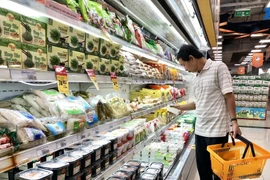
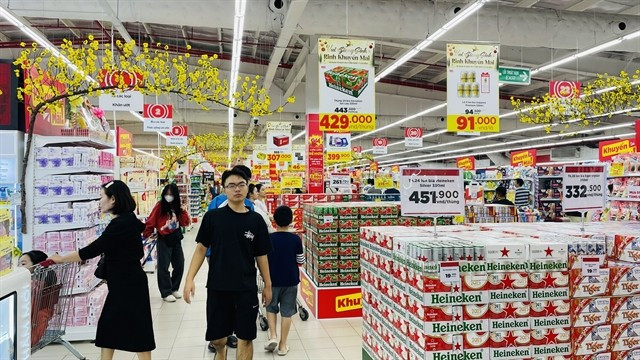
Consumers shop at a supermarket in Hanoi. (Photo: VNS/VNA)

Hanoi (VNS/VNA) – Vietnam’s retail industry is experiencing a period of remarkable growth, fuelled by favourable economic conditions and evolving consumer behaviour.

With a young and dynamic population, rising incomes and increasing urbanisation, the sector is emerging as one of the most promising engines for economic expansion in the coming years.

Tien Phong Securities Corporation projected the retail market in Vietnam to grow at an impressive rate of 12.05% between 2024 and 2029.

This robust trajectory is attributed to a burgeoning middle class, widespread adoption of digital payment systems and the rapid expansion of modern retail formats.

The rise in consumer confidence and disposable incomes further cements the retail sector's pivotal role in the nation’s economic recovery and growth.

Vietnam's demographic structure is critical to the retail industry's momentum. With a population exceeding 100 million, over 70% are under the age of 40, forming a consumer base that is tech-savvy, urban-oriented, and aspirational.

By 2025, the country’s GDP per capita is expected to surpass 5,000 USD, marking a significant milestone to stimulate consumer spending further.

Hoang Xuan Trung, Head of Corporate Clients at Citi Vietnam, this demographic advantage, coupled with an increasingly affluent middle class, is set to drive retail demand for years to come.

Dang Thuy Ha, Director of Customer Behaviour Research at NielsenIQ Vietnam, also highlights the growing consumer focus on not just basic needs but also quality-of-life enhancements, a shift that offers lucrative opportunities for retailers to diversify their offerings.

Key drivers of retail growth

The evolution of the country's retail industry can be attributed to several interrelated factors.

Tien Phong Securities said that the expansion of retail networks has brought modern shopping experiences to underserved areas. Supermarkets, convenience stores and online platforms are increasingly penetrating rural markets, offering consumers a more accessible and efficient alternative to traditional retail channels.

Additionally, the surge in digital payments reflects the growing integration of technology into daily life.

Close to 40% of consumers now use banking apps for shopping transactions, underscoring a shift towards cashless societies. This trend aligns with the government’s push to promote digital transformation, enhancing both convenience and transparency in retail transactions.

The country’s expanding middle class, projected to account for 26% of the population by 2026, also represents a significant driver of consumption. Estimates suggest that an additional 23.2 million people will join this demographic by 2033, creating vast opportunities for growth across all retail segments.

Vietnam's favourable labour demographics, with a majority of its population in the working age group and a high participation rate of women in the workforce, ensure sustained consumer spending across categories.

Shifting consumer trends

Consumer preferences in Vietnam are undergoing a rapid transformation.

Health and sustainability are becoming central to purchasing decisions, with increasing demand for eco-friendly and high-quality products. Shoppers are also showing greater loyalty to trusted brands, signalling a shift from price-sensitive behaviour to value-driven consumption.

Leading retail enterprises are positioning themselves to capitalise on the sector’s recovery and expansion.

Companies like FPT Retail (FRT), Mobile World Investment Corporation (MWG), Digiworld (DGW), Masan Group (MSN) and Phu Nhuan Jewelry JSC (PNJ) are leveraging their strengths to adapt to changing market conditions.

For MWG, strategic restructuring and operational efficiency have set the stage for a strong performance in 2024 and beyond.

The company’s initiatives to enhance its grocery chain, Bach Hoa Xanh, and consumer electronics brand, Erablue, are expected to yield significant results as the economy recovers and urbanisation progresses.

Similarly, Digiworld anticipates robust growth as foreign direct investment inflows bolster the economy, leading to higher consumer incomes and confidence.

Policy measures such as a 2% reduction in VAT for specific goods and services are also expected to stimulate spending, further benefiting retail players.

Mordor Intelligence predicts a 12.1% annual Compound Annual Growth Rate (CAGR) for Vietnam's retail and consumer services sector from 2024 to 2029. Retail enterprises still have room for growth.

Nguyen Viet Duc, head of Digital Business at VPBank Securities, expected that retail stocks will rebound due to escalating demand, enhanced consumer spending and the overall economic recovery momentum./.

VNA

See more

Amata Industrial Park in Dong Nai city (Photo: VNA)

Green shift powers investment in southeast Vietnam

The Amata Industrial Park in Dong Nai City, established 32 years ago and covering more than 500ha, is home to over 160 domestic and foreign businesses. Selected in 2020 as one of three national pilot sites for conversion into an eco-industrial park, Amata has raised its compliance with the international eco-industrial park framework from 41% to 86% in 2024, and is working towards becoming Dong Nai's first certified eco-industrial park.

At a port in Ho Chi Minh City (Photo: VNA)

Multi-channel capital mobilisation needed to achieve double-digit growth

The Ministry of Finance estimates development investment for 2026-2030 at a minimum of 38.5 quadrillion VND (1.48 trillion USD), or about 40% of GDP. The state budget is expected to provide only about 20%, or more than 7.7 quadrillion VND, leaving over 80%, or more than 30 quadrillion VND, to be raised from the broader economy. That makes expanding capital mobilisation channels beyond bank credit essential.

An aerial view of the Nhieu Loc – Thi Nghe area in Ho Chi Minh City. The southern metropolis is home to the Vietnam International Financial Centre. (Photo: VNA)

Vietnam International Financial Centre launches membership registration system

Integrated into the official Vietnam International Financial Centre portal at vifc.gov.vn, the online system for registering and recognising members provides a unified online service channel through which investors, organisations and businesses can complete procedures related to membership, from new registration and recognition to information updates and termination of membership.

At a tax office in Hung Yen province (Photo: VNA)

Finance ministry moves to cut business costs, spur growth

Tax policy is among the solutions with the most direct impact on companies. Rather than prioritising near-term revenue collection, fiscal policy is being run to help them preserve cash flow, expand production and build more sustainable revenue sources.

In the Kim Long Motor Hue factory (Photo: VNA)

Hue courts capital to turn industrial zones into growth engine

The economic and industrial zones in Hue city host more than 200 active investment projects worth over 152 trillion VND (5.84 billion USD), with 139 already operational. Since the start of 2026, they have generated about 32 trillion VND, contributed 4.2 trillion VND to the state budget and brought in 730 million USD in exports, while employing more than 46,000 workers.

An overview of a meeting between Politburo member and Secretary of the Hanoi Party Committee Tran Duc Thang and representatives of Saint Petersburg businesses. (Photo: VNA)

Saint Petersburg’s metro expertise valuable for Vietnam

As Hanoi implements its master plan with a 100-year vision, in which metro lines are identified as the backbone of the capital city’s transport network, Secretary of the municipal Party Committee Tran Duc Thang met with representatives from several Saint Petersburg companies specialising in urban rail development.

An art performance at 2026 Dak Lak Durian Festival. (Photo: VNA)

Dak Lak Durian Festival seeks to elevate Vietnam’s agricultural brand globally

Dak Lak has about 41,000ha of durian, with this year’s output estimated at nearly 500,000 tonnes. The province has 280 growing-area codes covering around 7,500ha, along with 41 packing facilities approved for export. In 2025, Dak Lak’s durian sector contributed about 1.1 billion USD to the country’s export turnover.

Delegates cut the ribbon to inaugurate the Ho Chi Minh City-Shenzhen direct air route. Photo: baodautu.vn

Vietravel Airlines launches direct Ho Chi Minh City-Shenzhen route

Vietravel Airlines' new route connects Tan Son Nhat International Airport (SGN) in Ho Chi Minh City with Shenzhen Bao'an International Airport (SZX), meeting growing demand for travel between the two markets for investment, trade, tourism and visiting relatives.

Thanks to digital transformation among local officials, Tam Dao commune of Phu Tho province has achieved an almost 100% on-time rate for processing administrative applications, helping improve public services for residents. (Photo: VNA)

Institutional reform fuels private sector's growth in Phu Tho province

The private sector is increasingly emerging as a key growth engine of the economy. To unleash its potential and ensure sustainable development, the northern province of Phu Tho is stepping up institutional and administrative reforms to cut costs, shorten procedures, and build a more transparent, business-friendly investment climate.