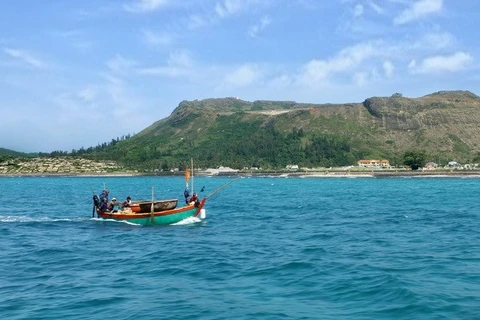
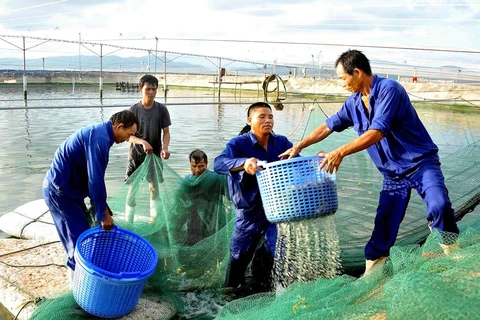
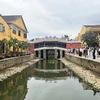
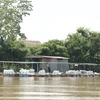
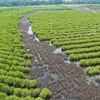
Aquatic farming in the waters of Con Dao Island, Ba Ria-Vung Tau province (Photo: VNA)
 Hanoi (VNA) – The potential resources in Vietnam’s coastal zones are believed to be significant, playing an important role in national development.
A coastal zone, the interface between land and water, is affected by sea waves, currents and tides, other natural impacts, local residents’ daily activities, and resource users.
Coastal zone resources are major “real estate” reserves, of which ecosystems are a critical infrastructure factor in coastal zones.
About 35 minerals with varying reserves, including fuel, metals, construction materials, precious and semi-precious gemstones, and liquid minerals have been discovered in the country’s coastal zones.
These zones also contain mineral sands and heavy minerals with rare elements like titanium (which has an annual output of 220,000 tonnes), zirconium and cerium (1,500 tonnes a year), and 60,000 hectares of salt fields.
Some sand mines with reserves of more than 100 billion tonnes have recently been discovered in seabeds near the mainland. Van Hai and Vinh Thuc are famous silica mines with respective reserves of 7 billion tonnes and 20,000 tonnes. Meanwhile, there is a quartz sandbar that boasts a reserve of almost 9 billion tonnes in the coastal seabed of northern Quang Ninh province.
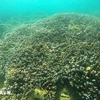
Coastal zones of Vietnam are home to more than 20 ecosystems of which submerged forests, coral reefs and seagrass beds are most typical. About 800,000 hectares of intertidal zones, lagoons and bays are also favourable for farming aquatic species that could be valuable when exported.
More than 100 locations can be used to build ports, many of which can serve as international points of transit. Many islands also have conditions for constructing logistics centres to serve offshore fishing.
Among more than 125 beaches of all sizes, 20 beaches are internationally qualified for sea tourism.
At present, more than 50 percent of big cities in Vietnam are located along the coast, which also accommodates the northern, central and southern key economic regions, nearly 30 export processing and industrial zones, and over 80 seaports able to handle 100 million tonnes of goods every year.
The country’s sea tourism also attracts nearly 15 million visitors a year, including 3 million foreigners, posting an average annual growth rate of 13 percent.
Oil and gas extraction is conducted in six fields in the southern continental shelf.
While about 80 percent of Vietnam’s annual fish haul comes from inshore shallow waters, about 90 percent of shrimp output is farmed in the coastal brackish water areas, according to the Ministry of Agriculture and Rural Development.
The scale of Vietnam’s sea-based and coastal economy between 2000 and 2005 is estimated at 30 percent of GDP. Economic sectors that directly relate to the exploitation of marine resources such as shipbuilding and repair, oil and gas processing, aquatic product processing, and communications have made progress. However, their scale remains modest, about 2 percent of the sea-based economy and 0.4 percent of the country’s GDP.
Fifteen economic zones have been created along the coast of Vietnam. They act as sea-oriented economic development centres that foster sea-related activities like fishery logistics, seaport and shipping, marine tourism, and marine scientific research.
In addition, 13 of the 28 national parks, 22 of the 55 nature reserves and 17 of the 34 forests with cultural, historical and environmental importance are located in coastal areas and inshore islands. Outstanding world biosphere reserves in Vietnam’s coastal zones include the Can Gio submerged forest, the area of Cat Ba archipelago, and the river mouth areas of the Red and Mekong rivers.
In the planning of a system of 16 marine protected areas that was signed off by the Government in 2010, 14 areas are in coastal zones.
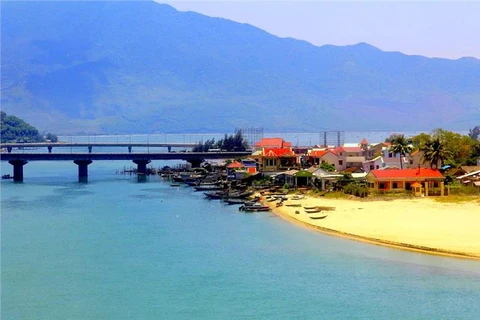
In 1994, Ha Long Bay of northern Quang Ninh province was named a world natural heritage. Nha Trang Bay of the south central province of Khanh Hoa and Lang Co Bay in central Thua Thien-Hue province were recognised as beautiful bays of the world.
Hoi An Ancient Town, the Complex of Hue Monuments, My Son Sanctuary and Phong Nha-Ke Bang National Park, which are world cultural and natural heritage sites, are all located in coastal areas.
However, strong socio-economic development in coastal zones has been putting pressure on ecosystem conservation there. Those development activities are out of control of the local communities. Therefore, it is a must to soon have synchronous management policies for coastal zones.-VNA
VNA