Vietnam’s cultural industries require national direction and funding.

Experts believed if Vietnam’s cultural industries are fully understood in the context of global integration, competent authorities should be able to outline suitable development measures to enhance the nation’s economy.
Vietnam’s cultural industries require national direction and funding. ảnh 1A stunning light performances at the Opera House, Hanoi (Photo: VNA)

Hanoi (VNA) – Experts believed if Vietnam’s cultural industries are fully understood in the context of global integration, competent authorities should be able to outline suitable development measures to enhance the nation’s economy.

Each nation has its distinct culture and art, however, not all have developed cultural industries around it, according to PhD Nguyen Thi Quy Phuong, former deputy director of the institute for journalism and communications studies.

“We are talking about a cultural industry, which has not been developed”, she said.

The concept of the cultural industry, according to the United Nations Educational, Scientific and Cultural Organisation (UNESCO), is part of the creative industry, and is combined by creation, production and commercialisation of creative products and services, which are protected by the intellectual property rights.

Vietnam’s cultural industries require national direction and funding. ảnh 2PhD Nguyen Thi Quy Phuong believes that cultural tourism industry is mentioned a lot but it has not yet been fully developed. (Photo: VNA)


Phuong used the cinema industry as an example, stating that there should be coordination among creative makers like film directors, screenwriters, and actors. The films could be coordinated to promote the nation’s cultural values.

Advanced technologies need to be employed, and the capacity to develop a brand for the film is necessary as well, she added.

Meanwhile, Associate Professor, PhD Bui Hoai Son, member of the National Assembly’s Committee for Culture, Education, Youth, Adolescents and Children said cultural industry is made up of everything from cinema, fashion, and performing art, to broadcasting, advertisements, and architecture.

Within statistics announced by UNESCO in 2017, the cultural industry generated some 2.25 trillion USD in revenue, created 29.5 million jobs – compared to 25 million offered by the automobile sector of the EU, Japan and the US.

In the Asia-Pacific alone, the figures were 743 billion USD and 12.7 million jobs.

While in China, the cultural industry contributed 4.23 percent to the nation’s gross domestic product (GDP) in 2017.

In the meantime, the Hallyu (Korean wave) of the Republic of Korea contributed 10.8 billion USD to the nation’s GDP in 2019. As of August, 2020, the country set up 32 cultural centres in 28 countries across Africa, Asia-Pacific, Europe and America to promote its Hallyu culture. Korea’s so called “soft power” was carried across the globe by promotion and guidance.

Since cultural industries are thought of as the “hen that lays golden eggs” in many countries, Vietnam should see this as a way to spearhead in its economic development under a defined and mobilized banner or brand.  

Strategic investment in need

Without serious investment, Vietnam’s cultural industry may not develop in a coordinated fashion towards a market-oriented economy, according to Bui Hoai Son.

Vietnam’s cultural industries require national direction and funding. ảnh 3Associate Professor, PhD Bui Hoai Son, member of the National Assembly’s Committee for Culture, Education, Youth, Adolescents and Children (Photo courtesy of the Ministry of Culture, Sports and Tourism)


“Investment resources for the cultural sector are still limited. Vietnam targeted to spend 1.8 percent of its budget on culture in 2010, however, the figure was only 1.71 percent in 2019. During the 2021-2025 period, the country planned to invest 1.12 percent of the state budget, which is not enough to realise its goal of supporting its rich cultural industries”, Son stressed.

Key resources in the cultural sector, namely infrastructure, finance and human resources, fail to meet development demand, he added.

At the National Cultural Conference held in Hanoi in November last year, the Party Central Committee’s Commission for Popularisation and Education unveiled its report, highlighting the revenue from film screening worth 1.1 trillion VND (47.25 million USD), earning from art organisations managed by the Ministry of Culture, Sports and Tourism was 5.3 billion VND.

However, the report failed to give details on the total number of tickets sold in the year, the number of private film makers, and achievements of the cultural sector such as index of the fashion industry development.

Vietnam’s cultural industries require national direction and funding. ảnh 4Cinema is among 12 segments that form Vietnam’s cultural industry. (Photo: VietnamPlus)

One key missing statistic is the new era of game and software design – a non-smoke segment which could generate billions of USD, Son added.

Vietnam was not listed in the United Nations’ Creative Economy Reports in 2018 which spotlighted the development of cultural – creative industry of 130 countries and territories.

Son suggested the National Assembly add the criteria on such cultural institutions as museums and theatres to the list of cultural statistic indicators to contribute to proper evaluation and guide measures to develop Vietnam’s culture./.
VNA

See more

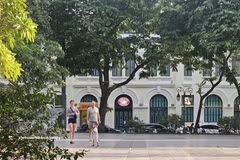
International visitors stroll beneath the leafy trees along Hoan Kiem Lake, enjoying Hanoi’s cool autumn weather. (Photo: VNA)

Hanoi’s autumn charms visitors with scenery, food and memories

Hoan Kiem lake remains a popular attraction, with colourful flowerbeds drawing residents and tourists for walks and photos. Visitors can continue through the Old Quarter, explore cafés in old buildings and sample local favourites such as pho and bun cha.

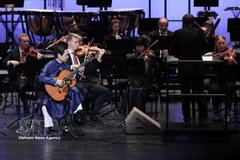
Guitarist Dang Ngoc Long performs with the Tübingen Symphony Orchestra (Germany) at the “A Rhapsody of Two Worlds” concert at Ho Guom Theatre in Hanoi in December 2025. (Photo: VNA)

From Berlin, the Vietnamese guitar fosters cultural connections to global community

This year, 30 contestants from 15 countries entered the competition, with five finalists set to compete on October 10 at Ballhaus Prinzenallee in Berlin. The programme also includes a gala concert, masterclasses and a guitar exhibition. Long’s compositions have been selected as compulsory pieces, introducing international musicians to Vietnamese music.

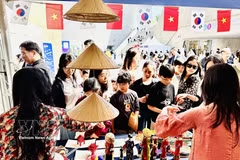
Visitors explore the Vietnamese booth. (Photo: VNA)

Vietnam showcases cultural identity at RoK festival

The Vietnamese booth, presented by the Vietnamese Women’s Association in the RoK, attracted visitors with traditional items such as ao dai, conical hats, handicrafts and models showcasing Vietnamese folk culture, offering insights into the country’s heritage and people.

International tourists enthusiastically participate in activities associated with the Mid-Autumn Festival (Photo: VNA)

Vietnam ranks among world’s top 10 favourite countries in 2026

Vietnam’s inclusion in the top 10 favourite countries in the 2026 Readers’ Choice Awards adds another important milestone to the country’s international tourism brand. The result not only underscores the destination’s appeal but also reflects growing international appreciation for Vietnam’s natural beauty, cultural heritage, cuisine and people.

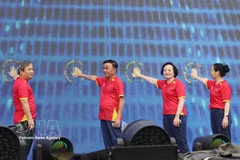
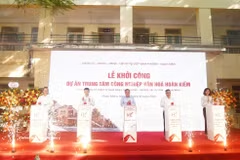
Hanoi leaders attend the groundbreaking ceremony for the cultural industry centre. (Photo: VNA)

Hanoi launches project to build cultural industry hub in Old Quarter

The project, covering about 3,862sqm. at 17 Nguyen Thien Thuat and 40 Thanh Ha, includes around 2,317sqm. of construction area. It will renovate existing structures, improve architecture and landscaping, upgrade technical infrastructure and create spaces for cultural, artistic and creative activities.

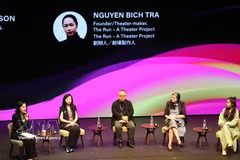
Director Tra Nguyen, founder of “The Run – A Theatre Project” (far right), joins international speakers at the panel discussion. (Photo: VNA)

Vietnamese experimental theatre shines at AAPPAC 2026

Vietnam’s participation in the 2026 Annual Conference of the Association of Asia Pacific Performing Arts Centres (AAPPAC 2026) in Hong Kong highlights the growing international engagement of the country’s performing arts community.

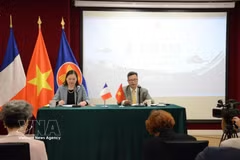
Vietnamese Ambassador to France Trinh Duc Hai (right) speaks at a press conference introducing the Vietnamese Theatre Week in France. (Photo: VNA)

Vietnamese theatre arts to take centre stage in France

Vietnamese Ambassador to France Trinh Duc Hai noted that Paris is chosen for its status as a major global cultural and artistic centre and the headquarters of UNESCO. The year 2026 also marks 50 years since Vietnam joined UNESCO.

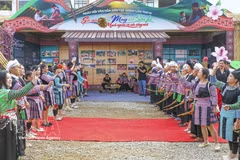
An overview of the press conference (Photo: VNA)

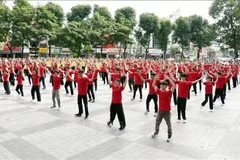
Over 2,000 people to perform Thai Xoe dance in Lao Cai in October

The festival will provide an opportunity to review achievements in preserving and promoting the values of Thai Xoe, honour the cultural identities of ethnic groups in the Northwestern region, and promote the land and people of Lao Cai. It will also showcase local tourism products and destinations and strengthen linkages for tourism development.

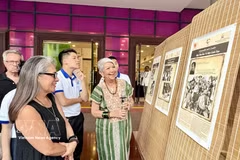
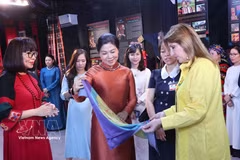
The Vietnamese and Panamanian first ladies experience cultures of Vietnam's ethnic groups. (Photo: VNA)

Vietnamese, Panamanian first ladies bond over ethnic textiles at Hanoi cultural event

The two ladies were briefed on the cultural diversity of Vietnam's ethnic groups and shown traditional costumes, along with weaving, embroidery and pattern-making techniques preserved and handed down through generations. The materials, colours and patterns of the costumes reflect aesthetic values as well as stories of history, customs, traditions and the distinct identity of each community.

Historical cinema helps foster patriotism, strengthen Vietnam’s soft power

Historical cinema helps foster patriotism, strengthen Vietnam’s soft power

When history is told through human stories, using modern cinematic language and backed by adequate investment, films can both nurture patriotism and national pride and become competitive cultural industry products. This is also a way for cinema to help turn the spirit of Politburo Resolution No. 80-NQ/TW into reality by transforming Vietnamese values into an internal resource and a source of national soft power.