Vietnam’s pepper industry spices up export earnings despite volume dip

Vietnam’s pepper export earnings surged by 40.8% year-on-year to 764.2 million USD in the first seven months of this year, despite a slight decline of 2.2% in export volume, according to the Vietnam Pepper and Spice Association (VPSA).

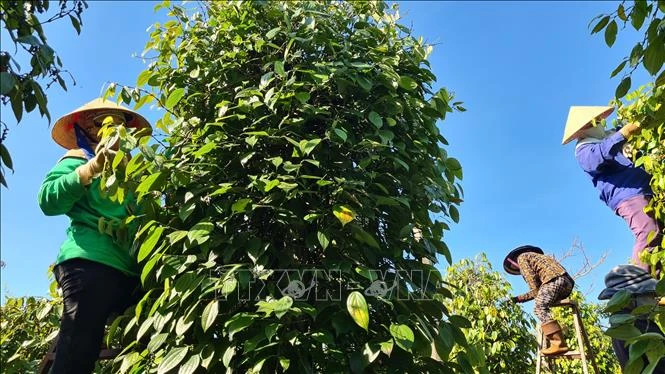
Illustrative image (Photo: VNA)

HCM City (VNA) – Vietnam’s pepper export earnings surged by 40.8% year-on-year to 764.2 million USD in the first seven months of this year, despite a slight decline of 2.2% in export volume, according to the Vietnam Pepper and Spice Association (VPSA).

Rising global pepper prices primarily drove the remarkable growth. The US remained Vietnam's top pepper importer, purchasing 43,349 tonnes of Vietnamese pepper, a significant 48.4% increase from the previous year, accounting for 26.4% of the market share. It was followed by Germany, the United Arab Emirates (UAE), India, and China.

In July alone, Vietnam shipped 21,771 tonnes of pepper, including 19,371 tonnes of black pepper and 2,400 tonnes of white pepper, earning 129.9 million USD. This represented a 43.7% increase in volume and a staggering 128.9% jump in value compared to the same period last year.

In January-July, Vietnam exported 164,357 tonnes of pepper, comprising 145,330 tonnes of black pepper and 19,027 tonnes of white pepper, with total export revenue reaching 764.2 million USD, up 40.8%.

To maintain this upward trajectory, VPSA Chairwoman Hoang Thi Lien underlined the need to stabilise pepper cultivation areas while enhancing product quality and diversifying high-value processed products.

The association recommends farmers adopt international standards, including those related to chemical residues, cultivation practices, pest control, and preservation practices suited to regional climatic conditions. It is crucial to develop new pepper varieties with higher yields, better quality, and disease resistance, she said.

Lien also encouraged local authorities to support the pepper industry by planning raw material areas and facilitating connections among farmers, processors and exporters.

Leveraging digital technology for production management, traceability, and market access is essential. Moreover, promoting cooperatives and production groups can strengthen the supply chain and benefit exporters, Lien added./.


VNA

See more

Vietnam is strengthening its position in the technology value chain, becoming a major manufacturing hub for complete consumer electronics products. (Photo: VNA)

ESG standards offer opportunities to reposition Vietnam’s electronics firms

The 2025-2027 period will be a critical turning point, as exporters to the European market will be required to strictly comply with ESG standards, including net-zero emissions roadmaps, labour standards, corporate governance and transparency requirements. As a key export sector, the electronics industry is being directly and strongly affected by this shift.

A production line for camera modules and electronic components at the factory of MCNEX VINA Co. Ltd, a Republic of Korean-invested company in Phuc Son Industrial Park, Ninh Binh province. (Photo: VNA)

Science, technology, innovation as engines of economic growth

To ensure that science and technology truly act as a powerful growth engine, experts emphasised the need for the Government to put in place supportive mechanisms and policies that encourage enterprises to invest in research and development, while strengthening cooperation among the State, research institutions and the business sector.

The headquarters of the Ministry of Industry and Trade in Hanoi (Photo: VNA)

PM updates lead roles to drive UKVFTA forward

The Ministry of Industry and Trade (MoIT) is named the lead agency, with overall responsibility for the agreement’s general goals and definitions, trade remedies, non-tariff barriers to trade and investment in renewable energy, competition policies, State-owned enterprises, enterprises with special or exclusive rights and those with designated monopolies, as well as institutional, general and final terms.

Vietravel Airlines is taking measures to enhance service quality and optimise operations amid high travel demand during Tet. (Photo: VNA)

Vietravel Airlines to add new route serving Lunar New Year travel peak

During the peak period of the Lunar New Year (Tet) festival in 2026, Vietravel Airlines plans to operate six – eight flights daily on the Ho Chi Minh City – Hanoi route, three flights daily on the Ho Chi Minh City – Da Nang and Ho Chi Minh City – Vinh routes; and two flights daily on the Ho Chi Minh City – Quy Nhon route.

The completion of Can Tho - Ca Mau expressway has helped shorten travel time from Can Tho to Ca Mau to just one hour and a half (Photo: VNA)

Can Tho–Ca Mau expressway fully opens from January 19

The new section, together with the Can Tho–Hau Giang segment that has been operating smoothly since late December last year, has completed the entire 110.85-km route. With total investment exceeding 27.52 trillion VND (1.04 billion USD), the four-lane expressway is built to modern standards and serves as a key transport artery linking major economic and political centres, industrial zones and seaports in the southwestern region.