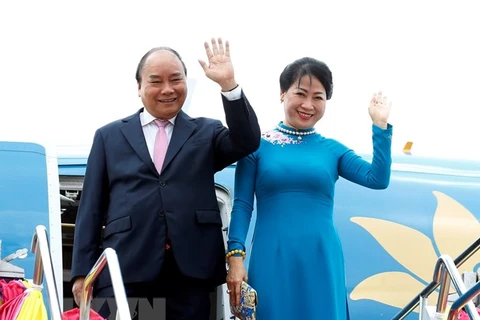
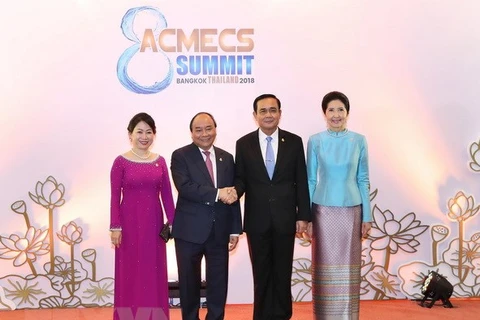
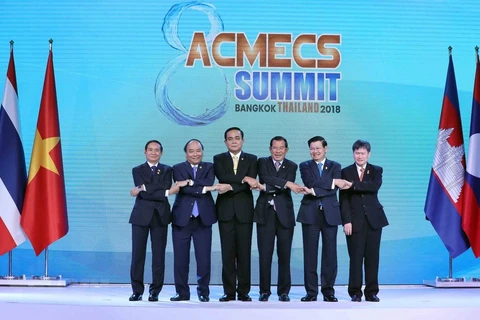
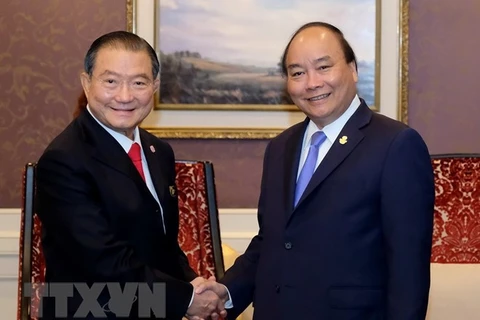
Prime Minister Nguyen Xuan Phuc at the event (Source: VNA)
 Bangkok (VNA) – Prime Minister Nguyen Xuan Phuc suggested a number of measures to make ACMECS cooperation more effective at the 8th Ayeyawady-Chao Phraya-Mekong Economic Cooperation Strategy Summit (ACMECS 8) that opened in Bangkok, Thailand on June 16.
He said it is necessary to push for coordination of stance between ACMECS members and development partners, and build a common voice on issues needed to be addressed and cooperation priorities.
Greater attention should be paid to the mobilisation of financial sources via initiatives like the ACMECS Fund and ACMECS Infrastructure Fund and Trust, the Vietnamese PM noted.
He said ACMECS operation mechanism should be improved to be leaner and more effective, suggesting the organization of ACMECS meetings in conjunction with events held by the ASEAN and other Mekong cooperation mechanisms.
The PM added that ACMECS needs to contribute more directly to and become an integral part of the ASEAN Community formation process through integrating the implementation of the ACMECS Master Plan with that of the ASEAN Community Vision 2025, the Master Plan on ASEAN Connectivity, and other ASEAN cooperation programmes.
The Vietnamese PM also recommended a number of specific contents for cooperation in transport connectivity, trade-investment, agriculture, tourism, environmental protection, natural resources management, and human resources development
Besides PM Phuc, the ACMECS 8 was attended by State and governments leaders of Cambodia, Laos, Myanmar and Thailand.
Themed “Towards an Integrated and Connected ACMECS Community”, ACMECS 8 focused its discussions on measures to facilitate socio-economic development, improve competitiveness of member economies, and outlined orientations for cooperation for inclusive and sustainable development in the Mekong region.
Leaders shared the view that the Mekong region boasts a wide market, capable human resources, and a strategic geo-economic location connecting Indian Ocean, the Pacific and Asian markets.
However, regional countries have to face challenges from the slow recovery of the world economy, the emergence of populism, the return of protectionism, non-traditional security issues such as environment degradation, climate change and natural disasters, requiring ACMECS to further improve the efficiency of its cooperation and enhance coordination between ACMECS and other region and sub-regional mechanisms.
Participants adopted the Bangkok Declaration and the ACMECS Master Plan for the 2019-2023 period with the goal of turning ACMECS into an economic hub with seamless connectivity and strong integration, on the three main pillars of hard infrastructure and soft infrastructure connectivity and smart and sustainable development.
Accordingly, ACMECS will promote seamless connectivity from multi-modal transports links (roads, rails, bridges, ports, air, inland waterway, and maritime connectivity) including but not limited to infrastructures designed for sub-regional digital connectivity and energy infrastructure interconnection. Special emphasis will be on filling all the missing links in the sub-region, and the auxiliary connection lines linking industrial parks and seaports to main corridor routes; completing the missing railway links to enhance operations of sub-regional railway network, particularly the East-West Economic Corridor (EWEC) and Southern Economic Corridor (SEC).
It will also harmonise and simplify rules and regulations to facilitate the movement of people, free flow of goods, services, and investment while promoting financial literacy, capital market cooperation as well as financial connectivity such as payment and settlement, use of local currency, fintech and cooperation between banks and other financial service providers.
For smart and sustainable development, ACMECS will promote the development of human capital in strategic areas including entrepreneurship (MSMEs/Startups), agriculture, tourism, medical services and education. Environmental cooperation will continue to be promoted, particularly in sustainable water resource management and in other strategic fields, including agriculture, industry, tourism, health, renewable energy, climate change, disaster-risk management, and natural resources conservation.
The summit also discussed Thailand’s initiative on establishing the ACMECS Fund and ACMECS Infrastructure Fund and Trust as a financing mechanism for cooperation projects in the region. The funds are said to support the implementation of proritised projects in ACMECS member countries.
The summit highlighted the role of businesses in and outside of the region, with the ACMECS CEO Forum and a dialogue between ACMECS country leaders and CEOs of leading companies in the region taking place for the first time. This showed that the private sector is set to be an important partner of the ACMECS in the future.
ACMECS leaders also welcomed Vietnam’s hosting of the World Economic Forum on ASEAN in Hanoi on September 11 – 13 this year. They said it would be an opportunity to highlight the Mekong region as an ASEAN’s new dynamic economic engine and promote entrepreneurship in ACMECS countries.
They agreed that Cambodia will host the 9th ACMECS Summit in 2020.-VNA
He said it is necessary to push for coordination of stance between ACMECS members and development partners, and build a common voice on issues needed to be addressed and cooperation priorities.
Greater attention should be paid to the mobilisation of financial sources via initiatives like the ACMECS Fund and ACMECS Infrastructure Fund and Trust, the Vietnamese PM noted.
He said ACMECS operation mechanism should be improved to be leaner and more effective, suggesting the organization of ACMECS meetings in conjunction with events held by the ASEAN and other Mekong cooperation mechanisms.
The PM added that ACMECS needs to contribute more directly to and become an integral part of the ASEAN Community formation process through integrating the implementation of the ACMECS Master Plan with that of the ASEAN Community Vision 2025, the Master Plan on ASEAN Connectivity, and other ASEAN cooperation programmes.
The Vietnamese PM also recommended a number of specific contents for cooperation in transport connectivity, trade-investment, agriculture, tourism, environmental protection, natural resources management, and human resources development
Besides PM Phuc, the ACMECS 8 was attended by State and governments leaders of Cambodia, Laos, Myanmar and Thailand.
Themed “Towards an Integrated and Connected ACMECS Community”, ACMECS 8 focused its discussions on measures to facilitate socio-economic development, improve competitiveness of member economies, and outlined orientations for cooperation for inclusive and sustainable development in the Mekong region.
Leaders shared the view that the Mekong region boasts a wide market, capable human resources, and a strategic geo-economic location connecting Indian Ocean, the Pacific and Asian markets.
However, regional countries have to face challenges from the slow recovery of the world economy, the emergence of populism, the return of protectionism, non-traditional security issues such as environment degradation, climate change and natural disasters, requiring ACMECS to further improve the efficiency of its cooperation and enhance coordination between ACMECS and other region and sub-regional mechanisms.
Participants adopted the Bangkok Declaration and the ACMECS Master Plan for the 2019-2023 period with the goal of turning ACMECS into an economic hub with seamless connectivity and strong integration, on the three main pillars of hard infrastructure and soft infrastructure connectivity and smart and sustainable development.
Accordingly, ACMECS will promote seamless connectivity from multi-modal transports links (roads, rails, bridges, ports, air, inland waterway, and maritime connectivity) including but not limited to infrastructures designed for sub-regional digital connectivity and energy infrastructure interconnection. Special emphasis will be on filling all the missing links in the sub-region, and the auxiliary connection lines linking industrial parks and seaports to main corridor routes; completing the missing railway links to enhance operations of sub-regional railway network, particularly the East-West Economic Corridor (EWEC) and Southern Economic Corridor (SEC).
It will also harmonise and simplify rules and regulations to facilitate the movement of people, free flow of goods, services, and investment while promoting financial literacy, capital market cooperation as well as financial connectivity such as payment and settlement, use of local currency, fintech and cooperation between banks and other financial service providers.
For smart and sustainable development, ACMECS will promote the development of human capital in strategic areas including entrepreneurship (MSMEs/Startups), agriculture, tourism, medical services and education. Environmental cooperation will continue to be promoted, particularly in sustainable water resource management and in other strategic fields, including agriculture, industry, tourism, health, renewable energy, climate change, disaster-risk management, and natural resources conservation.
The summit also discussed Thailand’s initiative on establishing the ACMECS Fund and ACMECS Infrastructure Fund and Trust as a financing mechanism for cooperation projects in the region. The funds are said to support the implementation of proritised projects in ACMECS member countries.
The summit highlighted the role of businesses in and outside of the region, with the ACMECS CEO Forum and a dialogue between ACMECS country leaders and CEOs of leading companies in the region taking place for the first time. This showed that the private sector is set to be an important partner of the ACMECS in the future.
ACMECS leaders also welcomed Vietnam’s hosting of the World Economic Forum on ASEAN in Hanoi on September 11 – 13 this year. They said it would be an opportunity to highlight the Mekong region as an ASEAN’s new dynamic economic engine and promote entrepreneurship in ACMECS countries.
They agreed that Cambodia will host the 9th ACMECS Summit in 2020.-VNA
VNA