Vietnam’s production decreases in August

The Vietnam Manufacturing Purchasing Managers' Index (PMI) fell to 45.7 in August from 47.6 in July as the effects of COVID-19 led to a deterioration of business conditions in the country’s manufacturing sector, the latest survey by IHS Markit released this week showed.
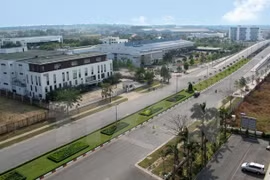
Vietnam’s production decreases in August ảnh 1The effects of the COVID-19 pandemic led to declines in both output and new orders for the Vietnamese manufacturing industry in August. (Photo: baoninhthuan.com.vn)

Hanoi (VNA) -
The Vietnam Manufacturing Purchasing Managers' Index(PMI) fell to 45.7 in August from 47.6 in July as the effects of COVID-19 ledto a deterioration of business conditions in the country’s manufacturingsector, the latest survey by IHS Markit released this week showed.

This represented a second successive deterioration in the health of themanufacturing sector after a return to growth had been signalled in June.Although marked, the latest decline in business conditions was much less severethan that seen during the worst of the COVID-19 related downturn in April.

According to the survey, respondents indicated that the effects of the COVID-19pandemic led to declines in both output and new orders. New business decreasedat a solid pace amid reports of weak customer demand. Data also pointed to asharp reduction in new export orders, and one that was faster than that seenfor total new business.

The latest reduction in manufacturing output was the eighth in the past ninemonths, and faster than that seen in July. All three broad sectors posteddrops, with the rate of contraction sharpest among intermediate goodsproducers.

“Declining new orders led to further reductions in both backlogs of work andemployment amid a lack of pressure on operating capacity. The rate of depletionin outstanding business was sharp, while firms scaled back their staffinglevels to an extent only exceeded during the worst of the recent downturn inApril,” the survey stated.

A faster reduction in purchasing activity was also recorded amid lower neworders and production requirements. That said, the fall in input buying wasstill much weaker than April's record. The scaling back of inventories alsocontinued, with stocks of both purchases and finished goods decreasing inAugust. Some respondents indicated that finished products had been dispatchedto customers as soon as they were ready to avoid a build-up of inventories.

Input prices increased for the third month running in August, albeit at only aslight pace that was slower than the series average. A scarcity of materialsdue to the COVID-19 pandemic was the principal cause of the rise in inputcosts, according to respondents. Similarly, the impact of the pandemic wascentral to another lengthening of suppliers' delivery times.

Manufacturers responded to weak demand conditions by lowering their outputprices again midway through the third quarter of the year. Selling prices havenow decreased in each of the past seven months, with the latest fall thefastest since May.

Concerns around the ongoing effects of COVID-19 on demand led to a drop inconfidence among manufacturers regarding the 12-month outlook for production.Firms still predicted, on balance, that output will rise over the coming year,linked to hopes that the pandemic will be brought under control. That said,optimism was among the weakest since the series began in April 2012.

“With the data moving in the wrong direction at present, the latest PMI datafor Vietnam highlight the ongoing effects of COVID-19 on the manufacturingsector and the challenges faced in trying to overcome them. Customer demandremained weak, with firms scaling back production accordingly. The picturearound employment was particularly worrying, with jobs lost at thesecond-fastest pace in nine-and-a-half years of data collection,” AndrewHarker, Economics Director at IHS Markit, said.

However, he noted: "Firms will be hoping that the virus can be broughtback under control so that the recovery that got underway in June can get backon track."/.
VNA

See more

Production of footwear for export at Lefaso Tra Vinh Industrial Investment and Production Joint Stock Company, Tra Cu commune, Vinh Long province (Illustrative image. Source: VNA)

VEFTA implementation requires exporters to restructure supply chains: Experts

Under VEFTA, tariff reductions to zero will be meaningless for Vietnam’s key export sectors, including textiles and garments, footwear, and agricultural and aquatic products, if goods are found to contain banned chemicals, violate rules of origin or lack transparency regarding their carbon footprints.

Deputy Prime Minister Nguyen Van Thang meets with Martin Sommer, head of the IMF’s Article IV consultation mission team to Vietnam, in Hanoi on November 13, 2026. (Photo: VNA)

IMF sees positive growth prospects for Vietnam, urges cautious monetary policy

Martin Sommer, head of the IMF’s Article IV consultation mission team to Vietnam, noted that inflation risks in Vietnam remain under control, but several factors could add to price pressures. He therefore called for cautious monetary policy management and readiness to respond promptly if inflationary pressures increased.

Representatives of the three first-prize-winning startups receive their awards at the event. (Photo: SGGP)

Seven green-tech startups secure 770,000 USD at Net Zero Challenge 2026

In its fourth year, the competition attracted more than 1,100 applications from 80 countries and territories, making it the most competitive edition since its launch in 2023. Nine finalists presented solutions in three categories, namely renewable energy and carbon removal; food systems and sustainable agriculture; and circular economy and waste management.

Vietnamese and Malaysian businesses connect at the event (Photo: VNA)

Vietnam, Malaysia connect businesses to boost bilateral trade cooperation

It centred on a business-to-business (B2B) matchmaking session, bringing Vietnamese and Malaysian companies together to discuss import-export needs, seek partners and explore cooperation. Vietnamese businesses aimed to connect with Malaysian importers, distributors and retailers, while expanding access for their products to Malaysia and other markets.

Visitors browse traditional Southern Vietnamese checked scarves on display at the Vietnam-Cambodia Trade Fair. (Photo: VNA)

Vietnam-Cambodia trade fair opens in An Giang

The fair features 150 booths representing 200 businesses, cooperatives, household businesses and production and trading establishments from both countries. The exhibition space is arranged into 10 zones showcasing products from Vietnamese localities and three zones featuring Cambodian products, creating opportunities for businesses from the two countries to promote their products, seek partners and expand markets.

An overview of the press conference to announce the organisation of the second Vietnam International Rice Festival - Can Tho 2026. (Photo: VNA)

Festival to chart new course for rice industry

The second Vietnam International Rice Festival - Can Tho 2026 will take place from November 22 to 25, showcasing the achievements and potential of Vietnam’s rice industry while promoting Can Tho’s image, cultural identity and people, as well as the distinctive river culture of the Mekong Delta.

Japanese business representatives review Ho Chi Minh City’s investment project portfolio at the conference. (Photo: VNA)

Vietnam remains attractive destination for Japanese businesses

Fukai Akihiko, President and Representative Director at Gunma Bank and head of a business delegation from Japan’s Gunma prefecture, said cooperation between Gunma and Vietnam has continued to expand in recent years. Around 15,000 Vietnamese people currently live in Gunma, forming the largest foreign community in the prefecture.