Work starts on Quang Tri airport project

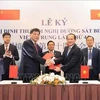
Construction started on the Quang Tri airport project, which has an initial outlay of 5.8 trillion VND (227 million USD), in Gio Linh district on July 6 by the People’s Committee of the central province of Quang Tri and a joint venture between T&T Group and CIENCO 4.

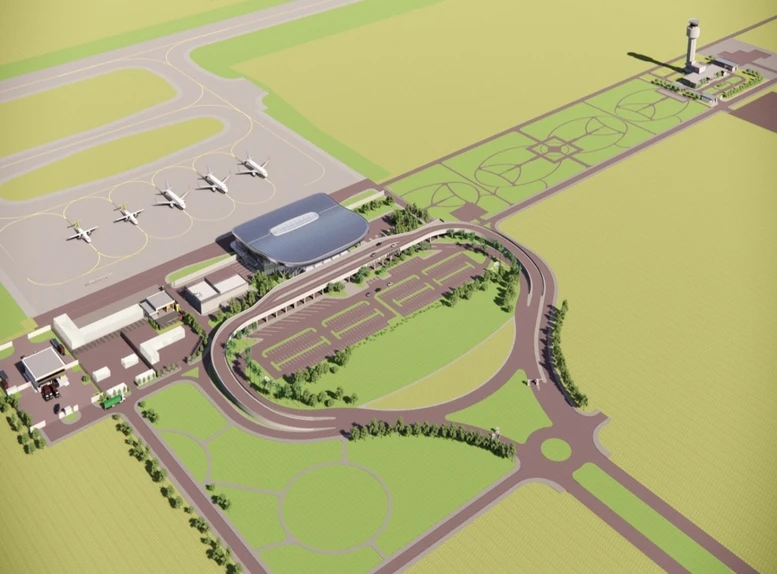
Blueprint of Quang Tri airport. (Photo: baochinhphu.vn)

Quang Tri (VNA) - Construction started on the Quang Tri airport project, which has an initial outlay of 5.8 trillion VND (227 million USD), in Gio Linh district on July 6 by the People’s Committee of the central province of Quang Tri and a joint venture between T&T Group and CIENCO 4.

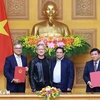
Vice President Vo Thi Anh Xuan, Deputy Prime Minister Le Thanh Long and representatives from central and local agencies attended the groundbreaking ceremony.

The project, approved by the Prime Minister under the public-private partnership model, is located in the communes of Gio Quang, Gio Hai, and Gio Mai in Gio Linh district, covering an area of 265 ha.

The project is expected to be implemented in 50 years including 24 months for preparation and construction and 47 years and 2 months for operation and toll collection to recoup investment.

Upon completion, the airport will meet the standards of a Class 4C airport defined by the International Civil Aviation Organisation and a Level II military airport, capable of handling Code E aircraft and serving about 5 million passengers and 25,500 tonnes of cargo annually.

It will address the ever-growing demand for air travel, foster economic growth, and ensure high mobility for military operations and disaster relief efforts in the Central Region.

The construction of the airport is expected to be completed by July 2026.

Speaking at the ceremony, Deputy PM Le Thanh Long applauded the provincial People’s Committee, the Transport Ministry and relevant agencies for overcoming difficulties and creating favourable conditions for the airport project to be implemented.

He asked the province to support investors, construction and consultancy units during the project's implementation, especially ensuring the progress of site clearance and resettlement./.


VNA

See more

Experts said that Vietnam’s economic outlook continues to be underpinned by stable foreign direct investment inflows and public investment, which is playing an important role in driving growth. (Photo: thoibaotaichinh.vn)

Foreign investors maintain strong confidence in Vietnam’s market

Looking ahead to 2026, prospects remain bright as manufacturing, economic growth and foreign investment in Vietnam are expected to stay robust, with the country forecast to post the highest growth rate in the region this year, according to Adam Sitkoff, Executive Director of the American Chamber of Commerce (AmCham) in Vietnam.

Toy production at a Hong Kong-invested factory (Photo: VNA)

Vietnam targets deeper market penetration in Hong Kong in 2026

Vietnam-Hong Kong trade hit 62.3 billion USD in the first 11 months of 2025, soaring 73.1% annually. Vietnamese exports to Hong Kong amounted to 36.8 billion USD, a 90.6% hike, ranking fourth among Hong Kong’s import sources, while imports from Hong Kong stood at 25.5 billion USD, up 52.9% and ranking third.

Vietnam’s start-up market enters restructuring phase

Vietnam’s start-up market enters restructuring phase

In 2026, venture capital inflows into Vietnam’s start-up ecosystem are expected to recover gradually, though in a more selective manner. VinVentures forecasts that capital will focus on start-ups that have survived the rigorous screening of 2024–2025, possess clear business models, strong commercialisation capacity, and the ability to generate real cash flows.

Workers process tra (pangasius) for export (Photo: VNA)

Vietnam–Singapore trade continues to thrive

For the year as a whole, Vietnam retained its position as Singapore’s 10th largest trading partner. Bilateral trade reached a record high of nearly 40 billion SGD, up 26.2% from the previous peak of 31.67 billion SGD recorded in 2024.

Eric Van Vaerenbergh, an energy expert and lecturer at the Brussels Engineering School (ECAM) (Photo: VNA)

Belgian expert optimistic about Vietnam’s economic outlook

Vietnam should move from a growth model based mainly on expanding capital and labour to one driven by productivity improvements. He said that this requires enhancing the quality of the workforce, particularly engineers, technicians, and managers in industrial sectors.

Workers at the VSIP Hai Phong industrial and urban complex, which specialises in producing electronic components for office equipment. (Photo: VNA)

Roadmap aims to improve business climate and boost competitiveness

By the end of 2026, Vietnam aims to rank among the world’s top 50 performers in the United Nations Sustainable Development Goals, advance at least three places in the International Property Rights Index, and climb at least one position in the Global Innovation Index.

Vietnam is strengthening its position in the technology value chain, becoming a major manufacturing hub for complete consumer electronics products. (Photo: VNA)

ESG standards offer opportunities to reposition Vietnam’s electronics firms

The 2025-2027 period will be a critical turning point, as exporters to the European market will be required to strictly comply with ESG standards, including net-zero emissions roadmaps, labour standards, corporate governance and transparency requirements. As a key export sector, the electronics industry is being directly and strongly affected by this shift.