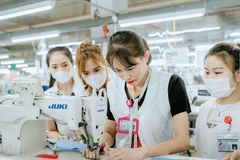
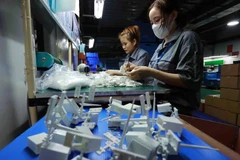
Garment production for export to Japan at Hung Yen Garment Corporation in Yen My district, the northern province of Hung Yen. (Photo: VNA)
Hanoi (VNA) – A surge in demand for personal protective equipment (PPE) from the manufacturing sector in Vietnam due to COVID-19 pandemic, along with the orders that flowed in from around the world helped to buoy the country’s important garment-making industry with many manufacturers rejigging their facilities to produce PPE, said an article on forbes.com.
The article cited statistics from Vietnam’s Ministry of Industry and Trade showing that there are more than 6,000 garment factories and textile mills in the country, and the sector employed some 3 million workers in 2020.
The Vietnamese government had initially restricted the export of goods, such as face masks, to ensure there was an adequate domestic supply to help combat the virus. But once the restrictions were lifted in March of last year, Vietnam’s manufacturers exported almost 1.2 billion masks through to December 2020 to North America, Europe and around Asia, it noted.
As the pandemic spread and global consumption slowed, Vietnam's significant garment industry saw orders sharply reduced. Vietnam's garment and textile exports were down overall in 2020, the first time it has seen negative growth in a quarter of a century.
The article mentioned as an example Vietnam Goods and Exports (VGE) which turned to making cloth face masks.
VGE founder Anh Tran was quoted as saying that he made the decision to switch in early 2020, and sees an ongoing demand for his product.
“Despite vaccines now rolling out, the [Centers for Disease Control] is still recommending people to wear masks because it is a slow rollout, and there are still many at-risk people you can affect or be affected by,” he said.
“If vaccines are effective, you will probably see a drop-off in the wearing of masks near the end of 2021, but from now until then, it is still a massive industry that just exploded overnight.”
Anh said Vietnam had always excelled at garment manufacturing and low-tech products like personal protective equipment, such as face masks, gowns, hand sanitizers, wipes and things of that nature. “Vietnam has definitely become a shining star in the global PPE trade in 2020 because prior to that most PPE was manufactured in China or the United States,” he added.
Vietnam’s Ministry of Industry and Trade is bullish on the possibilities of the garment and textile industry producing PPE, particularly in the anti-bacterial cloth mask segment. In an interview with the Vietnam News Agency, Deputy Director of the ministry’s Import-Export Department Tran Thanh Hai said that Vietnam was capable of becoming one of the world’s major cloth face mask producers.
Coupled with the fact that anti-bacterial fabric was now being produced locally, he believed production capacity could be increased significantly.
“It is important to raise awareness among consumers about cloth masks and encourage them to switch to cloth masks instead of medical masks,” Hai said.
The rapid expansion of the PPE manufacturing sector helped to buoy parts of the economy, but the massive global demand has also created its own set of challenges in terms of production capacity.
NKC Holdings CEO Sonny Subedi became stranded in Vietnam when countries closed their borders. He said he initially got into PPE to try to do some good in combating the pandemic and began by importing N95 masks into Vietnam. However, with the country so effectively controlling the virus, his local factory contacts soon had an excess supply of masks and he began selling to international buyers./.