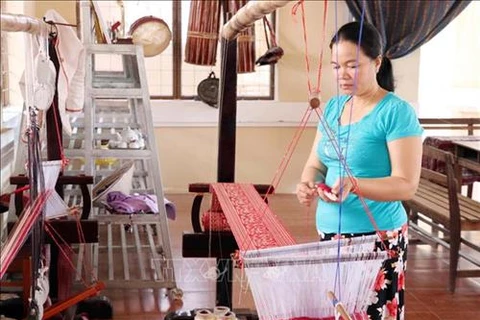
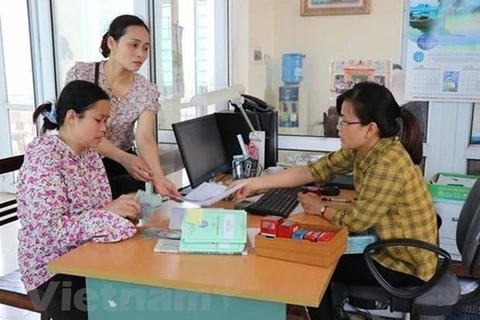
Illustrative image (Photo: VNA)
 Vinh Long (VNA) - The Mekong Delta province of Vinh Long is focusing on providing rural labourers with vocational skills that are needed by local businesses.
Binh Minh Town Continuing Education and Vocational Training Centre is providing new training courses on sedge weaving for labourers in Dong Thanh commune. The job helps them earn additional income after working in the rice field.
Most of people in Dong Thanh are ethnic Khmer and live on growing rice and have a low income.
Thach Thi Tham, one of the women who participated in a training course in Dong Thanh, said: "After learning the skills, we can earn an additional income of one million VND (42.5 USD) a month from making sedge weaving products."
Son Thi Say Ha, a teacher at the centre, said the craft of sedge weaving does not require high techniques and high education, and people can use their leisure time to do sedge weaving products.
“The centre has cooperated with establishments that produce sedge weaving products to secure outlets for trainees so they can have a job later,” she said.
The province’s vocational centres have diversified their training courses and time of training so labourers can participate in courses and still do their job.
According to Vo Thi To Lan, deputy chairwoman of the Tich Thien Commune Women's Union in Tra On district, most women in the commune live on agricultural production and do not have other work to do when they have leisure time.
The union has worked with a vocational training centre to provide courses on making handicraft products for its members.
This year, the province plans to provide vocational skills for 35,500 labourers, including short-term vocational skills for 7,000 rural labourers, according to the provincial Department of Labour, Invalids and Social Affairs.
Of the 7,000 rural labourers, 1,500 will be provided agricultural vocational skills and 5,500 will be provided non-agricultural vocational skills.
Last year, the province provided vocational skill training for 32,741 labourers, including 5,405 from rural areas. More than 50 percent of the trainees have found stable jobs.
Huynh Thi My Ha, deputy director of the department, said the province’s vocational training had achieved positive results but the rate of trained labourers reached only 50 percent.
The province targets increasing the rate of trained labourers to 55 percent by the end of the year, Ha said.
The province will give priority to vocational skills in high demand like civil construction, welding, industrial sewing and hospitality services.
It will also work with local companies to provide vocational training based on their requirements./.
Binh Minh Town Continuing Education and Vocational Training Centre is providing new training courses on sedge weaving for labourers in Dong Thanh commune. The job helps them earn additional income after working in the rice field.
Most of people in Dong Thanh are ethnic Khmer and live on growing rice and have a low income.
Thach Thi Tham, one of the women who participated in a training course in Dong Thanh, said: "After learning the skills, we can earn an additional income of one million VND (42.5 USD) a month from making sedge weaving products."
Son Thi Say Ha, a teacher at the centre, said the craft of sedge weaving does not require high techniques and high education, and people can use their leisure time to do sedge weaving products.
“The centre has cooperated with establishments that produce sedge weaving products to secure outlets for trainees so they can have a job later,” she said.
The province’s vocational centres have diversified their training courses and time of training so labourers can participate in courses and still do their job.
According to Vo Thi To Lan, deputy chairwoman of the Tich Thien Commune Women's Union in Tra On district, most women in the commune live on agricultural production and do not have other work to do when they have leisure time.
The union has worked with a vocational training centre to provide courses on making handicraft products for its members.
This year, the province plans to provide vocational skills for 35,500 labourers, including short-term vocational skills for 7,000 rural labourers, according to the provincial Department of Labour, Invalids and Social Affairs.
Of the 7,000 rural labourers, 1,500 will be provided agricultural vocational skills and 5,500 will be provided non-agricultural vocational skills.
Last year, the province provided vocational skill training for 32,741 labourers, including 5,405 from rural areas. More than 50 percent of the trainees have found stable jobs.
Huynh Thi My Ha, deputy director of the department, said the province’s vocational training had achieved positive results but the rate of trained labourers reached only 50 percent.
The province targets increasing the rate of trained labourers to 55 percent by the end of the year, Ha said.
The province will give priority to vocational skills in high demand like civil construction, welding, industrial sewing and hospitality services.
It will also work with local companies to provide vocational training based on their requirements./.
VNA