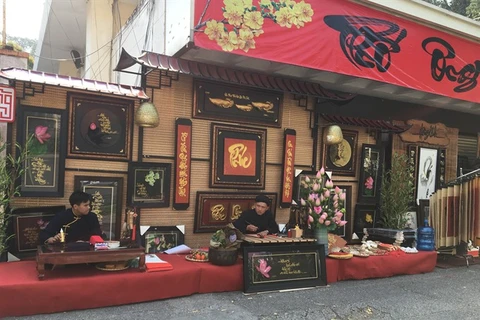
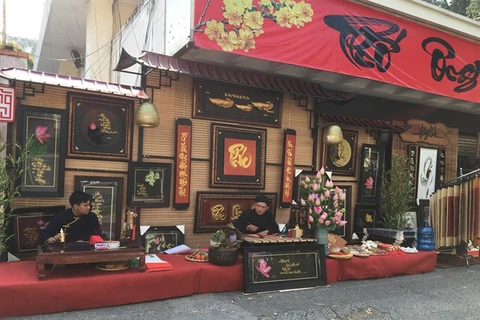
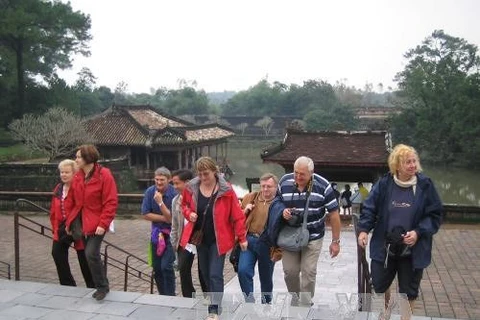
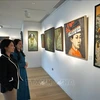
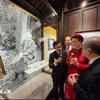
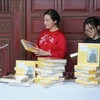
People look at the calligraphic words at the Quoc Tu Giam (Imperial Academy) (Photo: VNA)
 Hanoi (VNA) – For generations, Vietnamese have preserved a traditional New Year custom of collecting calligraphic words written in ancient Vietnamese-Chinese script. The practice reflects their respect for knowledge and learning.
Word-asking activity – a New Year traditional custom
A long time ago, when the lunar New Year began, people looked for scholarly intellectuals, who understood calligraphy, to ask for meaningful words or sets of words. Word-seekers were often heads of families, who wished for new opportunities and for their relatives’ academic fortunes. Calligraphers were prestigious teachers or nationally honoured contributors.
According to calligrapher Cung Khac Luoc, the words connect the writer’s mind and the word-seeker’s heart. When people ask for words, they ask not only for luck but also for for kindness and the talent of the calligraphers to remind them to lead a good life, he said.
The activity demonstrates the nation’s desire for knowledge, Luoc noted.
In the past, the word-asking event was a special occasion, whose date and time needed to be chosen carefully. The words, once brought home, would be hanged at the best spots inside.
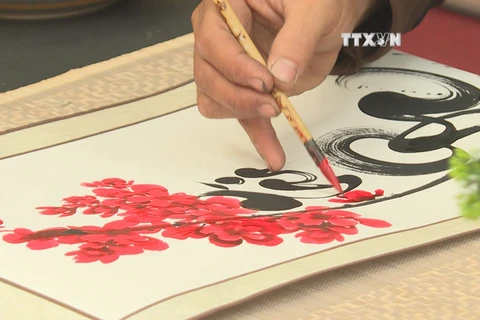
Words in the ancient Vietnamese-Chinese script could be written in many different ways based on writers’ moods, styles and creativity. Calligraphers’ work was imbued with expectations for a year of happiness and peace ahead. Words are selected following the seekers’ wishes. The most popular ones included “Blessing” and “Luck” for families and children; “Prosperity”, “Wealth”, and “Creditability” for businessmen; “Talent” and “Success” for students; “Longevity” for people yearning for good health and a long life; and “Patience” for those who want to train their tolerance.
The words were often written on red paper. The colour red in East Asia is associated with luck, life and vitality.
An enduring cultural tradition of the nation
After 1954, the word-asking activity and writing of Han script was boycotted due to its relation with the feudal era. At the time, writers did not dare to write, and people did not dare to ask for words. The custom fell into oblivion.
Fortunately, old masters have revived it. In the early period of the 21st century, some sat on the corner of the Ba Trieu street in Hanoi, writing and selling their calligraphic works. The place later got crowded with calligraphers. The corner was moved to the Literature Lake area in front of the Temple of Literature, forming the commonly called “Calligraphers’ Street”. After a quarter of century, the custom is now thriving.
In recent years, “Calligraphers’ Street” has turned into a popular spot around the lunar New Year holiday (Tet). Against the ancient backdrop of Quoc Tu Giam (Imperial Academy) – the country’s first national university – calligraphers in traditional tunics, in jeans and T-shirts and even in suits perform calligraphy. Lucky words are now written in both ancient Vietnamese-Chinese and Vietnamese scripts. Similar streets have been formed in provinces and cities nationwide.
The Temple of Literature’s annual Spring Calligraphy Festival falls between the 20th day of the 12th month in the past year and the 15th day of the first month of the lunar New Year. The event attracts thousands of people nationwide who wish to obtain lucky words for New Year. It links both calligraphers and word-seekers, and contributes to preserving the custom.
As Tet is coming to all corners of the country, people are on their way to bring home calligraphic papers, which are full of hope for a blessed New Year.-VNA
Word-asking activity – a New Year traditional custom
A long time ago, when the lunar New Year began, people looked for scholarly intellectuals, who understood calligraphy, to ask for meaningful words or sets of words. Word-seekers were often heads of families, who wished for new opportunities and for their relatives’ academic fortunes. Calligraphers were prestigious teachers or nationally honoured contributors.
According to calligrapher Cung Khac Luoc, the words connect the writer’s mind and the word-seeker’s heart. When people ask for words, they ask not only for luck but also for for kindness and the talent of the calligraphers to remind them to lead a good life, he said.
The activity demonstrates the nation’s desire for knowledge, Luoc noted.
In the past, the word-asking event was a special occasion, whose date and time needed to be chosen carefully. The words, once brought home, would be hanged at the best spots inside.
Words in the ancient Vietnamese-Chinese script could be written in many different ways based on writers’ moods, styles and creativity. Calligraphers’ work was imbued with expectations for a year of happiness and peace ahead. Words are selected following the seekers’ wishes. The most popular ones included “Blessing” and “Luck” for families and children; “Prosperity”, “Wealth”, and “Creditability” for businessmen; “Talent” and “Success” for students; “Longevity” for people yearning for good health and a long life; and “Patience” for those who want to train their tolerance.
The words were often written on red paper. The colour red in East Asia is associated with luck, life and vitality.
An enduring cultural tradition of the nation
After 1954, the word-asking activity and writing of Han script was boycotted due to its relation with the feudal era. At the time, writers did not dare to write, and people did not dare to ask for words. The custom fell into oblivion.
Fortunately, old masters have revived it. In the early period of the 21st century, some sat on the corner of the Ba Trieu street in Hanoi, writing and selling their calligraphic works. The place later got crowded with calligraphers. The corner was moved to the Literature Lake area in front of the Temple of Literature, forming the commonly called “Calligraphers’ Street”. After a quarter of century, the custom is now thriving.
In recent years, “Calligraphers’ Street” has turned into a popular spot around the lunar New Year holiday (Tet). Against the ancient backdrop of Quoc Tu Giam (Imperial Academy) – the country’s first national university – calligraphers in traditional tunics, in jeans and T-shirts and even in suits perform calligraphy. Lucky words are now written in both ancient Vietnamese-Chinese and Vietnamese scripts. Similar streets have been formed in provinces and cities nationwide.
The Temple of Literature’s annual Spring Calligraphy Festival falls between the 20th day of the 12th month in the past year and the 15th day of the first month of the lunar New Year. The event attracts thousands of people nationwide who wish to obtain lucky words for New Year. It links both calligraphers and word-seekers, and contributes to preserving the custom.
As Tet is coming to all corners of the country, people are on their way to bring home calligraphic papers, which are full of hope for a blessed New Year.-VNA
VNA