World Bank builds offshore wind roadmap for Vietnam

The World Bank has recommended 20 actions that address three priority themes for Vietnam’s successful offshore wind industry.
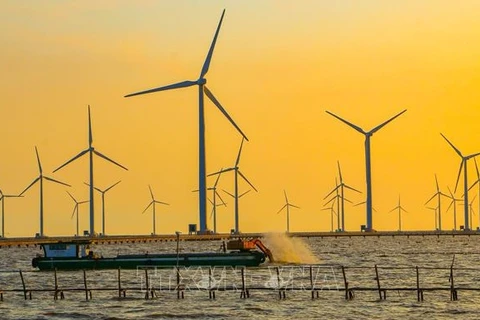
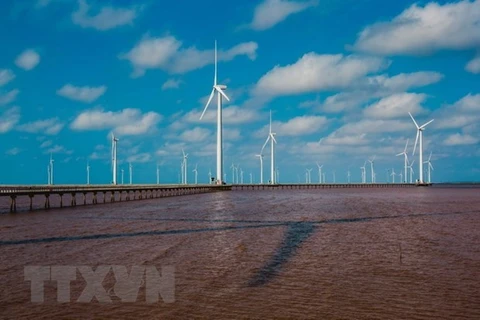
World Bank builds offshore wind roadmap for Vietnam ảnh 1A wind farm in Bac Lieu province (Photo: VNA)

Hanoi (VNA) – The World Bank has recommended 20actions that address three priority themes for Vietnam’s successful offshore windindustry.

The ‘Offshore Wind Roadmap for Vietnam’ report is the outcome of a study that followed an invitation from the Vietnamese Government to theWB. It was carried out from February to October 2020.

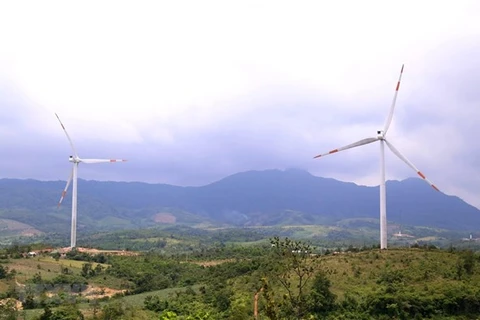
According to the WB, by 2035, there will be about 450 largeoffshore wind turbines operating in Vietnam, installed at about 10 large conventionalfixed offshore wind farms and one or two at floating ones.

In addition, based on leases issued to date, there will beabout 30 smaller nearshore wind farms using smaller turbines.

The WB warned that nearshore projects in proximity to keybiodiversity areas, critical habitats, and sensitive natural habitats willlikely result in very high environmental impacts and may be unlikely to meet WBGroup environmental and social standards.

The cost of energy of the first offshore wind projects willlikely be high, at 150-200 USD/MWh, due to a lower capacity factor,limited use of local suppliers, and small project scale.

Experience from other markets has shown that the cost ofenergy quickly reduces as more capacity is built out, with risks reducing andlocal capability increasing. In this scenario, the cost of energy of projectscan be expected to reduce to around 80–90 USD/MWh by 2030 and 60–70 USD/MWh by2035.

Under high growth scenario, with significant expansion ofoffshore wind resulting in offshore wind supplying 12 percent of Vietnam’selectricity needs by 2035, levelised cost of energy is projected to be 20percent lower.

Local jobs will quadruple and there will be more value addedto the economy. Consumers will enjoy less than half the net cost, according tothe report.

Experience in developed offshore wind markets suggest thatambitious, long-term targets can serve as cornerstones for industry development,it continued.

The results of this roadmap suggest that a target of 10 GWby 2030 and 25 GW by 2035 would likely accomplish this objective. At the sametime, a consequence of higher growth is a higher risk of adverse environmentaland social impacts.

This places even greater importance on the need to develop amarine spatial plan and a framework for environmental legislation to be put inplace before development leases are issued./.
VNA

See more

Quang Tri recently received two endangered pangolins from local resident. (Photo published by VNA)

Two pangolins handed over to authorities in Quang Tri

At around 8:30 pm on April 12, Le Thanh Tung, a resident of Thuong Nghia hamlet in Cam Lo commune, and his friend spotted the two pangolins, weighing over 4 kg, while working near the Cam Lo–La Son Expressway.

A view of Phong Nha - Ke Bang National Park in Da Nang city (Photo: VNA)

Phong Nha – Ke Bang: untapped biological treasure in Truong Son mountains

Unlike ecosystems where species inventories are largely complete, Phong Nha–Ke Bang National Park remains scientifically “open,” with each survey revealing new findings. Recent studies - from local research projects to international collaborations - have recorded additional bird species and identified the rare parasitic plant Sapria himalayana, which only survives in intact primary forests.

The interface of Vietnam Weather KTTV mobile application (Photo: baochinhphu,vn)

Application of dangerous weather warning introduced

All unusual weather events, from widespread thunderstorms, lightning strikes, landslides, flash floods, tropical depressions to strong winds at sea, are continuously updated from official data sources of the NCMHF and meteorological stations and prominently displayed on the main interface.

An overview of the kick-off meeting for the “Sustainable Management of Substances Controlled by the Montreal Protocol” project (Photo: VNA)

Vietnam launches 13 mln USD project to phase out ozone-depleting substances

Funded by the Multilateral Fund for the Implementation of the Montreal Protocol and implemented through the World Bank (WB) and the United Nations Environment Programme (UNEP), the project aims to help Vietnam meet its international commitments in managing and phasing out controlled substances. It will run from 2026 to 2031 with a total budget of over 13 million USD.

Tram Chim National Park and the Mekong Conservancy Foundation (MCF) organise the workshop on sustainable restoration of wetland ecosystems in the Mekong Delta on March 24. (Photo: VNA)

Solutions sought to restore Mekong Delta wetland ecosystems

Experts at the workshop described wetlands as the “ecological heart” of the Mekong Delta, playing a vital role in water storage and regulation, climate moderation, carbon sequestration, biodiversity conservation, and livelihoods for millions of people through aquaculture, agriculture, and ecotourism. These ecosystems also help reduce disaster risks and enhance climate resilience.

Deputy Minister of Agriculture and Environment Le Cong Thanh speaks at the ceremony to launch major environmental campaign. (Photo: VNA)

Vietnam calls for collective action on water, air, climate and sustainable future

Deputy Minister of Agriculture and Environment Le Cong Thanh underscored that water, climate, and energy are fundamental pillars of sustainable development. In Vietnam, water resources and weather patterns influence every aspect of life, from food and water security to livelihoods, ecosystem stability, and economic growth.