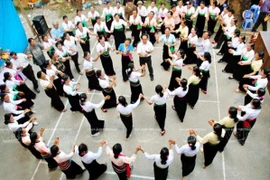
Xoe - unique dance of Thai ethnic minority group in Northwestern region (Photo: VNA)
Hanoi (VNA) – The art of Xoe dance symbolises the beauty, artistic value, and culture of the Thai ethnic minority group in the Northwestern region comprising Yen Bai, Lai Chau, Son La and Dien Bien provinces.
With the art of Xoe dance recognised by UNESCO as an Intangible Cultural Heritage of Humanity, Thai ethnic minorities and people of other ethnic groups in the Northwestern region are determined to make every effort to preserve and further promote the art in the contemporary life.
From ancient times, the Thai people have had folk songs as follows: “Without Xoe, crops cannot grow well/ Without Xoe, the harvest will fail/ Without Xoe, flowers will wither/ Without Xoe, boys and girls cannot fall in love with each other.”
 The art of Xoe dance is a unique form of traditional dance imbued with cultural identity of Thai people in the northwestern provinces of Lai Chau, Dien Bien, Son La and Yen Bai. (Photo: VNA)
The art of Xoe dance is a unique form of traditional dance imbued with cultural identity of Thai people in the northwestern provinces of Lai Chau, Dien Bien, Son La and Yen Bai.
With movements emulating activities in the daily life, Xoe has long been an indispensable part in the Thai cultural and spiritual life. It is performed at all important events of the Thai people, ranging from weddings and funerals to village festivals and community cultural activities. Xoe music conveys the Thai worldview and their outlook on life in heaven, on earth, and of the deities. Xoe also expresses the Thai people’s wishes for help and blessing from the deities for a peaceful and prosperous life.
The art of Xoe dance was born in the working process of the Thai people, gradually becoming a dance that unites ethnic groups in the Northwestern region.
Meritorious Artisan Lo Van Bien from Cang Na hamlet, Trung Tam ward, Nghia Lo township Yen Bai province has wholeheartedly devoted himself to the study of Thai culture. He suggested that living amidst majestic nature with a creative spirit in the conquest of nature, the Thai ethnic minority people often held hands together and danced around a fire to celebrate their completion of a major work. Xoe dance was formed and developed from there.
 The art of Xoe dance was born in the working process of the Thai people, gradually becoming a dance that unites ethnic groups in the Northwestern region. (Photo: VNA)
Xoe is known as “Xoe kham khe” (hand-held dance), which arose from ethnic minority labour, daily life, customs and festivals.
Many Xoe dances simulate their forefathers’ steps to clear the land and fields, plant rice, collect water, throw handkerchiefs and offer wine. All of them describe vividly the reality of life to express the aspirations and dreams of the Thai ethnic people.
The Thai people have six ancient Xoe dances, which is the origin of the folk-dance art of the Thai people. The most basic dance is "kham khan moi lau" - an invitation to neighbours to drink rice wine. This Xoe dance shows the culture in communication and behaviour of the Thai ethnic group. According to the Thai people, anyone who comes to visit the house is welcomed very respectfully and sincerely.
The second is the "pha xi", a dance that displays the solidarity of the Thai community. The third, also the most jubilant and bustling Xoe dance, is the "nhom khan" or the tossing scarfs dance. Born with the development of cotton-weaving, it praises the creative labour of weaving the scarfs.
The other three are ‘kham khen’ (holding hands), which illustrates solidarity and cohesion in the community. The ‘don hon’ (stepping up and down), conveying a message that everyone should stay with strong beliefs despite ups and downs in life. The ‘om lom top mu’ dance (clapping hands while walking in a circle), represents joy and happiness at the end of a celebration.
Xoe dances may be divided into three main types - ritual, circle and presentational. The ritual and presentational Xoe are often named after props used during the performances such as Xoe khan (dance with scarves), Xoe non (dance with conical hats), Xoe quat (dance with fans), Xoe sap (dance with bamboo poles), Xoe qua nhac (dance with small copper balls), Xoe gay (dance with sticks), and Xoe hoa (dance with flowers).
The most popular form of Xoe is circle Xoe, a collective dance which is usually performed in festivals such as the lunar New Year. Dancers stand in a circle, hand in hand, move to the sound of traditional music in a friendly, happy and sociable atmosphere. The circle will be gradually expanded when more people join the dance.
 The art of Xoe Thai dance has been handed down by generations of community members, regardless of age or gender (Photo: VNA)
The art of Xoe Thai dance has been handed down by generations of community members, regardless of age or gender. Practitioners of Xoe dances can learn from each other to rhythmically engage with the music.
With artistic and humanistic values, at present, Xoe dances are compiled and put into basic dance lessons to preserve the cultural practice. Many Xoe dances have been staged in national-level festivals, competitions both home and the world./.