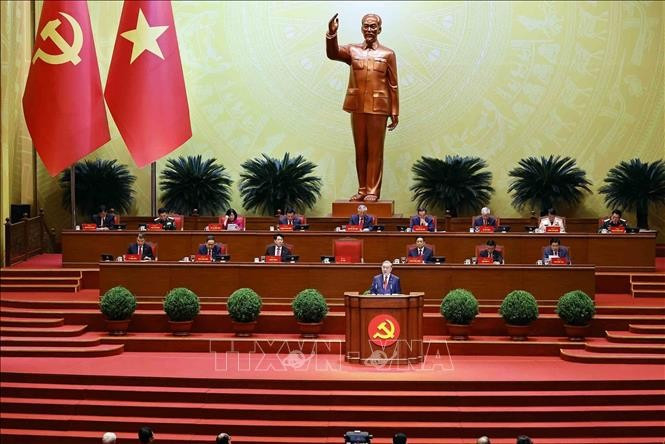
Hanoi (VNA) – As the 14th National Congress of the Communist Party of Vietnam officially opened on January 20, international media outlets have continued to publish articles analysing Vietnam’s socio-economic development strategy, describing the country as one of the world’s most dynamic and consistently high-performing economies.
An article in The New York Times described the 14th National Congress as the most consequential in decades, taking place at a time when Vietnam — an emerging middle power and one of Asia’s most dynamic countries — is facing its best and last chance to “get rich before getting old.”
According to the article, after 40 years of renewal and an extraordinary rise out of poverty, Vietnam is under growing pressure to pursue bolder reforms to catch up with regional peers. Beyond geopolitical challenges, the country’s main challenge is implementing policies that build openness, efficiency and competition, it wrote.
Commenting on Vietnam’s agenda for the next five years, Modern Diplomacy noted that the draft Resolution of the CPV’s 14th National Congress reflects a stronger focus on security alongside ambitious economic growth targets. The Party has set a goal of achieving annual growth of at least 10% over the next five years - a significant leap compared to earlier targets. The article observed that, internationally, Vietnam’s political stability continues to provide reassurance for investors seeking predictability.
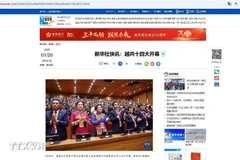
Meanwhile, an article on the Congress, published by China’s Shangguan News website, recalled the economic targets set at the 13th National Congress. These include transforming Vietnam by 2025 into a developing country with a modern-oriented industry and surpassing the lower-middle-income threshold. By 2030, the country would develop into an upper-middle-income nation with modern industry, and by 2045, into a high-income developed nation.
Analysts noted that this will require Vietnam’s per-capita GDP to increase by around 70% by 2030 from its current level of approximately 5,000 USD. It is anticipated that the Vietnamese Government will focus on promoting private-sector development, the digital economy, and science and technology.
The article also revealed that despite facing an additional 20% tariff imposed by the US Government, Vietnam’s economy has demonstrated strong resilience, recording economic growth of over 8% last year. However, the country continues to face significant challenges, including meeting the expectations of its domestic youth workforce, balancing relations with China and the US, and addressing issues such as environmental pollution.
The Chinese news portal 163.com highlighted three strategic breakthroughs identified in the draft documents submitted for discussion at the 14th National Congress. They include developing institutions, economic restructuring, and improving the quality of human resources. Further breakthroughs include building socio-economic infrastructure, particularly in transport, technology and energy infrastructure.
In an article published on January 20, Bloomberg quoted analysts as saying that the 14th National Congress of the CPV represents the formalisation and consolidation of measures that have shaped the country’s macroeconomic trajectory. As Vietnam seeks to move up the value chain and achieve high-income status by 2045, the Congress is aiming to promote the development of the private sector as one of the most important drivers of growth. Vietnam continues to position itself as an economy open to trade and investment, while seeking to reduce vulnerability to external shocks through diversification, strengthening internal capacity and enhancing institutions./.
See more
ASEAN boasts potential of world's battery
He stressed that the deployment of smart grids would demonstrate ASEAN’s collective commitment to climate mitigation and green initiatives, adding that the bloc has the potential to become a major energy provider, or “battery”, for the world.
Malaysia’s manufacturing sector expected to sustain growth into 2026
RHB Investment Bank maintained an optimistic view on the sector’s prospects, forecasting IPI growth of 4.1% in 2026. Despite concerns over a global economic slowdown, higher tariffs and geopolitical volatility, industrial activity is expected to remain on a growth trajectory. For the whole of 2025, Malaysia’s IPI expanded by 3.6%, nearly matching the 3.7% increase recorded in 2024.
Foreign arrivals to Thailand since 2026 beginning surpass 4 million
For the week February 2–8, Thailand recorded 796,978 international arrivals, up 34,586, or 4.54%, from the previous week, averaging 113,854 arrivals per day.
Malaysia combats smuggling of e-waste
The Malaysian government is stepping up campaigns to strictly control cross-border e-waste and dismantle illegal processing facilities in an effort to protect the environment and fulfil its commitment to sustainable development.
Malaysia optimistic about palm oil growth prospects in 2026
In 2025, Malaysia's total export value of palm oil and palm oil products rose to 112.51 billion MYR (28.68 billion USD), up from 109.39 billion MYR in 2024, reflecting stable global demand as well as Malaysia’s focus on improving reliability and quality and investing in value-added products.
Indonesia accelerates shipbuilding as strategic pillar of national logistics
Industry Minister Agus Gumiwang Kartasasmita said that as a archipelagic nation, Indonesia relies heavily on maritime transport, which serves as the backbone of its national logistics system. Strengthening shipbuilding capacity is therefore crucial to improving inter-island distribution of goods and ensuring smooth connectivity across the country.
Philippines probes cause of deadly ferry sinking in the south
Preliminary findings showed that vehicles on board the ferry at the time of the accident, including trucks and motorcycles, did not pass through weighing stations as required, nor were they weighed in accordance with regulations.
Phnom Penh Post: Vietnam–Cambodia ties enter strategic turning point
Deepening substantive cooperation will enable Vietnam and Cambodia to maintain control over their own destinies and move toward a stable and prosperous future for the benefit of their people a well as for peace and development in the region.
Import permit delays disrupt Indonesian sugar refiners’ output
According to the Indonesian Sugar Refiners Association, as of February 7, only seven of its 11 members had received permits to import raw sugar for 2026, covering about 41% of the total annual quota. Analysts said the recent issuance of some permits has led to temporary production disruptions at several refineries.
Indonesia announces D-8 priorities ahead of Jakarta Summit
Indonesia will host the D-8 Summit in Jakarta next April under the theme “Navigating Global Shifts: Strengthening Equality, Solidarity and Cooperation for Shared Prosperity.”
Malaysia opens airport centre to welcome international students
With the launch of the International Student Arrival Centre, Malaysia is sending a clear message about its determination to build an open, high-quality international education environment, attract global talent and enhance the global standing of its education sector.
Thai PM welcomes recount of election votes
As of February 10, among the 10 constituencies where recounts have been requested, six showed preliminary results in favour of BJT candidates, two for the Pheu Thai Party (PTP), and two for the Klatham Party. The PP also called on voters to provide photos and relevant documents, particularly images of vote-count tally sheets posted at polling stations, to compare with the final consolidated results to be announced by the ECT.
Indonesia disburses 3.5 billion USD from international funds for green economy projects
According to the minister, total green financing commitments for JETP programmes in Indonesia currently amount to 21.4 billion USD, while initiatives under AZEC contribute around 500 million USD.
Singapore raises economic growth forecast for 2026
The adjustment came after Singapore’s gross domestic product (GDP) expanded by 6.9% year-on-year in the fourth quarter of 2025. The full-year growth estimate for 2025 was also raised to 5% from an earlier projection of 4.8%, while the 2024 figure was revised up to 5.3% from 4.4%.
Singapore monitors Nipah case in Bangladesh
The World Health Organisation (WHO) announced on February 6 that a woman had died in January after contracting the Nipah virus. She was reported to have consumed raw date palm sap, a known high-risk source of infection.
Lunar New Year celebrations planned across Thailand’s capital
The Lunar New Year is not an official public holiday in Thailand. However, with relatively large Chinese-Thai and Vietnamese communities, Bangkok and several other cities across the country are filled each year with festive celebrations welcoming spring in line with the traditional Lunar New Year customs of Chinese and Vietnamese culture.
Indonesia promotes sustainable journalism amid platform rivalry
Coordinating Minister for Community Empowerment Abdul Muhaimin Iskandar said journalism will continue to require a human touch to ensure quality, uphold ethics, and remain faithful to the truth amid ongoing technological disruption.
Singapore reports worrying rise in youth drug abuse
The total number of drug abusers arrested in Singapore rose slightly from 3,175 in 2024 to 3,208 in 2025, while the number of repeat offenders fell by 6% to 2,043. However, the number of new drug abusers increased significantly by 17%, from 996 to 1,165
Malaysia’s economy expected to outperform forecasts
Malaysia’s approved investments reached 285.2 billion MYR (72.65 billion USD) in the first nine months of 2025, one of the highest levels recorded. The country’s total trade also hit a record 3 trillion MYR (764 billion USD) in 2025.
Malaysia launches national data-sharing policy
In the coming period, Malaysia’s Ministry of Digital will accelerate nationwide digital transformation efforts, including tackling long-standing issues such as non-digitised records and fragmented data systems across government agencies.