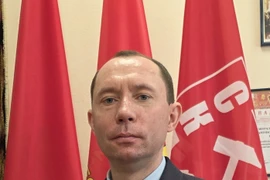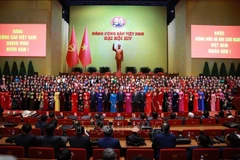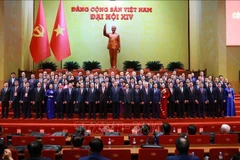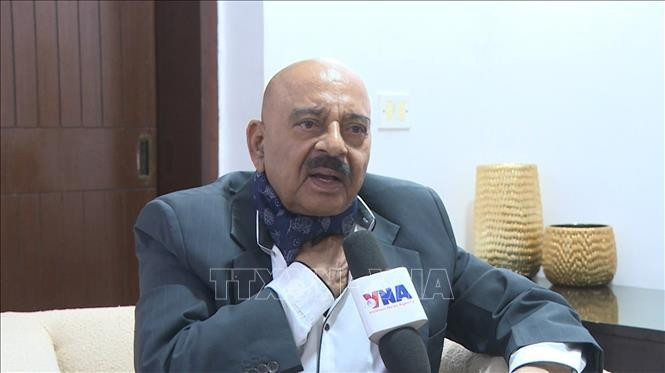
New Delhi (VNA) – The 14th National Congress of the Communist Party of Viet Nam (CPV) demonstrates the Party’s strong capacity for self-renewal and its ability to draw lessons from practice, as reflected in its frank acknowledgement of the limitations of the current development model and its firm commitment to continued reform, according to former Indian Deputy National Security Adviser S.D. Pradhan.
In an interview with Vietnam News Agency correspondents in New Delhi, Pradhan said that making the theory of Doi moi (Renewal) an integral part of the Party’s ideological foundation underscores flexibility in thinking and high pragmatic governance approach. The inclusion of the theory of Doi moi as a constituent part of the Party’s ideological foundation reflects flexible thinking and a high degree of pragmatism, he said, adding the Congress documents place stronger emphasis on governance capacity, corruption prevention and control, and human resource development.
Pradhan described the 14th Congress as a critical turning point in Vietnam’s development trajectory, taking place amid intensifying geopolitical competition, rapid technological change and mounting development constraints. Against this backdrop, it seeks to consolidate a long-term vision of transforming Vietnam into a developed, high-income country by the mid-21st century.
A historically significant highlight, he said, is Vietnam’s adoption of a new growth model driven by science and technology, innovation and digital transformation. This marks a decisive shift from an input-based development approach to a knowledge- and productivity-driven economy.
He also cited recent remarks by Party General Secretary To Lam identifying key strategic breakthroughs, including decentralisation and delegation of authority, stronger emphasis on science, innovation and digital transformation, and priority given to developing a highly skilled workforce. These pillars, Pradhan said, are essential for achieving rapid and sustainable growth in the new development phase.
In that spirit, the 14th Congress sets the objective of elevating science and technology to the role of a primary productive force by increasing investment in research and development, strengthening linkages among universities, research institutes and enterprises, and prioritising strategic technologies such as artificial intelligence, semiconductors, biotechnology and renewable energy, with a view to gradually reducing reliance on imported technologies. The private sector is identified as a key driver of innovation, while AI and digital transformation are regarded as cross-cutting growth accelerators.
Pradhan said these orientations carry significant political and strategic implications, helping to enhance economic resilience and strategic autonomy, enabling Vietnam to navigate major power competition without becoming a “proxy” of any country, and strengthening its role in global governance. They also reflect Vietnam’s capacity and readiness to re-define its socialism development path in line with innovation and digital transformation.
Commenting on new points in the draft Congress documents, the Indian expert highlighted the alignment of environmental protection with socio-economic development, the elevation of foreign affairs and international integration as regular and critical tasks alongside defence and security, and the reaffirmation of culture, people and the private economy as central development drivers. These adjustments, he said, show recognition that Vietnam’s main development constraints now lie in productivity, innovation and institutional capacity rather than capital or labour.
The goals to be achieved by 2030 require innovation to sustain growth and modernise the industrial base, while the vision to 2045 demands innovation to reposition Vietnam’s standing in the global economy. The new growth model therefore serves as a strategic bridge between medium-term objectives and long-term development aspirations, he noted./.