In the family: Hien (left) and Tilo have nurtured their happiness at the centre (Courtesy Photo of the family)
Ninh Binh (VNA) - The EndangeredPrimate Rescue Centre in the Cuc Phuong National Park is run by enthusiasticexperts who have overcome many problems over the past 20 years.
A bright morning and the sun sends fragile raysthrough layers of leaves in Cuc Phuong National Park in the northern provinceof Ninh Binh. The twittering of birds and chattering monkeys is a natural alarmfor staff at the Endangered Primate Rescue Centre (EPRC).
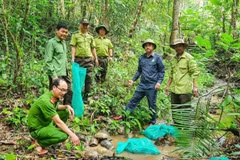
Two attendants slowly walk on the path betweenthe trees and cages of primates that need special cares. They talk about themonkeys they put geographical positioning rings on. They will releasethem back into the wild in few days.
For the past 20 years, Nguyen Thi Thu Hien andTilo Nadler have enjoyed the start of each day walking round the centre.
Nadler first went to Cuc Phuong in 1991 to makea report for German TV on Delacour’s langur – one of the world’s rarestprimates, which was discovered by a French expedition in 1930, based on twoskins from a local hunter.
After more than 50 years without any informationabout this primate, in 1987 the first living individuals were seen in thenational park. Nadler sent a project proposal to Frankfurt Zoological Societyfor conservation work and research.
In January 1993, he started the primate centrein Cuc Phuong. It was the first in Indochina.
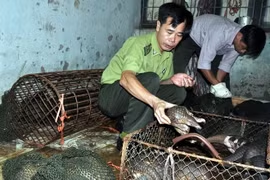
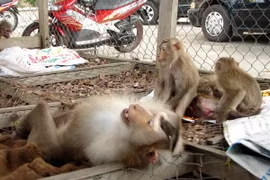
“The first goal of the centre was to providehousing for trapped or injured primates,” he said, “This work not only help theanimals, but supports the work of rangers and forest protection authoritiesthrough the whole country.”
Nadler said the knowledge about the status ofmany primate species in the early days was poor, the numbers of the rarestspecies over-estimated and the problems and survival of populations in the wildcompletely under-estimated.
“It was often very difficult to convince forestprotection authorities and police to support conservation activities,” he said,“With correct and stricter law enforcement, the numbers of confiscationsincrease, requiring us to intensify fund-raising activities abroad and to hiremore staff.
“With better knowledge, we recognised thatseveral species were already on the brink of extinction. Therefore the goal ofthe centre concentrated not only on rescuing monkeys, but building a breedingcentre to re-introduce animals back into the wild to bolster depleted wildpopulations or to establish a new population where they had been wiped out,” hesaid.
The centre runs successful breeding programmesfor some of the world’s rarest primate species – the Cat Ba langur, Delacour’slangur, Grey-shanked douc langur, Hatinh langur and other highly endangeredspecies. It now keeps 15 Vietnamese primate species, six of them survive onlyat the centre.
More than 200 primates have been born at thecentre and reintroduction programmes carried out for Delacour’s and Ha Tinhlangurs, Pygmy and Slow lorises.
The centre also carries out education programmeand research activities. More than 20 Master and PhD theses are produced inco-operation with universities in Vietnam and abroad. This has led to thepublication of more than 100 scientific papers.
Nadler has not only found success in preservingprimates, he found his family in Vietnam as well.
With Hien, his assistant at the beginning of theproject, Nadler has set up a happy family and now has two sons.
Yet their marriage has not been as easy asrunning the centre due to the 31-year-gap in their ages.
“My parents and relatives did not agree until myfather retired and my relatives found a letter written by my grandfatherpredicting that I would get married to a foreigner,” Hien said.
In 2,000, they married in a simple ceremony inDresden, Germany, following an engagement ceremony in Vietnam.
"My two sons love painting," she said."It is a talent inherited from their father’s family. They also enjoystudying nature.
“On our holidays, we often visit forests andparks in Vietnam, Thailand and other neighbouring countries to explore nature,”she said.
Since 2016, Nadler and Hien have graduallytransferred part of their tasks to other colleagues at the centre.
The centre now has 28 staff, a communicationsspecialist, a volunteer coordinator, a foreign head keeper and one director.The main financial sources are from international organisations and zoos.
“The difference between conservation work inGermany and Vietnam is that in Germany it is funded by the government andnational donors, such as companies and institutions,” said Nadler, “While inVietnam, the biggest financial source for conservation work in Vietnam comesfrom abroad.
The director of the centre, Sonya Prosser, saidshe thought Nadler had achieved a lot. “Without his work, the Delacours langurwould most probably be extinct. He had the foresight to breed the animals herescued, where most rescue centres do not.
“This work is important for these species as itprovides biologists with opportunities to study to animals, which better equipsthem for conserving the animals.
“It also creates a population forre-introduction into empty areas. I think the centre, under Nadler’s managementprovided a great source of data for researchers in many fields over its 23years of operation,” she said.
She believes now is the time for Vietnamesepeople to feel a sense of ownership of the EPRC.
“Nadler has been caring for it, but it’s timefor the Vietnamese people to own it,” she said, “This means takingresponsibilities for what is happening to local wildlife.”
Prosser suggested the centre generate its ownrunning costs. Leipzig Zoo is a great support, financially - and alsoin attempting to reach a similar vision.
“If the centre can cover its own running costs,then all additional donations or support can go directly towards education,research, re-introduction programmes. Current staff will be given opportunitiesto develop a career path if they desire, which in turn will grow the centre’scapacity.”-VNA
source