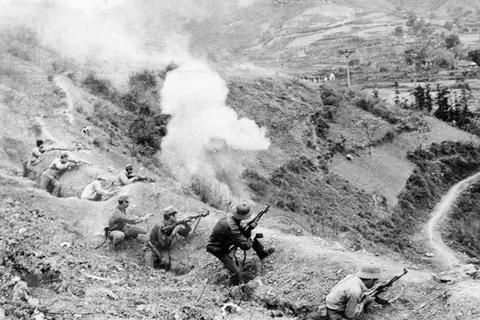
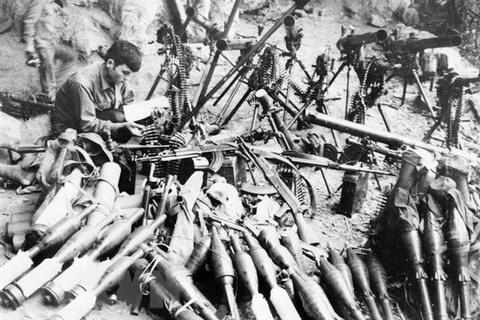
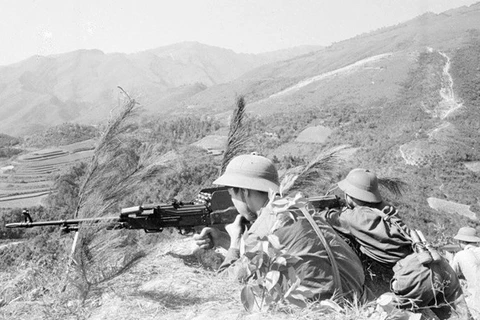
Hoang Lien Son artillery division 368 fired on the enemy's position during the northern border defence war in 1979. (Photo: VNA)
 Hanoi, (VNA) – The northern border defence war in 1979 has demonstrated Vietnam’s strength and intelligence in critical situations. The art of command during that war is analysed in an article by Associate Professor and Doctor Ho Khang, former deputy director of the Vietnam Military History Institute.
In early 1979, when the Vietnam People’s Army toppled the reactionary Pol Pot regime in Cambodia and helped the Cambodian people escape from genocide, the Chinese Government joined some Western countries in launching propaganda campaigns distorting the presence of the Vietnamese voluntary troops in Cambodia, with the aim of sabotaging Vietnam’s revolution and imposing its interest on the Indochina peninsula.
As both political and diplomatic pressure failed to produce the desired goal, Chinese leaders mobilized around 600,000 troops along with hundreds of tanks and armoured vehicles to open a direct attack on February 17, 1979 on Vietnam along the full length of the border shared by the two countries.
The attack brought a great challenge for Vietnamese people as it happened when the country was still struggling to overcome the serious consequences of the anti-US liberation war which concluded not long ago (in 1975) while performing an international mission to help the Cambodian people demolish the genocidal regime and revive their country. In addition, the national economy was facing many difficulties caused by the US’s embargo and sabotage attempts by both domestic and foreign reactionary forces. The was also had a tremendous impact on the psychology and felling of the people of both countries, as China had provided great support and assistance both political, physical and spiritual for Vietnam during the past two liberation wars against France and the US.
In such a situation, the command of the war was discussed carefully by the Politburo of the Communist Party of Vietnam and the Central Military Commission. They agreed on the guideline of bringing into full play the nation’s combined strength to firmly safeguard national independence, sovereignty and territorial integrity; while upholding justice and the good will to work for peace, restore the friendship between the two nations, and at the same time preventing the war from affecting other strategic missions, especially the international mission in Cambodia, and continuing to win over the sympathy and wide support of world opinion.
Under the guideline, the Vietnamese Government issued a statement on February 17, 1979 pointing out that the Chinese administration had acted against the interest of the people and seriously undermined the friendship between the two people. Vietnam also affirmed that the Vietnamese people had no other choice than to exercise their legitimate right to self-defence and fight back.
At the beginning, Vietnam decided not to use its strategic reserve force early, neither to withdraw key forces from Cambodia. Instead, Vietnam made use of the people-based strength and local forces of Army Corps No.1 and No.2, along with units sent from the rear.
At the same time, plans were drafted to gradually move strategic reserve army corps so as to get prepared for counterattacks when necessary and prepare the people nationwide for the possibility of war expanding.
Under the direction of the Politburo and the Central Military Commission, the military and people in the front line bravely fought back, wearing out enemy forces and destroying their many weapons, thus forcing China to mobilize its strategic reserve force in battle.
However, with the advantage of big volumes of troops and weapons, the Chinese side occupied several key areas and towns one by one, such as Lao Cai (on February 19), Cao Bang (February 24), Cam Duong (February 25) and Lang Son (March 5).
In such an urgent situation, the Politburo and the Central Military Commission decided to dispatch strategic reserve forces to join local forces in preparing for large-scale counter attacks. Accordingly, in early March 1979, the Central Military Commission and the Defence Ministry ordered Army Corp No2, which had basically completed its international mission in Cambodia, to quickly move all units to gather in the north of Hanoi, and issued a decision to establish Army Corp No.5 right at the border front. Besides, key units of Army Corps No.1, the Air and Air Defence Force, and other technical forces were order to get prepared for battle.
On March 5, 1979, the President issued a general mobilization. Millions of young people, both men and women, volunteered to join the army.
The resolve of Vietnam’s supreme command, particularly the moves to prepare for a strategic counter attack, made a great impact on the war’s situation and the Chinese administration’s psychology and strengthened the confidence of the Vietnamese people as well as of friends in the world, particularly the Cambodian people who had just escaped from genocide with Vietnam’s support. Socialist countries, progressive forces and peace and justice-loving people around the world continued to strongly condemn the unjust war launched by China and called for support for Vietnam.
Suffering from heavy losses while failing to achieve the basic goal, and at the same time being condemned by world opinion, on March 5, 1979, the Chinese administration declared a pull-out from Vietnam’s territories. With the tradition of benevolence and righteousness and the wish to strengthen peace and restore the friendly relationship between the two countries, Vietnam’s Party Central Committee and Government instructed the armed forces and people in the northern border battlefield to cease all military operations to let the Chinese troops withdraw. As of March 18, 1979, China completed the withdrawal of all its troops from Vietnam.
The victory of Vietnam in the 1979 northern border defence war is attributable to the combination of various factors, from the unyielding fighting spirit for national independence, freedom and territorial integrity, the great support and help of international friends, the strong people-based defence posture, and a battle-hardened army with a contingent of talented and experienced generals. But topping it all was the independent and sound command of the Politburo and the Central Military Commission.
The command has creatively combined the traditional and modern war tactics, built strong defence across the fields of politics, economics, defence and security, tapped the strength of the people-based defence war, and brought into full play the nation’s humanistic ideals along with the Vietnamese revolutionary heroism in the Ho Chi Minh era.-VNA
VNA