Australia, US, Japan concerned about Chinese behaviour in East Sea

The foreign ministers of Australia, the US and Japan have expressed their "serious concern" over "credible reports of disruptive activities in relation to longstanding oil and gas projects" in the East Sea - a coded reference to Chinese vessels harassing Vietnamese ships trying to access key oil rigs.
Australia, US, Japan concerned about Chinese behaviour in East Sea ảnh 1US Secretary of State Mike Pompeo (second from left) and Australian Foreign Minister Marise Payne (second from right) at the consultation on August 4
(Photo: AFP/VNA)

Hanoi (VNA) – The foreign ministers of Australia,the US and Japan have expressed their "serious concern" over"credible reports of disruptive activities in relation to longstanding oiland gas projects" in the East Sea - a coded reference to Chinese vesselsharassing Vietnamese ships trying to access key oil rigs.

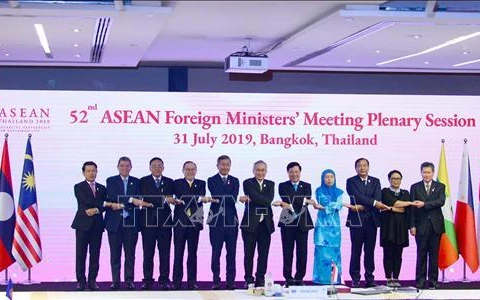
According to Australia’s newspaper The Canberra Times, Australian ForeignMinister Marise Payne, US Secretary of State Mike Pompeo and Japanese ForeignMinister Taro Kono discussed the issue during their meeting in Bangkok lastweek.

They expressed serious concerns about negative developments in the East Sea,and voiced strong opposition to coercive unilateral actions that could alterthe status quo and increase tensions such as land reclamation, construction ofoutposts, militarisation of disputed features and other actions that causepermanent physical change to the marine environment in areas pending delimitationin the waters.

Meanwhile, on August 3,Reuters reported that US Defense Secretary Mark Esper held that China isdestabilising the Indo-Pacific, charging Beijing with predatory economics,intellectual property theft and “weaponising the global commons”.

“We also stand firmly againsta disturbing pattern of aggressive behaviour, destabilising behaviour fromChina. This includes weaponising the global commons, using predatory economicsand debt for sovereignty deals, and promoting state-sponsored theft of othernations’ intellectual property,” he stated.

He declared that the US andits allies and partners will work to ensure security in the region amidstescalating threats.

Earlier, US State Departmentspokesman Morgan Ortagus said that the United States is concerned byreports of China’s interference with oil and gas activities in the East Sea,including Vietnam’s long-standing exploration and production activities. 

China’s reclamation and militarisation of disputed outposts in the EastSea, along with other efforts to assert its unlawful East Sea maritime claims,including the use of maritime militia to intimidate, coerce, and threaten othernations, undermine the peace and security of the region, he said.

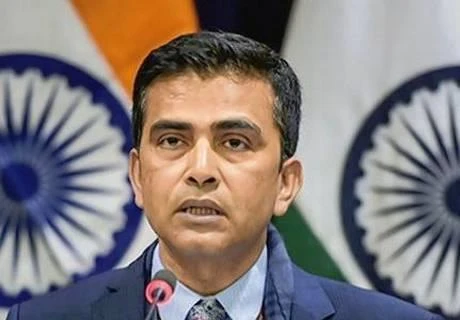
At the same time,spokesperson of the India’s External Affairs Ministry Raveesh Kumar said at theweekly press conference: “We have genuine and legitimate interests in peace,stability and predictability of access to the major waterways in the region.”The East Sea is important as 55 percent of India’s trade passes through it, headded.-VNA
VNA

See more

A street in Bangkok, Thailand. (Illustrative photo: Xinhua/VNA)

Thailand’s business activity shows signs of gradual recovery

As of August 31, Thailand had more than 1 million active legal entities with total registered capital of 24.13 trillion THB. The service sector accounted for the largest share, with 552,830 entities, or 54.48%, followed by wholesale and retail with 332,791 entities (32.79%) and manufacturing with 129,215 (12.73%).

Prime Minister Hun Manet (front row, centre) and Labour and Vocational Training Minister Heng Sour (front row, right) visit a garment factory in Preah Sihanouk province. MLVT (Photo: khmertimeskh.com)

Cambodia records 7,458 more enterprises in three years

A Cambodian official said that the growth should not be assessed solely by the number of newly established enterprises and facilities, but also by their contributions to investment, production, job creation and household incomes.

The ASEAN Senior Officials’ Meeting (SOM) convenes in Manila, the Philippines, on September 9. The Vietnamese delegation is led by Deputy Minister of Foreign Affairs Dang Hoang Giang (fifth, left), head of the ASEAN-Vietnam SOM.(Photo: asean.org)

Vietnam calls for stronger ASEAN unity, resilience

Deputy Minister of Foreign Affairs Dang Hoang Giang urged ASEAN to make full use of existing mechanisms to enhance dialogue, build trust and prevent risks and conflicts, particularly by strengthening the Treaty of Amity and Cooperation in Southeast Asia (TAC), the Southeast Asia Nuclear Weapon-Free Zone Treaty (SEANWFZ), and cooperation based on international law.

Timor-Leste President Jose Ramos-Horta (Photo: VNA)

Timor-Leste diversifies economy, seeks to attract investment

The President noted Timor-Leste is pursuing sustainable development, stronger regional connectivity and expanded international cooperation while seeking investment opportunities in energy, tourism and emerging economic sectors to reduce its dependence on oil and gas revenues.

Minister Counsellor Nguyen Hai Luu, Deputy Permanent Representative of Vietnam to the UN (Photo published by VNA)

Vietnam cooperates with UN to advance gender equality

Minister Counsellor Nguyen Hai Luu highlighted Vietnam’s positive achievements in promoting gender equality, noting that 13 of the 20 targets under the national strategy on gender equality had been met or exceeded by 2025.

General Secretary of the Communist Party of Vietnam Central Committee and President To Lam meets with Russian President Vladimir Putin in Moscow on September 9, 2026. (Photo: VNA)

Russian public, experts praise top Vietnamese leader’s visit

Positive reactions to General Secretary and President To Lam’s visit have reaffirmed Vietnam’s steady foreign policy amid global changes, while highlighting the enduring trust and friendship between Vietnam and Russia, which are working together to create new breakthroughs in bilateral cooperation.

Thailand eases rules for foreign enterprises

Thailand eases rules for foreign enterprises

The regulatory adjustment is part of Thailand's efforts to simplify regulations governing foreign business operations and clarify licensing requirements, while simultaneously fostering economic development and enhancing the country's international competitiveness.