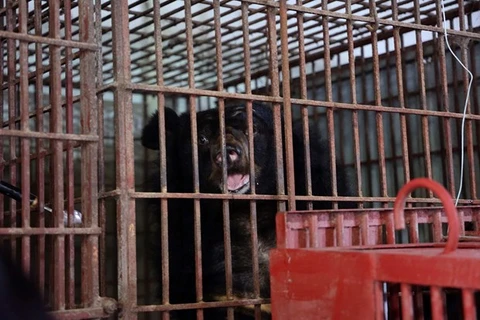
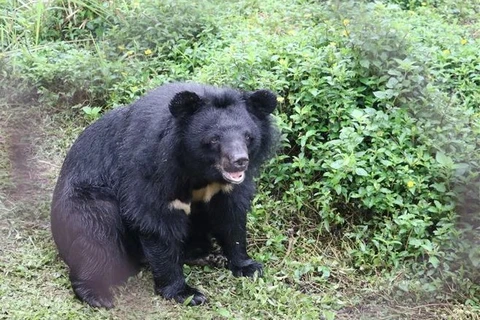
Bears playing in grounds of the Vietnam Bear Sanctuary in buffer zone of Tam Dao National Park, Vinh Phuc province. (Photo:VietnamPlus)
 Hanoi (VNA) - The Bear Protection Programme 2024 was launched to boost the management of bear farming, toward the goal of erasing bear farming in Hanoi and indeed, across the country.
Animals Asia campaign joined the Hanoi Forest Protection Sub-Department on March 19 and launched the “Bear Protection Programme 2024” in Phung Thuong commune, Hanoi’s outlying district of Phuc Tho, which is home to the largest number of bears farmed in the country.
A representative of the Animals Asia said the event aims to boost the management of the bear farming, towards the goal of having no bear individual farmed in the locality and the whole country. It is also important to raise awareness in the community on the protection of the bears, helping improve the health and the civilised living environment.
In the plan for the implementation of the programme, the Hanoi Forest Protection Sub-Department and Animals Asia will continue the communications work on the protection of bears through health consultation and emulation programmes at local schools.
The representative said the communications work will be accompanied by inspection to persuade bear farmers to voluntarily hand the animals to the state, and to take care of the more bears.
Earlier this year, the two sides successfully rescued a moon bear to the Vietnam Bear Sanctuary at the Tam Dao National Park in Vinh Phuc province, raising the total of the bears rescued from Phung Thuong commune into 18.
Animals Asia is an international non-governmental organisation that has been cooperating with the Ministry of Agriculture and Rural Development, represented by the Forest Protection Sub-Committee, in implementing two projects on building the Vietnam Bear Sanctuaries at the Tam Dao National Park and the Bach Ma National Park. Each sanctuary covers about 12ha dedicated to the care of the rescued animals.
At most, each of the centres can accommodate 300-500 individuals. At the sanctuaries, bears will be cared for and kept in a semi-natural environment, in the best possible conditions. Bears found at the centres were either transferred by the forest protection authority from trafficking cases or voluntarily handed over by the people.
 “Bear Protection Programme 2024” launched in Hanoi. (Photo: VietnamPlus)
 The main goal is to raise the awareness of the community on the protection of bears. Animals Asia has also held communications programmes to improve the mindfulness and cooperation from the central committee of the Vietnam Traditional Medicine Association. They have worked to publish nearly 40,000 handbooks. The books detail the 32 herbal plants that can be used in replacement of bear gall.
In Hanoi, since 2016, the conservation organisation has conducted communications campaigns on the protection of bears and monthly health consultations in Phung Thuong commune.
After its nearly 20 years of operation in Vietnam, Animals Asia has rescued 273 bears. Of them 197 now live in the semi-natural environment at the Vietnam Bear Sanctuary in the buffer zone of the Tam Dao National Park and five others are now cared for at Vietnam Bear Sanctuary II in the Bach Ma National Park.
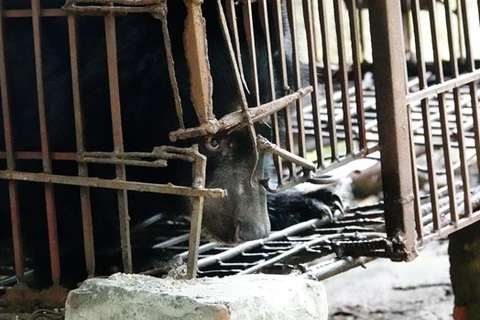
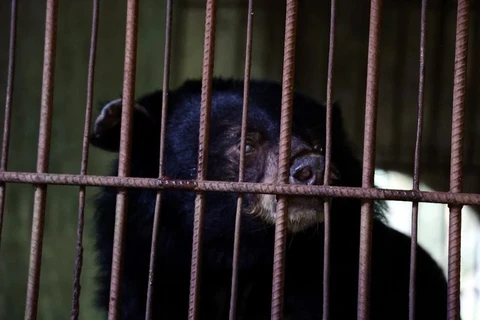
According to the Animals Asia, because of encroachment, i.e. the destruction of natural forests, worsened by the poaching of natural bears for farming for their gall, the number of the bears in the wild is only a few hundred. Meanwhile, according to the latest statistics by the Vietnam Forest Department, there are now only about 300 individuals at bear farms throughout the country. They are kept for the whole of their life in tight gall extraction cages. They cannot survive if they are released back to nature./.