Brazilian President’s visit to mark significant step forward in relations with Vietnam: diplomat

Brazil is currently Vietnam’s largest trading partner in Latin America, with two-way trade nearing 8 billion last year. The two governments aim to elevate the figure to 15 billion USD by 2030.

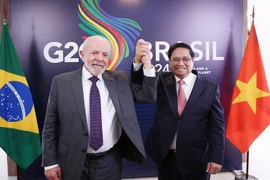
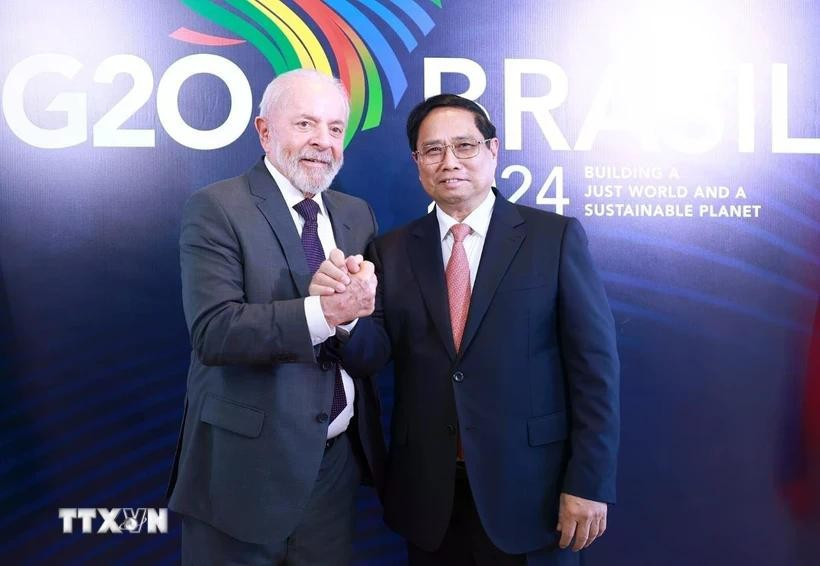
Prime Minister Pham Minh Chinh (R) meets with Brazilian President Luiz Inácio Lula da Silva. (Photo: VNA)

Hanoi (VNA) – Brazilian President Lula da Silva's upcoming state visit to Vietnam holds great political and economic significance, as it will strengthen the bilateral friendship and create opportunities to diversify economic, trade, and investment cooperation, and boost political ties, Brazilian Ambassador to Vietnam Marco Farani has stated.

In an interview with the Vietnam News Agency ahead of the visit, the Brazilian diplomat said the March 27-29 trip will mark an important milestone in the bilateral relations.

He revealed that President Lula will be accompanied by a highest-level political delegation, including leaders of both upper and lower houses, as well as prominent entrepreneurs from the industrial and agricultural sectors, showing the significance of the visit.

Vietnam and Brazil announced the upgrade of their bilateral relations to a strategic partnership in 2024, reflecting the positive development and maturity of their ties. Brazil is well aware of Vietnam's role in Southeast Asia, its active participation in ASEAN, and its commitment to economic development and social welfare goals. Similarly, Brazil holds a strong position in the Southern Hemisphere and remains committed to economic growth. Both represent emerging economies, play significant roles in their respective regions, and maintain friendly and stable relations with the rest of the world.

President Lula’s visit will also highlight the complementarities between the two nations and the significant role of their economies in key sectors such as agriculture, science-technology and innovation. Additionally, it aims to expand new channels for cooperation in trade, economy, and investment.

According to the diplomat, the visit will also promote deeper engagement in people-to-people diplomacy. In addition to continuing the high-level dialogue initiated during Prime Minister Pham Minh Chinh’s visit to Brazil in 2023, Lula’s trip is hoped to mark a significant step forward in bilateral relations and dialogue between the two nations.

Regarding the potential for business cooperation between the two countries, Marco stated that both nations have increasing consumer demand, a balanced economy, and political stability, which facilitate bilateral trade flows.

The Ministry of Foreign Affairs and the National Confederation of Industry of Brazil, in coordination with the Brazilian Embassy in Vietnam, will host a Brazil-Vietnam economic forum on March 29, bringing together over 100 Vietnamese businesses and more than 50 firms from Brazil’s key industries, he said.

The forum will offer a venue for delegates to analyse and discuss key areas related industry, agriculture, and energy, he said, noting that these are sectors showing strong growth in both economies, driven by innovative mechanisms and high-tech applications.

Brazil and Vietnam have all the necessary conditions to leverage the advantages of bilateral trade cooperation, including technology exchange, establishing partnerships targeting third markets, and expanding defence cooperation, especially when Brazil excels in the aviation industry, while Vietnam has extensive experience in defence industry and security, he said.

The diplomat also mentioned the key priorities that Brazil aims to promote within the framework of the Vietnam – Brazil strategic partnership, stressing the common goal of peace and stability in the region and the world as one of the important factors bringing the two countries closer together.

He said that this is a prerequisite for promoting trade and economic cooperation, and strengthening political relations.

Brazil and Vietnam have agreed to build a strategic partnership based on five core cooperation pillars of politics and security; economy, trade, and investment; science, technology, and innovation; climate change and environment; and people-to-people diplomacy and cultural exchange, he said.

The new partnership also fosters deeper cultural cooperation, enhances delegation exchanges, and strengthens interactions between the people of both countries, he added.

Under the framework of the new bilateral partnership, the two sides will continue to maintain consultation and dialogue mechanisms, including regular bilateral political consultations, he said.

The two countries have witnessed strong growth in their trade ties. Brazil is currently Vietnam’s largest trading partner in Latin America, with two-way trade nearing 8 billion last year. The two governments aim to elevate the figure to 15 billion USD by 2030.

The two sides' commitment to sustainable development and innovation, along with their highly complementary economies, are expected to create numerous new opportunities for stronger economic cooperation in the future, he noted./.
VNA

See more

Minister of Agriculture and Environment Trinh Viet Hung presents the Government’s proposals on the amendments to the 2024 Land Law. (Photo: VNA)

Amendments to Land Law aim to achieve three key goals

The Government has identified three major objectives: promptly institutionalising Party policies on land, private-sector development and national digital transformation; addressing urgent practical obstacles to unlock resources and support the goal of double-digit economic growth; and building a modern, streamlined and effective land management system through stronger decentralisation and administrative reform.

Minister of Finance Ngo Van Tuan speaks at the session (Photo: VNA)

NA considers consolidated law to streamline public finance management

Consolidating the Law on State Budget 2025 and the Law on Public Investment 2024 (amended and supplemented in 2025) is necessary to establish a consistent public finance management mechanism; minimise procedures, time and compliance costs; and improve the mobilisation, management and use of State budget resources to support growth.

President Ho Chi Minh's Mausoleum attracts a large number of visitors (Photo: VNA)

📝OP-ED: A century of aspirations, a rising Vietnam

Today, Vietnam's mission is to open the doors wider to development, move the country forward and join the ranks of major powers through its own strength. This is also the most practical way to carry forward the spirit of the historic autumn of 1945.

The 16th National Assembly begins the second phase of its first extraordinary session on August 19. (Photo: VNA)

NA begins second phase of first extraordinary session, focusing on land, housing policies

The 16th National Assembly began the second phase of its first extraordinary session on August 19, hearing presentations on policy orientations for drafting the Law on State Budget (consolidated); amending the 2024 Land Law, the 2023 Housing Law, and the Law on Real Estate Business; and the integration of four national target programmes into a single one.

Member of the Communist Party of Vietnam Central Committee and Deputy Foreign Minister Nguyen Manh Cuong (R) meets with Roman Roun, Chairman of the Communist Party of Bohemia and Moravia (KSCM) in Hanoi on August 18. (Source: Baoquocte.vn)

Vietnam, Czech Republic step up effective implementation of Strategic Partnership

The two sides expressed their delight at the positive and substantive development of traditional friendship and multifaceted cooperation between Vietnam and the Czech Republic, and welcomed the elevation of bilateral ties to a Strategic Partnership in January 2025, which has created a new framework and impetus for deeper, more effective and sustainable cooperation.

Politburo member and Minister of Foreign Affairs Le Hoai Trung (R) receives visiting Chairman of the Communist Party of Bohemia and Moravia (KSCM) Roman Roun in Hanoi on August 18 (Photo: VNA)

Vietnam, Czech Republic seek to deepen multifaceted cooperation

Politburo member and Minister of Foreign Affairs Le Hoai Trung affirmed that the Party, State and people of Vietnam have always cherished the valuable support extended by the Communist Party and people of former Czechoslovakia, as well as by the KSCM and Czech people today.

Minister of Foreign Affairs Le Hoai Trung speaks at the event. (Photo: VNA)

Vietnam-India cooperation grows more practical, future-oriented

Vietnam-India relations, founded by President Ho Chi Minh and Indian leaders and nurtured by generations of the two countries, have developed into a special and enduring friendship. Bilateral cooperation has delivered significant and practical benefits, with two-way trade doubling over the past decade, while defence and security cooperation has become increasingly substantive and effective, reflecting high levels of strategic trust.

Prime Minister Le Minh Hung speaks at the Government's August law-building session on August 18. (Photo: VNA)

Draft laws must support management reform, stronger decentralisation: PM

Participants looked into 11 draft laws and one draft resolution, including laws amending and supplementing several articles of laws on non-agricultural land use tax and corporate income tax; natural resources tax; securities; accounting and independent auditing; the Labour Code; and laws on archives, gender equality, Red Cross activities and employment.

General Secretary of the Communist Party of Vietnam and President To Lam, who is also Secretary of the Central Military Commission, visits Infantry Division 308 of Army Corps 12 under the Ministry of National Defence in Hanoi on August 18 (Photo: VNA)

Top leader visits Infantry Division 308

General Secretary and President To Lam urged the division to preserve its proud tradition and turn it into determination and action, underscoring the need for it to uphold the “vanguard” spirit, especially in building a revolutionary, regular, elite and modern army; training and maintaining combat readiness; advancing science, technology, innovation and digital transformation; observing discipline and law; mastering modern weapons and equipment; and fulfilling its three functions as a combat, working and production force.