Vietnamese bananas on display at Lotte supermarkets across the Republic of Korea. (Photo: VNA)
 Hanoi (VNS/VNA) - For Vietnamese products to enter foreign distribution channels, it was necessary to be more professional and stable in product quality, said experts.
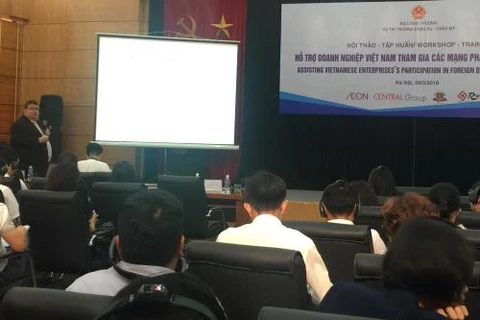
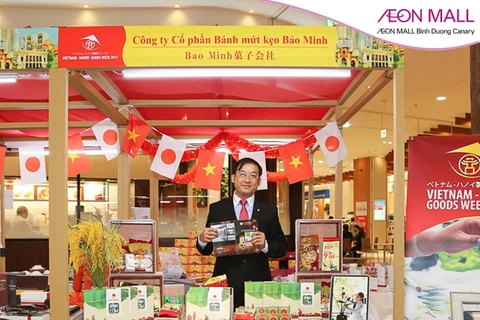
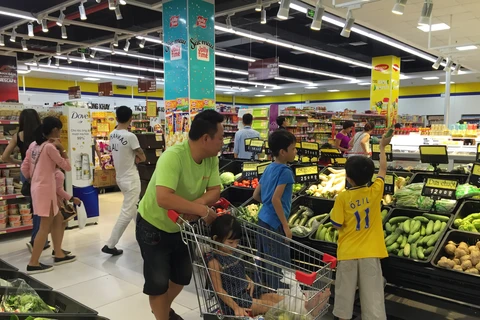
Foreign supermarkets such as Aeon, Lotte or MM Mega Market, which are operating in Vietnam, are effective distribution channels to help consume and export Vietnamese goods. However, it seems that Vietnamese businesses have not taken advantage of it.
In order for Vietnamese products to be sold through foreign distribution channels, the criteria for product quality and food safety and hygiene are a priority.
In addition, goods put on supermarket shelves need to be supplied in a large quantity, uniform quality and high stability, however, many products of domestic companies have not met these criteria, according to experts.
Consumers around the world are interested in many Vietnamese agricultural products, such as mango, banana, lychee, longan, and dragon fruit. However, in order to get into foreign supermarkets like Aeon or Lotte, it was quite difficult, said experts.
For example, Vietnam's bananas, according to Lotte Mart, are popular among Korean consumers, but the criteria for bananas of Vietnamese farmers to put on the shelves of the supermarket systems are to be uniform in quality, and must be delivered continuously and steadily.
However, the factors were difficult to implement not only for Vietnamese banana but also for many other agricultural products, according to experts.
Although Vietnamese agricultural products have many delicious varieties, which are popular among both domestic and foreign consumers, the country could not produce them in a chain to ensure safety and stability as well as other factors related to international standards, therefore, it was very difficult to enter foreign supermarkets.
Data of the Ministry of Industry and Trade showed that Central Group exported goods of Vietnamese enterprises through this system only reached 21 million USD in 2012 but soared to over 200 million USD last year.
Japanese Aeon has also contributed to the export of Vietnamese enterprises from 200 million USD in 2017 to over 500 million USD last year.
Market expert Vu Vinh Phu said in order to increase the amount of Vietnamese goods consumed through foreign distribution channels, Vietnamese enterprises had to improve their production capacity to be able to supply products that meet the criteria and standards of partners.
"This is the challenge of the globalisation game that forces every Vietnamese enterprise to strive to assert themselves," Phu told Dai Doan Ket (Great Unity) newspaper./.
Foreign supermarkets such as Aeon, Lotte or MM Mega Market, which are operating in Vietnam, are effective distribution channels to help consume and export Vietnamese goods. However, it seems that Vietnamese businesses have not taken advantage of it.
In order for Vietnamese products to be sold through foreign distribution channels, the criteria for product quality and food safety and hygiene are a priority.
In addition, goods put on supermarket shelves need to be supplied in a large quantity, uniform quality and high stability, however, many products of domestic companies have not met these criteria, according to experts.
Consumers around the world are interested in many Vietnamese agricultural products, such as mango, banana, lychee, longan, and dragon fruit. However, in order to get into foreign supermarkets like Aeon or Lotte, it was quite difficult, said experts.
For example, Vietnam's bananas, according to Lotte Mart, are popular among Korean consumers, but the criteria for bananas of Vietnamese farmers to put on the shelves of the supermarket systems are to be uniform in quality, and must be delivered continuously and steadily.
However, the factors were difficult to implement not only for Vietnamese banana but also for many other agricultural products, according to experts.
Although Vietnamese agricultural products have many delicious varieties, which are popular among both domestic and foreign consumers, the country could not produce them in a chain to ensure safety and stability as well as other factors related to international standards, therefore, it was very difficult to enter foreign supermarkets.
Data of the Ministry of Industry and Trade showed that Central Group exported goods of Vietnamese enterprises through this system only reached 21 million USD in 2012 but soared to over 200 million USD last year.
Japanese Aeon has also contributed to the export of Vietnamese enterprises from 200 million USD in 2017 to over 500 million USD last year.
Market expert Vu Vinh Phu said in order to increase the amount of Vietnamese goods consumed through foreign distribution channels, Vietnamese enterprises had to improve their production capacity to be able to supply products that meet the criteria and standards of partners.
"This is the challenge of the globalisation game that forces every Vietnamese enterprise to strive to assert themselves," Phu told Dai Doan Ket (Great Unity) newspaper./.
VNA