A red-shanked douc langur in Ba Na-Nui Chua forest near Da Nang city (Photo courtesy GreenViet)
 Da Nang (VNA) - Biologists have found 22 animal species, including nine endangered ones, through a wildlife supervision programme in the Ba Na-Nui Chua Nature Reserve near the central city of Da Nang.
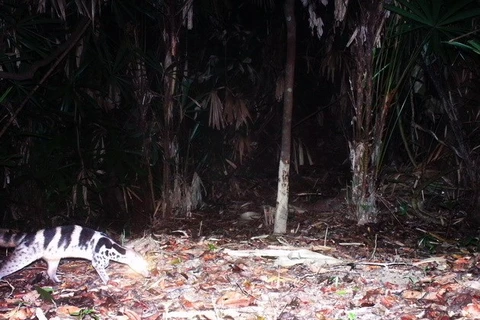
The Centre of Biodiversity Conservation (GreenViet) cooperated with the management board of the Ba Na-Nui Chua Nature Reserve to announce that two species – Owston’s Cvivet and Spotted Linsang – were spotted for the time ever in the reserve.
The camera trap system, which operated from May to December of 2016, also snapped the first-ever pictures of Chamois or Sumatran Serow and Crested argus pheasant in the reserve – 30km west of the city’s centre.
According to biologists, the 24-camera trap system set up at 29 sites recorded more than 11,400 photos, of which 2,100 had high resolution images of animals.
The wildlife supervision programme, which was jointly organised by GreenViet, the US-based San Diego Zoo Global and the Ba Na-Nui Chua Nature Reserve, helped record the movements of endangered species in the reserve, providing evidence for research and biodiversity protection.
Bui Van Tuan, a biologist from GreenViet, told Vietnam News that the camera trap, used for the first time in Da Nang, also got photos of nine herds of the endangered red-shanked douc langur with an estimate of 48 or 65 individuals, and 13 herds of gibbon – newly identified in 2010.
Tuan said the programme has added two species – Owston’s Cvivet and Spotted Linsang – in the official list of animals in the reserve.
He said nine endangered species are needed to be given a special protection by the Government including the red-shanked douc langur; Stump-tailed macaques; Northern Pig-tailed Macaque; Small Indian civet; Spotted linsang; Owston’s cvivet; musk-deer or Tragulus; Sumatran Serow; Crested argus pheasant or Ocellated Pheasant.
He said the programme was involved the participation of experts, biologists and scientists from the Frankfurt Zoological Society of German, the San Diego Zoo Global in the US and the International Union for Conservation of Nature (IUCN) and Save’s Vietnam Wildlife in identifying species through high-resolution pictures.
The 28,000ha-reserve, established in 1986, is home to 626 animal species and 793 plant species, including several endangered primates such as the Red-Shanked Douc, the northern buffed-cheeked gibbon and Edwards’s pheasant, which are rarely seen in nature.
Located 1,487m above sea level, it was initially used as a mountain resort by the French in 1912 and remains an attraction for tourists visiting the Ba Na Hills Mountain resort and using the cable car routes.
Rapid urbanisation and illegal logging have encroached on the wildlife habitat and threatened the biodiversity of the city’s two nature reserves – the Ba Na-Nui Chua and Son Tra.
The World Wide Fund for Nature set up camera traps in 1992 and recorded a living Sao la, Vu Quang ox, spindlehorn, or Asian bicorn – one of the world’s rarest large mammals - in the Vu Quang Nature Reserve in 1999 and another in Quang Nam province in 2013.
The central city has chosen the red-shanked douc langur as the official mascot of Da Nang at the 2017 APEC (Asia-Pacific Economic Cooperation) Economic Leaders’ Meeting.-VNA
VNA