Central Highlands develops long-term industrial crops

Central Highland provinces are expanding the cultivation of long-term industrial crops to promote socio-economic development and improve the living standards of ethnic minority people.
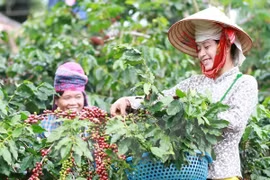
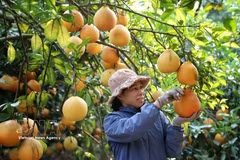
Central Highlands develops long-term industrial crops ảnh 1The Central Highlands is considered a key region of coffee nationwide with Dak Lak making up more than 40 percent in the region and 30 percent in the country (Photo: VNA) 

Dak Lak (VNA)
– Central Highlandprovinces are expanding the cultivation of long-term industrial crops topromote socio-economic development and improve the living standards of ethnicminority people.

Statistics showed that the region has 1.12million hectares of long-term industrial plants, making up more than 53 percentof total crop growing area, including 582,149 hectares of coffee, 251,348hectares of rubber and 85,000 hectares of pepper.

Dak Lak accounts for nearly 29 percent of theregion’s long-term industrial crop area, followed by Lam Dong, Gia Lai, DakNong and Kon Tum.

The Central Highlands is considered a key regionof coffee nationwide with Dak Lak making up more than 40 percent in the regionand 30 percent in the country. 

Annually, the province harvests about 450,000tonne of coffee or more. Coffee also accounts for 86 percent of the totalexport turnover of farm produce, contributing more than 20 percent to the localbudget.

The coffee industry in Dak Lak has generatedjobs for hundreds of thousands of local workers.

However, the development of coffee and pepperhas led to overexploitation of land and water resources and the abuse offertilisers and pesticides, threatening the sustainable development oflong-term industrial crops.

The high production cost of key farm producesuch as coffee, pepper, rubber and cashew makes the products uncompetitive.

At present, Central Highland provinces arebuilding a planning scheme to improve the quality of products and ensure the sustainabledevelopment of industrial crops.

By 2020, the provinces aim to zone off 530,000hectares of coffee. Dak Lak will reduce the area to 190,000 hectares, Lam Dong150,000 hectares, Dak Nong 115,000 hectares and Gia Lai 75,000 hectares.

The localities will adopt intensive farming toensure annual output of 1.2 – 1.3 million tonnes of coffee.

They will also call for investment to build processingfactories for export staples like coffee, pepper, rubber, cashew nut and teawhile enabling businesses to seek partners and expand export markets.-VNA
VNA


See more

The interface of the National E-Procurement System. (Photo: muasamcong.mpi.gov.vn)

Vietnam to move PPP bidding online from 2027

From January 1, 2027, PPP project proposals must be submitted through the National E-Procurement System. From September 1, 2027, investor selection for PPP projects tendered through open bidding will move fully online.

An automated robot-based production line at CAYI Technology Vietnam Co., Ltd. in Yen Phong II-C Industrial Park, Bac Ninh city (Photo: VNA)

EuroCham: Business Confidence Index in Vietnam remains high at 78.3 in Q3

The survey found that 64% of respondents described their current business conditions as good or very good, while 28% maintained a neutral or cautious outlook, reflecting a wait-and-see attitude as international demand remains flat and businesses look for policy momentum to translate into faster procedures and more predictable outcomes.

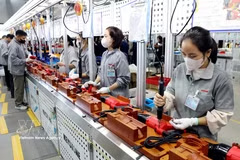
Workers manufacture handheld power tools at the Keystone Electrical Vietnam factory in Lien Ha Thai Industrial Park, Thai Thuy commune, Hung Yen province (Photo: VNA)

Vietnam seeks to turn FDI inflows into domestic value added

Vietnam is shifting its FDI attraction strategy from expanding investment volumes to prioritising capital inflows that brings technology, knowledge, modern management practices and stronger links with domestic businesses, particularly in semiconductors, artificial intelligence (AI), chips and renewable energy.

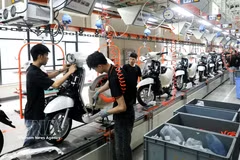
At Yadea Vietnam’s smart manufacturing plant in Tan Hung Industrial Park, Bac Ninh province (Photo: VNA)

Vietnam ties FDI incentives to local supplier commitments

Incentives will increasingly hinge on investors’ performance and commitments, not just on landing projects. Key commitments include transferring technology to Vietnamese firms, training workers, providing technical support and opening FDI supply chains to domestic companies.

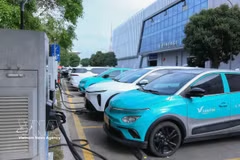
Green SM has launched all-electric taxi service in the US. (Illustrative photo: VNA)

Green SM launches all-electric taxi service in US

The move brings Green SM into one of the world’s most dynamic and demanding markets. It also marks another step in the international expansion of the Vietnamese mobility brand, following its rapid growth across markets in Asia and Europe.

An overview of the meeting between IMF Managing Director Kristalina Georgieva and ASEAN Finance Ministers and Central Bank Governors (Photo: VNA)

Vietnam strengthens financial cooperation at IMF-World Bank annual meetings

The Vietnamese Governor underscored the complementary roles of global and regional financial cooperation mechanisms, including the Chiang Mai Initiative Multilateralisation (CMIM) and the ASEAN+3 Macroeconomic Research Office (AMRO). He also highlighted the importance of technical assistance in fintech, digital transformation, cybersecurity and risk management.

Representatives of the organising committee at the opening ceremony of the fair (Photo: VNA)

Vietnam-Cambodia trade expo promotes bilateral economic cooperation

The Vietnam-Cambodia Business Networking and Product Promotion Exposition has become a key trade promotion event, creating business and investment opportunities while strengthening mutual understanding and trust between the two countries’ armies, people and enterprises.