Dak Lak’s aims for poverty rate below 5 percent in 2020

The rate of poor households in Dak Lak province is expected to drop below 5 percent in 2020 under the locality’s master plan on socio-economic development to 2020 with a vision towards 2030.
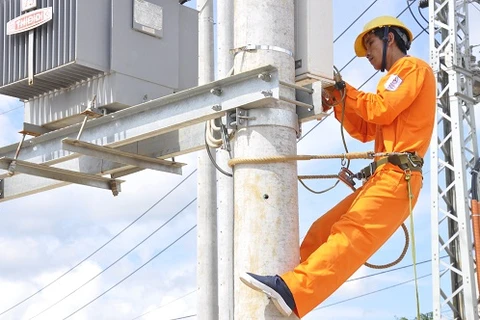
Dak Lak’s aims for poverty rate below 5 percent in 2020 ảnh 1Illustrative photo (Photo: VNA)

 Dak Lak (VNA) – The rate of poor households in the Central Highlands province of DakLak is expected to drop below 5 percent in 2020 under the locality’s masterplan on socio-economic development to 2020 with a vision towards 2030.

Adjustments and supplementsto the master plan have been recently approved by Prime Minister Nguyen XuanPhuc.

The poverty rateis hoped to reduce by 1-2 percent each year from now to 2030 in line withpresent poverty standards.

Under the plan,Dak Lak’s annual gross regional domestic product (GRDP) during 2016-2020 ishoped to grow by 8.5-9 percent.

The province aimsto raise its GRDP per capita to 60-60.5 million VND (2,640-2,860 USD) in 2020 and217-220 million VND (9,548-9,680 USD) in 2030.

The number oflabourers working in the farming sector is expected to make up only 55 percentof the province’s total labourers in 2020 and 38 percent in 2030. Theunemployment rate in urban areas is projected at 2.5-2.7 percent for 2016-2020,and 2.2-2.5 percent for 2021-2030.

The agro-forestry-fisherysector is set to account for 38.5-39.5 percent of the province’s total GRDP in2020 and 19-20 percent in 2030, with annual average growth rate at 4.5-5 percentin 2016-2020 and 4-4.5 percent in 2021-2030.

Husbandry will beprioritised to create breakthroughs in agricultural development.

In industry, DakLak will focus on industrial production using modern, environmentally friendlytechnologies, along with the support industry to serve agriculture.

The province will utiliseits localities’ advantages and develop spearhead industries with highcompetitiveness and high added value, serving both domestic and foreignmarkets.

Industrialproduction is expected to grow by 10-11 percent annually during 2016-2020,hitting 65-66 trillion VND (2.86 billion-2.9 billion USD) in 2020, and 12-13percent in 2021-2020, according to the plan.

Dak Lak willspecialise in exploiting and processing farm produce, yarn, constructionmaterials, manufacturing mechanics, electricity, water and support industry.

The service sectoris also projected to expand by 11-12 percent in 2016-2020 and 12-12.5 percentin 2021-2030, making up 39-40 percent of the total GRDP in 2020 and 34-35 percentin 2030.

The plan also setthe average growth rate of retail sales and service revenue at 18.5 percentannually between 2016-2020 and 17 percent in 2021-2030.

The province willimprove the quality of financial, banking, transport, post, telecommunicationsand consultation services, and scientific-technological transfer.

It aims to welcomemore than 1.1 million visitors by 2020, including 103,000 foreigners, and morethan 2.8 million in 2030, including 256,000 foreigners.

The local tourismsector is expected to expand by 15.05 percent in 2016-2020, and 16.5 percent in2021-2030.-VNA
VNA

See more

Hanoi has over 1,100 libraries and numerous cultural and educational spaces in the community. (Photo: VNA)

Spreading value of books, building foundations of learning society

Each weekend in Hanoi, the “Reading with Children” Club brings together students to practise reading, explore language, and express ideas creatively. According to founder of the club Nguyen Thuy Anh, the club encourages children to reflect, retell stories, and connect books with personal experiences, making reading more vivid and meaningful.

Automated ticketing system is used on the urban railway Cat Linh-Ha Dong line in Hanoi. (Photo: VNA)

Digital transformation powers Hanoi metro expansion

Beyond convenience, stable fares and the elimination of fuel, parking and maintenance costs have made urban rail increasingly attractive. The growing preference for metro travel is also contributing to a greener, more modern urban lifestyle.

Delegates cut the ribbon to inaugurate the operation of electric bus route No. 43. (Photo: VNA)

Hanoi accelerates shift to green buses, targets 100% by 2030

In the 2027–2030 period, the city will accelerate the transition towards the complete phase-out of fossil fuel-powered buses. The share of electric and green energy-fueled buses is projected to reach 79–89% by 2029 and 100% by 2030.

At the second session of the Ho Chi Minh City People’s Council (Photo: VNA)

Ho Chi Minh City greenlights central square, administrative centre in Thu Thiem

The new central city square and administrative centre will create a modern, centralised political-administrative complex for Ho Chi Minh City, designed to house around 8,000 officials, civil servants, and employees. It will also handle daily traffic of 1,500- 2,000 citizens and business representatives through a unified one-stop-shop administrative service system.

A working session at the job fair (Photo: VNA)

Vietnamese students flock to Seoul Job Fair 2026

The second annual Job Fair 2026 was held for Vietnamese students in the Republic of Korea. Organisers pitched it as a straight-up bridge between eager students and bosses hungry for young talent who can actually handle multicultural workplaces.

Defendants at the court (Photo: VNA)

Ho Chi Minh City court opens trial over Agribank lending scandal

The investigation revealed that multiple credit files were incomplete or riddled with inaccurate information, while some pledged assets lacked proper legal standing yet were accepted and grossly overvalued. As a result, the loans became high-risk and largely unrecoverable, leading to losses surpassing 1 trillion VND.

Hanoi introduces 53 electric buses from April 18 (Photo: VNA)

Hanoi to add 53 electric buses from April 18

According to the plan, all buses operating within Ring Road 1 will use green energy by July 1, 2026. The requirement will expand to Ring Road 2 by January 1, 2028, and to Ring Road 3 by 2030.

Illustrative image (Photo: VNA)

National, local traffic safety committees to be dissolved from June 1

Under the dicision, ministries and ministerial-level agencies will assume responsibility for tasks previously performed by the committee, in line with their mandates under the Law on Government Organisation, the Law on Road Traffic Order and Safety, the Law on Roads and other relevant legal frameworks, ensuring that traffic safety and order are maintained without disrupiton.