The flag of the Association of Southeast Asian Nations (ASEAN) (Photo: AFP)
Hanoi (VNA) - The year 2018 marks the 15th anniversary ofthe establishment of strategic partnership between China and the Association ofSoutheast Asian Nations (ASEAN) featured with political trust, mutual respectand win-win cooperation.
The two sides have pledged to further develop their relations to a newhigh by adopting the China-ASEAN Strategic Partnership Vision 2030 last month,which is widely seen as a role model for cooperation in the Asia-Pacificregion, the Xinhua News Agency reported.
In 2003, China and ASEAN decided to establish their strategicpartnership, opening up a new chapter in the bilateral relations. Over the past15 years, the partnership has endured a changing international landscape andtheỉ cooperation has continued to deliver real benefits to the countries andthe peoples of the region.
China and ASEAN are firmly committed to good-neighborliness andfriendship while enhancing political and security ties to create stability acrossthe Asia-Pacific. Under this partnership, the two sides have properly managedsensitive issues and disputes through dialogue and negotiation in order to keeptheir relationship on track.
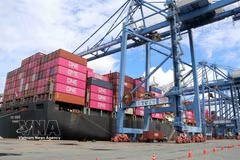
China and ASEAN have promoted trade and investment liberalisation, anapproach that has provided the backbone and engine for development andprosperity in the region.
The China-ASEAN Free Trade Area (FTA), the largest regional FTA in theworld in terms of population, went into effect in 2010, removing tariffs onmore than 90 percent of goods traded between China and 10 ASEAN members, namelyBrunei, Cambodia, Indonesia, Laos, Malaysia, Myanmar, the Philippines,Singapore, Thailand and Vietnam.
Moreover, an updated FTA was hammered out late in 2015, furtherfacilitating trade, scaling up bilateral investment and encouragingtechnological cooperation.
China and ASEAN are now working together to speed up negotiations of theRegional Comprehensive Economic Partnership (RCEP), a proposed free trade areamade up of the 10 ASEAN member states and its six FTA partners - China, Australia,India, Japan, the Republic of Korea and New Zealand, in order to furtherfacilitate trade and investment in the region.
Based on the principle of collaboration, China and ASEAN have worked toalign the former's Belt and Road Initiative with the latter's developmentplans. Connectivity projects include the China-Laos Railway, the China-Thailandhigh-speed railway, and Indonesia's Jakarta-Bandung high-speed railway.
China and ASEAN have also advocated people-to-people exchanges andmutual learning among their different and numerous civilizations. Ties haverapidly developed in the areas of culture, education, tourism, media, scienceand technology, environmental protection, disaster relief, poverty reductionand youth, among others.
China and ASEAN adopted last month a blueprint to further advance theirstrategic partnership and forge wider mutual beneficial cooperation so as tobuild a closer China-ASEAN community with a shared future.
The vision is a new cooperation framework between China and ASEAN,underpinned by the three pillars of political and security cooperation,economic cooperation and people-to-people exchange, and supported bycooperation in mutually-agreed areas.
As the backbone and engine for promoting development and prosperity inthe region, China and ASEAN hailed the continued strong growth in bilateraltrade, investment and tourism flows.
The two sides have pledged to intensify efforts to meet the joint targetof 1 trillion USD in trade and 150 billion USD in investment by 2020 throughdeepening economic linkages and improving connectivity with an eye on morefruitful results in trade and investment by 2030.
They also remained committed to intensifying efforts to finalizenegotiations for a modern, comprehensive, high-quality and mutually-beneficialRCEP agreement, boosting physical and institutional connectivity to bringmarkets closer together, deepening financial cooperation, enhancing dialogueand exchanges in maritime economic cooperation, engaging in the process ofeconomic globalization and facilitating further economic integration, amongothers.-VNA
VNA