Chinese expert advises Vietnam on free trade zone development

Vietnam is preparing to develop three FTZs in Hai Phong, Da Nang, and Ba Ria – Vung Tau, with plans to expand to other localities with strong air and rail connectivity, beyond just those with seaports

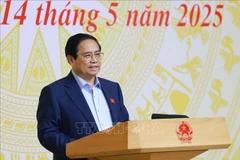
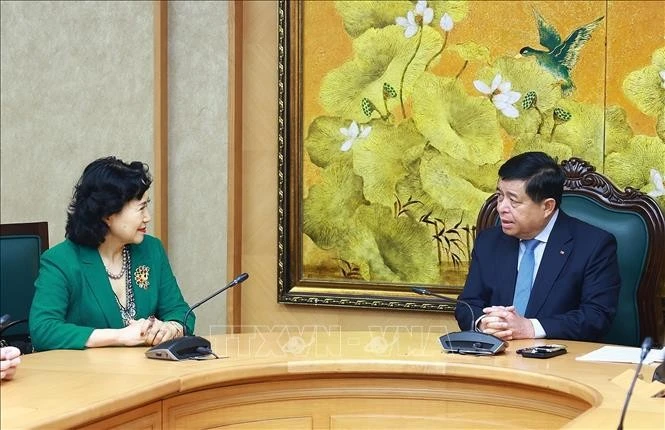
Deputy PM Nguyen Chi Dung (R) and CCSEZR Director Tao Yitao (Photo: VNA)

Hanoi (VNA) – Tao Yitao, Director of the China Centre for Special Economic Zone Research (CCSEZR) under Shenzhen University in China's Guangdong province, advised Vietnam to utilise China’s expertise in developing higher-standard free trade zones during a working session in Hanoi on April 17 with Deputy Prime Minister Nguyen Chi Dung.

Tao shared insights from her delegation’s field surveys in Binh Duong, Da Nang, Ho Chi Minh City, and Hai Phong, saying that through in-depth discussions with local authorities, they identified transportation, energy, and digital transformation as critical factors for successful FTZ development.

She underscored the pivotal role of digital economy and high technology, advising regions to capitalise on their unique strengths and growth drivers. Drawing on China’s experience, she proposed pilot FTZ projects in one or two cities to test new industries. If successful, these models could be scaled nationwide; if not, the economic impact would be limited.
re.jpg
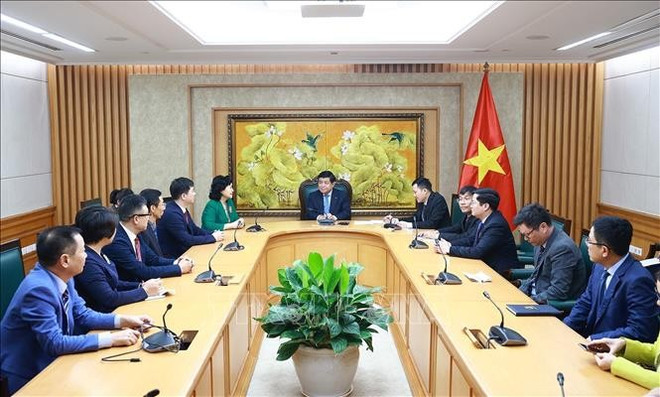
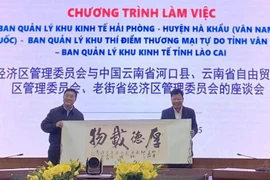
At the reception (Photo: VNA)

Citing Ho Chi Minh City as an example, Tao suggested designing its FTZ to drive growth for surrounding areas, focusing on hi-tech industries, finance, and modern services thanks to its ability to attract skilled talent. For the southern province of Ba Ria – Vung Tau, she recommended prioritising the seaport industry.

The delegation highlighted China’s FTZ models in Hong Kong, Macau, Shenzhen, and Xinjiang, which integrate diverse foreign and domestic enterprises and specialised sub-zones beyond core trade functions.

Deputy PM Dung praised Tao and CCSEZR for their insights and urged further consultations on the management of goods circulation within FTZs, taxation, talent retention and training, and global FTZ trends, particularly Shenzhen’s governance model.

Vietnam is preparing to develop three FTZs in Hai Phong, Da Nang, and Ba Ria – Vung Tau, with plans to expand to other localities with strong air and rail connectivity, beyond just those with seaports, he said./.
VNA

See more

Vietnam is strengthening its position in the technology value chain, becoming a major manufacturing hub for complete consumer electronics products. (Photo: VNA)

ESG standards offer opportunities to reposition Vietnam’s electronics firms

The 2025-2027 period will be a critical turning point, as exporters to the European market will be required to strictly comply with ESG standards, including net-zero emissions roadmaps, labour standards, corporate governance and transparency requirements. As a key export sector, the electronics industry is being directly and strongly affected by this shift.

A production line for camera modules and electronic components at the factory of MCNEX VINA Co. Ltd, a Republic of Korean-invested company in Phuc Son Industrial Park, Ninh Binh province. (Photo: VNA)

Science, technology, innovation as engines of economic growth

To ensure that science and technology truly act as a powerful growth engine, experts emphasised the need for the Government to put in place supportive mechanisms and policies that encourage enterprises to invest in research and development, while strengthening cooperation among the State, research institutions and the business sector.

The headquarters of the Ministry of Industry and Trade in Hanoi (Photo: VNA)

PM updates lead roles to drive UKVFTA forward

The Ministry of Industry and Trade (MoIT) is named the lead agency, with overall responsibility for the agreement’s general goals and definitions, trade remedies, non-tariff barriers to trade and investment in renewable energy, competition policies, State-owned enterprises, enterprises with special or exclusive rights and those with designated monopolies, as well as institutional, general and final terms.

Vietravel Airlines is taking measures to enhance service quality and optimise operations amid high travel demand during Tet. (Photo: VNA)

Vietravel Airlines to add new route serving Lunar New Year travel peak

During the peak period of the Lunar New Year (Tet) festival in 2026, Vietravel Airlines plans to operate six – eight flights daily on the Ho Chi Minh City – Hanoi route, three flights daily on the Ho Chi Minh City – Da Nang and Ho Chi Minh City – Vinh routes; and two flights daily on the Ho Chi Minh City – Quy Nhon route.

The completion of Can Tho - Ca Mau expressway has helped shorten travel time from Can Tho to Ca Mau to just one hour and a half (Photo: VNA)

Can Tho–Ca Mau expressway fully opens from January 19

The new section, together with the Can Tho–Hau Giang segment that has been operating smoothly since late December last year, has completed the entire 110.85-km route. With total investment exceeding 27.52 trillion VND (1.04 billion USD), the four-lane expressway is built to modern standards and serves as a key transport artery linking major economic and political centres, industrial zones and seaports in the southwestern region.

Vietnam aims to export 7 million tonnes of rice in 2026 (Photo: VNA)

Vietnam to proactively reduce rice exports from 2026

Do Ha Nam, Chairman of the Vietnam Food Association (VFA), said that 2026 presents numerous difficulties and challenges, and the global supply glut significantly impacts all exporters, including Vietnam.