Hanoi (VNS/VNA) - Vietnam's seafood industry is strategically pivoting towards market and product diversification to achieve its export target of this year, in a complex global landscape marked by tariff pressures.
Vietnam’s seafood sector is setting ambitious goals for 2025 with a 4.35% growth rate and an export turnover of 11 billion USD.
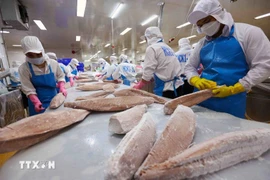
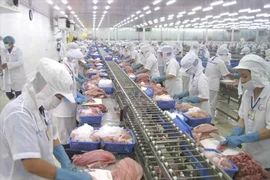
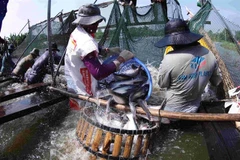
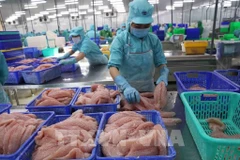
In the first four months of 2025, Vietnam's seafood exports showed promising signs, reaching 3.3 billion USD - a 21% increase compared to the same period in 2024, according to the Vietnam Association of Seafood Exporters and Producers (VASEP). Key contributors to this growth included shrimp, pangasius and molluscs.
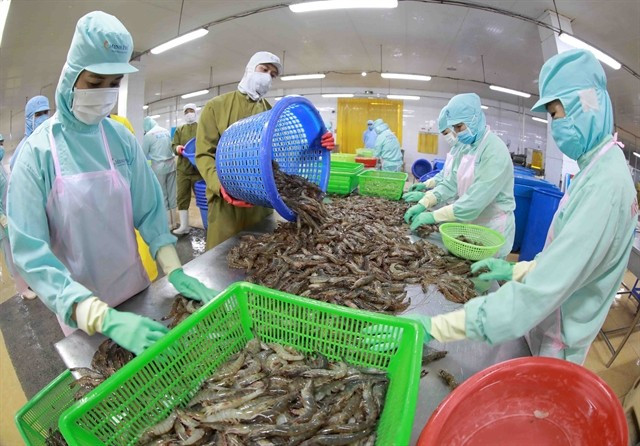
Shrimp exports alone surged by 30% year on year to 1.27 billion USD, fuelled by rising global prices and increased demand from markets such as China, Japan and the European Union.
Notably, mainland China and Hong Kong became the largest export markets of Vietnamese seafood, with turnover nearing 710 million USD, a 56% year-on-year increase.
Japan followed with 536 million USD (up 22%), and the US came in third at 498 million USD (up 7%). Other important markets, including the EU and the Republic of Korea (RoK), also posted double-digit growth.
Vietnamese exporters are proactively adjusting strategies to maintain growth, especially in light of potential risks in major markets like the US.
Vietnamese seafood companies are focusing on boosting deliveries, improving operational efficiency, and expanding into new export markets, including the Middle East, Australia and Canada.
Sao Ta Food JSC, for example, is actively exploring new markets like the RoK and Japan while preparing to enter China.
Meanwhile, Minh Phu Seafood Corporation is investing in a new shrimp processing facility in Ca Mau, aimed at meeting demand in Japan - its largest export market - followed by Australia, New Zealand, the EU and the US, according to General Director Le Van Quang.
Opportunities are also opening up in Brazil and Russia. Brazil recently lifted its suspension on tilapia imports from Vietnam, creating a strategic opportunity for pangasius and tilapia exporters.
Tuna exports to Russia have also grown significantly, reaching 45 million USD in 2024 - five times higher than in 2020. The first quarter of 2025 alone saw tuna exports to Russia rise by 15% year-on-year.
The EU market has remained a vital growth engine for Vietnamese seafood. In the first quarter of 2025, shrimp exports to the EU hit 107 million USD, up 33% from the previous year. Major markets like Germany, France, and Belgium saw increases of nearly 40% to 60%.
The EU’s diverse consumers - ranging from popular to high-end buyers - makes it an ideal destination for a wide range of seafood products.
To sustain this momentum, authorities are encouraging farmers and enterprises not to overreact to short-term market shifts by mass harvesting or scaling back production. Instead, the focus is on strategic planning and product diversification.
While shrimp and pangasius remain high-value commodities, overreliance on them leaves the industry vulnerable to price and disease risks.
Director of the Directorate of Fisheries Tran Dinh Luan advocated for diversification into other competitive species such as tilapia, eel, molluscs, seaweed, abalone and sea cucumber. These species offer high economic value and are well-suited to Vietnam’s diverse aquaculture environments.
According to the Vietnam Fisheries Development Strategy to 2030, with a vision to 2045, tilapia is slated to become the second-largest freshwater fish export after pangasius. By 2030, Vietnam aims to reach an annual output of 400,000 tonnes.
Expansion will include not just pond farming, but also reservoir-based aquaculture, with efforts underway to improve survival rates, reduce feed conversion, and optimise costs.
The Ministry of Agriculture and Environment has proposed several initiatives to support the sector’s transformation. These include investments in intensive, super-intensive, and recirculating aquaculture systems, as well as energy-saving and eco-friendly farming practices.
There is also a push for the application of artificial intelligence in disease management and the use of e-commerce platforms to boost sales.
Provinces like Ca Mau and Ben Tre are at the forefront of this transition. Ben Tre is finalising a plan to develop 4,000 hectares of high-tech brackish shrimp farms by the second quarter of 2025, targeting an output of 144,000 tonnes.
Ca Mau, with its vast 280,000-hectare shrimp farming area, has successfully implemented organic and ecological shrimp farming models. These sustainable practices have earned international certifications and opened access to premium markets./.
VNA