Conference promotes green innovation in agriculture through market mechanism

To promote green innovation in agriculture, Vietnam needs to build a flexible market mechanism to encourage and support the development of environmental agricultural products.

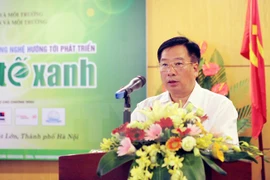
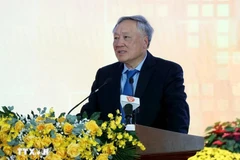
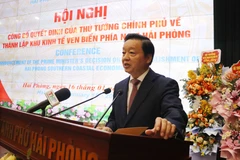
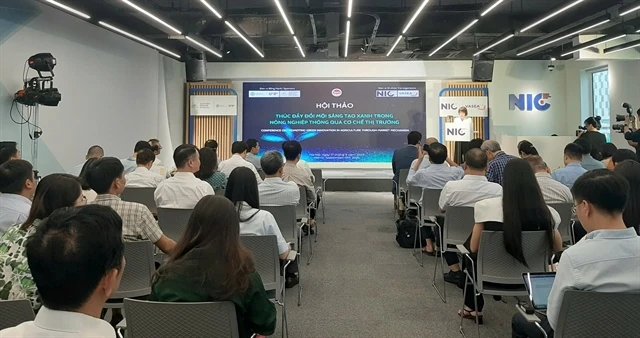
A conference on promoting green innovation in agriculture through market mechanism was held in Hanoi on September 17 by the National Innovation Centre (NIC) and the Vietnamese Australian Scholars and Experts Association (VASEA). (Photo courtesy of NIC)

Hanoi (VNA) - To promote green innovation in agriculture, Vietnam needs to build a flexible market mechanism to encourage and support the development of environmental agricultural products.

The recommendation was made by Deputy Minister of Planning and Investment, Nguyen Thi Bich Ngoc at a conference on promoting green innovation in agriculture in Hanoi on September 17.

Agriculture now accounts for about 12% of Vietnam's GDP and about 30% of the workforce, according to Ngoc.

However, this sector faces major challenges including climate change. For instance, the Mekong Delta - the country's largest rice producer - is forecast to lose from 500,000ha to one million ha of agricultural land by 2050 due to rising sea levels, causing annual losses of up to three% of GDP.

The challenges are forcing agricultural production towards a more sustainable development and lower emissions.

Green innovation is a core factor that helps agriculture respond to those challenges. At present, many Vietnamese enterprises have applied green technologies in agriculture, from drip irrigation systems to smart greenhouse technology and the use of renewable energy in production, according to the Ministry of Planning and Investment.

These models have helped them reduce carbon emissions, save water by up to 50% and increase crop yields by 20-30%.

Vietnam also aims to reduce greenhouse gas emissions by nine% by 2030 and commits to achieving net zero emissions by 2050. To achieve those goals, green innovation in the agricultural sector plays a key role.

However, it also faces many challenges. One of them is human resources, especially high-quality human resources, which are still limited with Vietnam lacking experts in agriculture and trained rural workers.

Farmers need to be trained in advanced farming methods, sustainable land management and efficient use of resources. In addition, they need access to green technologies, new crop varieties and green credit sources.

Green agriculture start-ups also face difficulties in connecting with experts, accessing markets and expanding production scale. Lack of infrastructure and resources is also a major barrier that needs to be addressed to promote the development of these enterprises.

Discussions were taking place at the event held at the National Innovation Centre (NIC) hosted by the Ministry of Planning and Investment in coordination with the Vietnamese Australian Scholars and Experts Association (VASEA).

The market mechanism played an essential role in implementing green innovation in agriculture, said Todd Sanderson, Social Systems Research Programme Manager of the Australian Centre for International Agricultural Research (ACIAR). This mechanism would help this sector increase productivity and reduce emissions and if it is not applied, it would affect the interests of small enterprises and farmers.

At the conference, participants gave suggestions on financial incentives for farmers to carry out green production in the rice sector and details of the costs and benefits of farmers when applying low-emission farming techniques.

There were also details on carbon credit certification and guidance for farmers and businesses on the process of converting from applying low-emission farming techniques into tradable credits./.

VNA
See more

Can Tho, Belarus eye trade, investment opportunities

Can Tho, Belarus eye trade, investment opportunities

Belarusian Consul General in Ho Chi Minh City Alexander Sidoruk said his working visit to Can Tho city exposes ample untapped economic potential. The Belarus side brings strengths in exporting fertilisers, crop protection chemicals, agricultural equipment, and high-tech products, and is interested in importing Vietnamese rice, coffee, rubber, seafood, and dairy products.

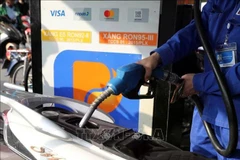
Retail fuel prices are simultaneously reduced from 15:00 on May 14. (Photo: VNA)

Retail fuel prices cut from May 14 afternoon

Retail fuel prices were simultaneously reduced from 15:00 on May 14 following the latest adjustment by the Ministry of Industry and Trade (MoIT) and and the Ministry of Finance, with E5RON92 biofuel recording the sharpest decline.

A chip assembly and testing plant of Intel at the Saigon Hi-Tech Park in Ho Chi Minh City (Photo: VNA)

Intel deepens engagement in Vietnam’s semiconductor industry

According to the Saigon Hi-Tech Park (SHTP) management board, Intel has relocated part of its production line from Costa Rica to SHTP as part of its global manufacturing restructuring strategy aimed at improving efficiency and competitiveness.

A customer purchase E10 biofuel petrol at a PVOIL filling station on Thai Thinh street in Hanoi. (Photo: VNA)

Biofuel ready for nationwide rollout

For biofuels, particularly E10, to develop successfully, stronger and more coordinated policies are needed, especially pricing mechanisms capable of creating a sufficiently attractive gap between E10 and mineral-based petrol, an expert has said.

An automobile assembly line of the THACO Truong Hai Group in Da Nang. (Photo: VNA)

Da Nang promotes investment attraction to achieve over 11% growth

Da Nang's foreign direct investment (FDI) attraction showed strong growth, reaching 237.7 million USD, double the level recorded a year earlier. The city granted licences for 47 new FDI projects, approved capital adjustments for 16 projects and recorded 10 transactions involving capital contributions and share acquisitions in economic organisations.

Deputy Prime Minister Nguyen Van Thang speaks at the forum. (Photo: vneconomy.vn)

Vietnam pivots to selective, high-quality FDI attraction for sustainable growth: Deputy PM

The FDI sector remains a key pillar of Vietnam’s economy, with more than 46,500 valid projects and total registered capital exceeding 543 billion USD so far. Disbursed capital has reached around 357.6 billion USD. The FDI sector contributes over 20% of GDP, accounts for around 70% of total export turnover, and creates jobs for millions of workers. Vietnam continues to rank among ASEAN’s leading FDI destinations despite global investment slowdowns.