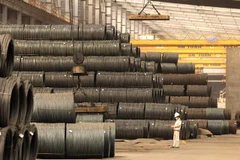
Contractors race against time to complete nearly 1,200 kilometres of expressway

The Ministry of Transport has asked project management boards and contractors to accelerate construction on key expressway projects, warning of strict punishment for violations and emphasising the critical national infrastructure development timeline.

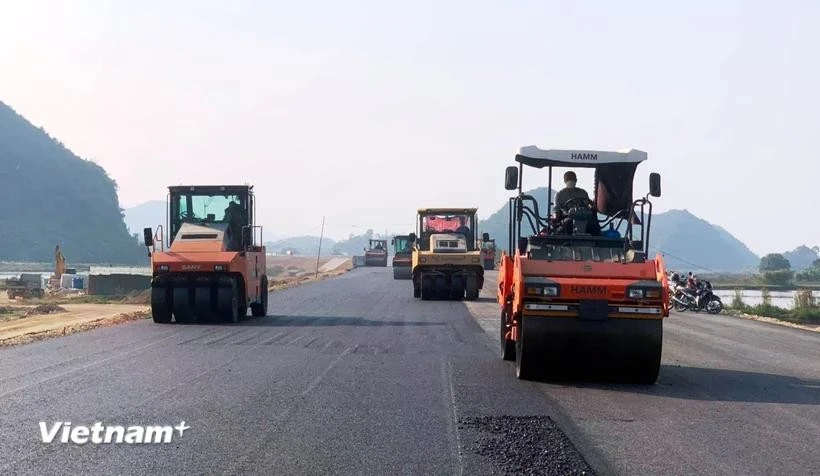
A contractor lays asphalt pavement for a section of the North-South Expressway project. (Photo: VietnamPlus)

Hanoi (VNA) - The Ministry of Transport has asked project management boards and contractors to accelerate construction on key expressway projects, warning of strict punishment for violations and emphasising the critical national infrastructure development timeline.

With a target of completing approximately 1,188 kilometres of expressways this year, investors and contractors are making efforts to meet the deadline across multiple strategic expressway segments.

Construction on the Quang Ngai – Hoai Nhon expressway has reached significant milestones. Director of the project management board Le Thang reported that roadbed consolidation has exceeded 95%, while water drainage systems and underground passages have been completed. The project has mobilised over 3,850 personnel and 1,550 pieces of equipment.

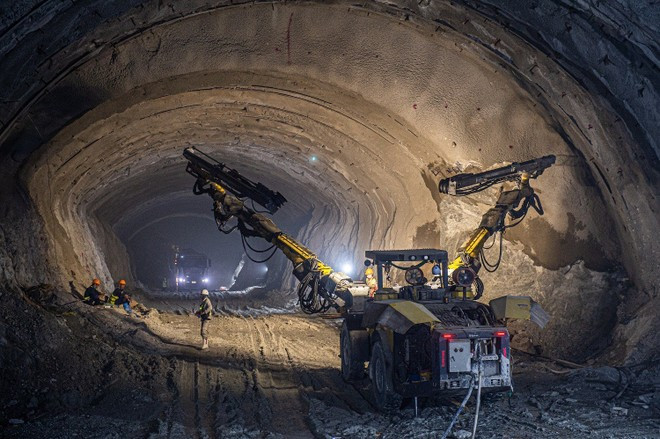
The Deo Ca Group, responsible for constructing three tunnels through mountains, is pushing to finish tunnel excavation and reduce project timelines by three months for road construction and eight months for the tunnel work. Project completion is scheduled for late 2025.

Meanwhile, Le Thanh Hai, Director of the Central Construction Group that is in charge a bidding package of the Chi Thanh – Van Phong expressway project, said the unit has completed half of the workload, though the work for roadbeds has been delayed due to poor weather conditions. The group is committed to mobilising resources to ensure the project is operational by September this year.

For the Bien Hoa – Vung Tau, the Ministry of Transport reported that road foundation and pavement work is well underway.

To accelerate progress on critical transport projects, the Ministry of Transport has directed investors and project management boards to develop both comprehensive and detailed construction schedules for each contract package, enabling precise progress tracking and evaluation.

When project timelines fall behind, contractors are required to implement immediate remedial actions, including extending work shifts and increasing personnel.

The ministry has requested weekly and monthly progress review meetings, with strict assessments of the performance of management board leaders whose projects lag behind schedule.

Punishments, such as warnings, work volume reductions, and even contract termination, will be meted out to any contractors failing to meet deadlines.
ham-duong-bo.jpg
Contractors are speeding up construction to meet the deadlines. (Photo: VietnamPlus)

Additionally, the transport ministry has joined hands with other ministries, sectors, and localities to handle challenges regarding site clearance and building materials, while working to streamline administrative procedures and expediting material licensing for contractors.

While emphasising speed, the ministry underscores that progress must not come at the expense of quality. Inspection and supervision must be put in place, ensuring absolute precision and preventing any potential errors.

According to Deputy Director of the Transport Construction Investment Management Authority Nguyen The Minh, the 1,188 kilometres of expressways set for 2025 span 28 projects, of them 17 managed by the Ministry of Transport and the remainders by local authorities.

The ministry has followed the Prime Minister’s directive to maintain round-the-clock work, ensuring construction uninterrupted through all conditions.

The 2,063-km North-South expressway project stretches from the northern border province of Lang Son to the southernmost province of Ca Mau, passing through 32 provinces and cities, and connecting four key economic regions, including the two major economic hubs – Hanoi and Ho Chi Minh City./.

VNA

See more

Tran Ngoc Quan, Trade Counsellor and head of the Vietnam Trade Office in Belgium and the EU (Photo: VNA)

Belgian firms suggested to expand presence in Vietnamese market

Entering 2026 – the first year of implementing the Vietnam – EU Comprehensive Strategic Partnership, the Vietnam Trade Office in Belgium and the EU views this as a pivotal time to inject new momentum into trade ties, said Trade Counsellor Tran Ngoc Quan.

Saigon Marina IFC, an emerging landmark, reflects Ho Chi Minh City’s pioneering spirit.

Saigon Marina IFC – The light of Ho Chi Minh City’s new icon

Saigon Marina IFC, an emerging landmark, reflects Ho Chi Minh City’s pioneering spirit. Designed to become an International Financial Centre, this new architectural icon along the Saigon River is envisioned not only as a premium commercial complex, but as a central platform supporting financial institutions, international investors and cross-border capital flows in the years ahead.

Shoppers at a supermarket in Hung Yen (Photo: VNA)

Retailers see tax compliance, AI as key to survival in 2026 survey

The annual survey, conducted at the end of 2025 among retail and food and beverage (F&B) sellers nationwide, found that businesses are shifting their focus from rapid growth to operational efficiency, cost control and legal compliance amid increasingly stringent regulatory standards.

Visitors shop at Glorious Spring Fair 2026 (Photo: VNA)

Spring Fair 2026 opens broader prospects for Vietnam–UAE trade cooperation

For Vietnam, the UAE serves not only as a consumer market but also as a gateway to the Middle East and North Africa. Vietnamese agricultural products such as cashew nuts, pepper, cinnamon and rice have steadily gained market share, while aquatic products, including tra fish and tuna, are increasingly present in the UAE’s hospitality sector.

Bao Viet Bank's employee counts Vietnamese banknotes at a transaction counter in Hanoi. (Photo: VNA)

Credit quota reform, tighter capital rules may widen gap among banks

Yuanta Vietnam Securities estimates that to achieve GDP growth above 10%, credit growth would need to exceed 16%. This suggests bank credit is no longer expected to be the main growth driver, with greater reliance on fiscal policy, public investment and capital markets.

Commercial Counsellor Do Viet Phuong, Head of the Vietnam Trade Office in Cambodia. (Photo: VNA)

Spring Fair 2026 offers ample room to deepen Vietnam–Cambodia trade ties

Cambodia holds substantial potential for cooperation in agro-processing and exports, especially in key products such as rice, cashew nuts and rubber. In recent years, the country’s cultivation area and agricultural output have grown steadily, providing a stable raw material base for processing industries.

Vietnam is projected to have approximately 2.4 million SMEs, accounting for over 98% of the country’s total enterprises. (Photo: cafef.vn)

Banks offer diverse solutions to support SMEs

With an increasingly significant role in the economy, the small and medium-sized enterprise (SME) sector is becoming a key segment in the credit growth strategies of many banks and the banks have been taking diverse solutions to support the enterprises.